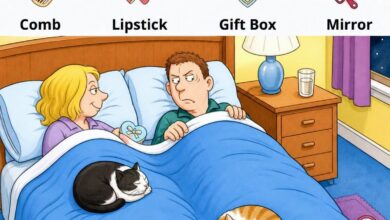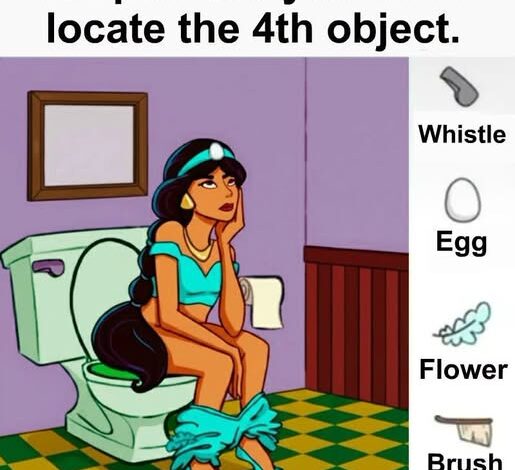
At first glance, it looks like nothing more than a simple visual puzzle. You’re asked to find a few hidden objects—a flower, an egg, or other cleverly disguised shapes—and the challenge seems almost childish. Yet within seconds, something far more interesting begins to happen. The puzzle stops testing your eyesight and starts revealing something about the way your mind responds to uncertainty.
The first reaction is often immediate.
“I don’t see it.”
For many people, that thought arrives almost automatically. Not because the objects are impossible to find, but because the brain dislikes ambiguity. When an answer isn’t obvious, it’s surprisingly easy to assume the answer simply isn’t there. What feels like a limitation of vision is often a momentary lapse in patience.
Then something changes.
Instead of giving up, you decide to look again.
Your eyes slow down.
Your attention shifts.
Patterns you overlooked just moments earlier begin to separate from the background. Suddenly, the hidden flower appears where you had already looked three times. The egg seems almost impossible to miss now that you’ve seen it. You wonder how it could have escaped your attention in the first place.
That feeling of discovery is deeply satisfying.
But the satisfaction isn’t really about solving the puzzle.
It’s about realizing your brain is capable of adapting when you resist the urge to quit too quickly.
Psychologists have long studied how perception works, and one consistent finding is that our brains don’t process every visual detail equally. Instead, they constantly filter information, focusing on what seems most important while ignoring much of the rest. This selective attention allows us to navigate a busy world efficiently, but it also means we sometimes overlook things that are directly in front of us.
Hidden-object puzzles take advantage of that tendency.
They encourage us to break our usual scanning habits and search in new ways. Once we stop expecting the answer to appear instantly, our perception becomes more flexible. We notice shapes, colors, and patterns that previously blended into the background.
In many ways, the puzzle isn’t changing.
We are.
That small shift mirrors countless situations beyond a printed image.
How many projects have been abandoned because progress wasn’t immediate?
How many hobbies have been dismissed with the words, “I’m just not good at this,” after only a few attempts?
How many opportunities have been overlooked simply because the solution wasn’t obvious at first glance?
Our minds naturally seek quick answers. When they don’t appear, frustration often replaces curiosity. Yet some of life’s most rewarding experiences require exactly the opposite approach: slowing down, remaining engaged, and allowing ourselves time to see what wasn’t immediately visible.
Even conversations work this way.
A misunderstanding may seem impossible to resolve until someone asks one more thoughtful question. A difficult relationship can appear hopeless until both people choose to listen instead of assuming they already know the other’s intentions. Clarity often arrives not because circumstances suddenly change, but because someone stays present long enough to discover a perspective they had previously overlooked.
The same principle applies to learning.
Every expert was once a beginner who repeatedly failed to recognize patterns that now seem obvious. Musicians struggle through unfamiliar notes before melodies become effortless. Artists produce awkward sketches before developing confident brushstrokes. Athletes repeat simple movements thousands of times before they become instinctive.
The difference is rarely natural talent alone.
More often, it is the willingness to keep looking after the first attempt fails.
That is why these seemingly simple visual challenges continue to fascinate people of all ages.
They remind us that perception is not fixed. Attention can be redirected. Frustration can give way to understanding with just a little more patience.
Of course, solving a hidden-object puzzle doesn’t prove someone possesses greater intelligence, nor does missing an object suggest a lack of ability. These puzzles are influenced by many factors, including visual search strategies, familiarity with similar challenges, and simple chance.
Their real value lies elsewhere.
They encourage persistence.
They reward careful observation.
And they remind us that first impressions are not always complete.
In everyday life, we often label situations as impossible long before we’ve truly explored them. We decide a problem has no solution, a goal is unattainable, or a dream isn’t meant for us because we stop searching after the first unsuccessful attempt.
Yet many breakthroughs begin with one simple decision:
To look again.
To think differently.
To remain curious just a little longer.
Perhaps that’s the quiet lesson hidden inside these tiny pictures.
The greatest obstacle isn’t always the object cleverly disguised within the image. Sometimes it’s the assumption that if we haven’t found it immediately, it must not exist.
When we challenge that assumption, something remarkable happens.
Our perspective expands.
Our patience grows.
And possibilities that once seemed invisible gradually come into focus.
So the next time a hidden object refuses to reveal itself, resist the temptation to declare defeat too quickly. Give your eyes another moment. Let your mind explore a different path. You may discover that the most valuable thing you find isn’t the flower, the egg, or any other concealed shape.
It’s the realization that many things only become visible after you’ve decided they’re still worth looking for.