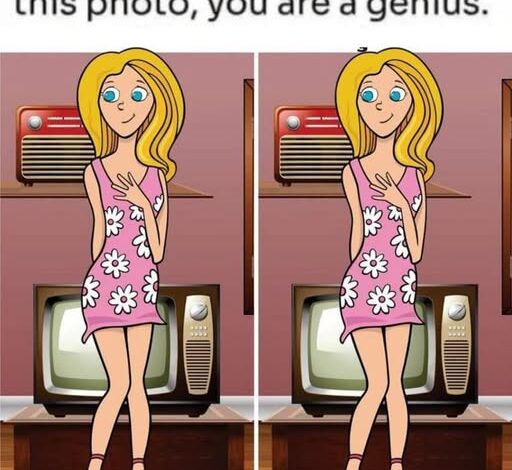
At first glance, the two pictures appear perfectly identical.
The same blonde woman stands in the same elegant pose. She wears the same pink floral dress, surrounded by the same charming retro décor. Behind her rests an old-fashioned television on a wooden stand, while a bright red vintage radio sits proudly on the shelf above it.
Everything seems to match.
But somewhere in this nostalgic scene, one tiny detail has been changed.
Only one.
Your challenge is to find it.
Welcome, puzzle lovers, to today’s visual brain teaser—a deceptively simple spot-the-difference test designed to challenge your focus, patience, and attention to detail. The two images may look like exact copies, but the artist has quietly altered one small element in the picture on the right.
Will your eyes catch it?
Before you begin, take a moment to settle in. Clear your mind, look carefully at both pictures, and resist the temptation to rush. This puzzle is not about guessing. It is about slowing down enough to notice something your brain may initially ignore.
The scene itself is full of possible hiding places.
The woman stands at the center of the room, immediately drawing your attention. Her blonde hair is neatly styled, and her pink floral dress adds a cheerful burst of color to the vintage setting. Because she is the main subject, many people instinctively begin their search with her.
That is a smart place to start—but don’t assume the difference must be obvious.
Study her hair closely. Is every curl arranged in the same way? Look at her face, shoulders, arms, and hands. Compare the floral pattern on her dress. Check the neckline, sleeves, waist, and hem. Even the tiniest missing flower, altered line, or shift in shape could be the answer.
Then move your eyes downward.
Examine her legs and shoes. Are they positioned exactly the same in both images? Is there a small detail present on one side but missing on the other? Sometimes the most difficult changes are hidden in areas people glance over quickly because they assume nothing important is there.
Once you have carefully checked the woman, turn your attention to the background.
Behind her is a large vintage television resting on a wooden cabinet or stand. Its screen, frame, knobs, and edges all deserve a closer look. Compare the shape of the screen in both pictures. Count the buttons or dials. Check whether a line, shadow, or small piece of decoration has changed.
Don’t forget the wooden furniture beneath it.
Look at the legs of the stand, the panels, and the visible edges. A missing handle, shorter line, or slightly altered corner can be surprisingly difficult to notice when your eyes are focused on the main character.
Now look higher.
Above the television sits a classic red radio, one of the most eye-catching objects in the room. Its bright color may make it seem easy to compare, but that can actually work against you. When an object looks familiar, the brain often processes it quickly instead of carefully.
Study the radio’s antenna, buttons, speaker, handle, and outline.
Does it have the same number of knobs in both pictures? Is the antenna pointing in the same direction? Is one small piece absent? Has the shape of the handle changed?
The answer could be hiding there—or it could be somewhere much less obvious.
That is what makes a one-difference puzzle so entertaining.
When a puzzle contains five or ten differences, your eyes often jump from one obvious change to another. But when there is only one alteration, the search becomes far more intense. You begin questioning every line, color, shape, and shadow.
Was that flower always there?
Is the television knob slightly smaller?
Did the woman’s hairstyle change?
Is something missing from the shelf?
The longer you look, the more suspicious every detail becomes.
If you are struggling, don’t worry. A difficult visual puzzle is not a test of intelligence. It simply reveals how the brain processes images. Our minds are designed to recognize complete scenes quickly, which means we often overlook tiny inconsistencies.
That ability is useful in everyday life. Imagine having to consciously examine every leaf on a tree, every brick in a wall, or every button on someone’s shirt. The brain saves time by filling in familiar information automatically.
Spot-the-difference puzzles interrupt that habit.
They force you to stop seeing the picture as one complete scene and start examining it as a collection of smaller details. Instead of seeing “a woman in a retro room,” you begin noticing individual objects, patterns, lines, and shapes.
That makes these puzzles more than simple entertainment.
They can give your attention span a quick workout, encourage patience, and help train your observation skills. They are also a relaxing way to step away from work, studying, or endless scrolling.
For a few minutes, there is only one task.
Find the difference.
You can make the challenge even more exciting by turning it into a friendly competition. Show the images to a friend, family member, or coworker and see who finds the change first.
Set a timer if you want extra pressure.
Can you solve it in ten seconds?
Five seconds?
Or will you need a full minute before the answer finally appears?
There is no shame in taking longer. Some people notice the difference immediately because their eyes happen to land on the correct spot. Others scan the image repeatedly before the changed detail suddenly becomes obvious.
Once you see it, you may wonder how you ever missed it.
If the answer still refuses to reveal itself, try changing your approach.
Instead of looking at both pictures as complete scenes, compare them section by section. Begin in the upper-left corner and move slowly across. Then continue downward in neat rows.
Look at one object in the left image and immediately compare it with the same object in the right image. Avoid jumping randomly around the scene, because that makes it easier to miss areas you have not fully inspected.
You can also step farther away from the screen. Sometimes distance helps the altered detail stand out. Blinking a few times or briefly looking away can also reset your vision and break the pattern your brain has become accustomed to.
Another useful technique is to focus on the empty spaces.
People naturally examine objects, but artists often hide changes in the areas around them. Check the space beside the woman, above the television, under the shelf, and near the floor.
Has a line disappeared?
Has a gap become wider?
Is there a shadow in one image but not the other?
Take your time and enjoy the hunt. There is no answer revealed here, so you have the chance to solve the mystery without having the surprise spoiled.
Return to the blonde woman.
Study the flowers on her pink dress.
Inspect the television and every one of its controls.
Look closely at the wooden stand, the shelf, and the bright red radio.
Somewhere in that charming retro room, one small detail does not belong.
It is waiting for the sharpest eyes to discover it.
So, how quickly can you find the hidden difference?
Look closely, trust your instincts, and don’t give up. The moment you finally spot it may be closer than you think.
ANSWER: