The courtroom fell into a silence so complete that even the smallest movement seemed impossibly loud.
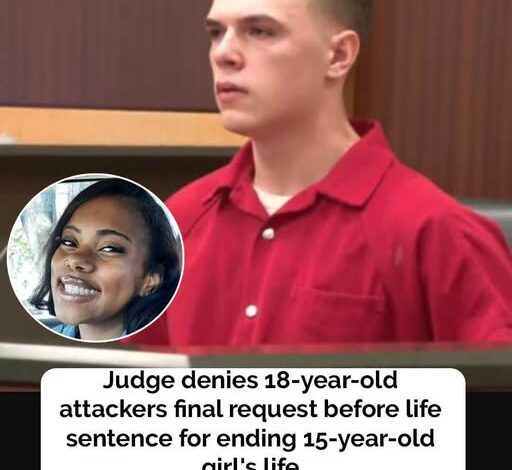
Standing before the judge, Thomas Stein struggled to keep his composure. His voice wavered, his shoulders trembled, and tears interrupted nearly every sentence as he made one final request before learning the full weight of his punishment.
“I just want to hug my family one last time.”
For a brief moment, the room seemed suspended between emotion and duty. His relatives sat only a short distance away, equally overcome with grief, knowing that the next few minutes would likely mark the last time they would see him as a free young man.
Then Judge Nick Thompson answered.
His response was calm, measured, and unmistakably firm.
Stein would be allowed to speak to his family.
He would be permitted to say goodbye.
But there would be no embrace.
No final hug.
No exception.
The decision reflected the reality of the proceeding unfolding before everyone present. Whatever sorrow Stein’s family was experiencing, another family had entered that courtroom carrying a loss no legal ruling could ever repair.
For Kayla Rincon-Miller’s loved ones, the moment was painfully difficult to watch.
They listened as the young man responsible for their daughter’s death pleaded for one final act of compassion, yet they could not escape the devastating truth that Kayla would never again hug her own parents, siblings, or friends. Every expression of remorse inside the courtroom existed alongside an absence that could never be undone.
That contrast hung over every testimony delivered that day.
One after another, Kayla’s friends stepped forward to describe the life they had been forced to rebuild without her.
Their words painted a picture of grief that had refused to fade with time.
Some spoke about waking in the middle of the night from recurring nightmares.
Others described panic attacks triggered by ordinary reminders of the tragedy.
One friend confessed that life since Kayla’s death had felt less like living and more like existing inside “a coma,” where every day blurred into the next under the weight of unbearable loss.
There were no dramatic speeches.
No attempts to seek revenge.
Only raw accounts of lives permanently altered by a single series of choices.
When it was Stein’s turn to address the court, he acknowledged the consequences of those choices.
He described his actions as selfish and repeatedly expressed regret for the events that led to Kayla’s death.
According to his statement, violence had never been part of what he believed would happen that day. He insisted he had not anticipated the tragedy that unfolded.
Yet he also admitted something that proved impossible to ignore.
After everything happened, he fled.
Rather than immediately facing the consequences or seeking help, he left the scene.
That decision, prosecutors argued, robbed Kayla of precious time during the critical moments when every second mattered.
Whether motivated by fear, panic, or desperation, the choice became one of the defining factors discussed throughout the proceedings.
In court, remorse carried undeniable emotion.
Outside the courthouse, however, public opinion quickly divided.
Across social media, countless people debated whether Stein’s tears reflected genuine accountability or whether they arrived only after every opportunity to avoid responsibility had disappeared.
Some saw a teenager whose life had been destroyed by catastrophic decisions made in youth—someone who would spend decades confronting irreversible mistakes.
Others believed the courtroom apology came far too late to hold meaningful weight, arguing that regret could never restore the life that had been taken or erase the suffering endured by Kayla’s family.
The discussion spread rapidly, revealing the difficult questions that often follow high-profile criminal cases.
Can sincere remorse exist alongside unforgivable actions?
Should visible emotion influence how society views accountability?
Where should compassion end when another family’s future has already been permanently shattered?
There were no simple answers.
Inside the courtroom, however, those broader debates carried little influence over the legal process.
The judge’s responsibility was not to settle public arguments or measure the depth of anyone’s regret.
His responsibility was to apply the law.
When sentencing was finally announced, the decision reflected the extraordinary seriousness of the case.
Stein received a sentence of life imprisonment, along with an additional forty-five years.
The numbers echoed through the courtroom with unmistakable finality.
For Stein, they represented a future transformed forever by choices he could never take back.
For his family, they marked the beginning of a lifetime spent visiting a loved one behind prison walls.
But for Kayla’s family, the sentence carried an entirely different meaning.
No amount of prison time could restore birthdays that would never again be celebrated together.
No verdict could replace conversations left unfinished, milestones left unrealized, or the countless ordinary moments stolen by a tragedy that forever changed their lives.
Justice, however necessary, could not erase grief.
As the hearing came to an end, spectators quietly filed out of the courtroom.
Stein’s relatives left knowing they had spoken their final words to him before incarceration.
Kayla’s loved ones walked away carrying something far heavier.
An absence.
One chair at future holidays that would always remain empty.
One voice forever missing from family gatherings.
One life remembered not through photographs alone, but through the silence left behind.
Long after legal arguments ended and headlines faded, that empty place would remain the truest reminder of what had been lost.
The courtroom proceedings eventually concluded, the sentence was entered into the record, and the justice system moved forward as it was designed to do.
Life, however, would never move forward in quite the same way for those who loved Kayla.
In the end, the law delivered its judgment with clarity and finality.
But beyond every legal document, every courtroom statement, and every public debate remained one undeniable truth: while prison sentences have an end measured in years, the absence left by a life cut short is measured in generations.