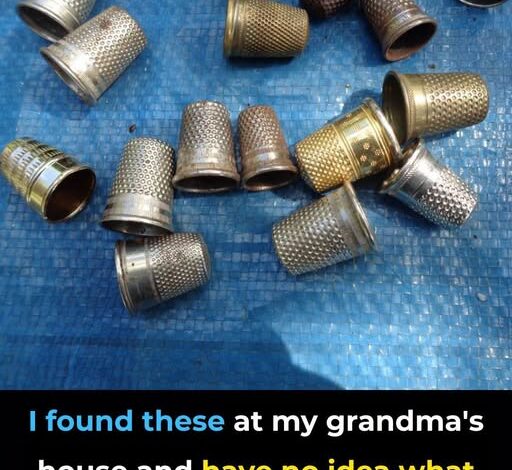
Today, a thimble might seem like nothing more than a charming relic tucked into an old sewing basket or displayed on a collector’s shelf. Small enough to fit on the tip of a finger, it is easy to overlook or dismiss as a simple accessory from another era. Yet for thousands of years, this humble object played a far greater role. Before factories produced clothing by the millions, before sewing machines transformed garment making, a thimble was an indispensable tool that helped families survive, preserving not only clothing but comfort, dignity, and daily life itself.
Long before sewing became a pastime or creative hobby, it was an essential skill practiced in nearly every household. Every stitch mattered. Torn garments needed repairing, blankets required mending, and new clothing often had to be made entirely by hand. Without proper protection, pushing a needle through thick layers of fabric, leather, or animal hide could quickly leave fingers bruised, cut, or painfully sore. The thimble solved that problem with remarkable simplicity, allowing countless generations to work longer, faster, and more safely.
Its story stretches back thousands of years.
Archaeological discoveries reveal that early versions existed in ancient civilizations, including China and the Roman Empire. Though far simpler than many modern examples, these early thimbles reflected remarkable ingenuity. Crafted from materials such as bone, bronze, ivory, or other readily available resources, they served a single, vital purpose: protecting the finger while providing the strength needed to push a needle through resistant materials.
That practical function carried enormous importance.
In a world where clothing was expensive, labor-intensive, and often handmade from start to finish, every garment represented a significant investment of time and effort. A well-maintained wardrobe could mean warmth during harsh winters, protection from the elements, and the ability to continue working each day. Sewing was not simply about appearance—it was closely tied to survival.
Within many households, the thimble became one of the most frequently used tools.
Parents repaired children’s clothing as they wore out.
Blankets were patched rather than discarded.
Work clothes were reinforced repeatedly instead of replaced.
Every careful stitch extended the life of essential belongings, helping families make the most of limited resources. The small metal or bone cap resting on a finger quietly supported countless hours of work that often went unnoticed but proved essential to everyday life.
As centuries passed, the thimble gradually evolved beyond its purely practical role.
Advances in metalworking allowed artisans to create stronger, more refined designs, while growing prosperity in parts of Europe transformed everyday objects into opportunities for artistic expression. By the sixteenth and seventeenth centuries, thimbles had become more than protective tools for some members of society. They also reflected craftsmanship, wealth, and personal taste.
Among Europe’s upper classes, finely crafted thimbles became symbols of elegance as well as utility.
Silversmiths and goldsmiths fashioned exquisite versions from precious metals, decorating them with intricate engravings, delicate patterns, and sometimes even gemstones. Although they remained functional, these luxurious pieces demonstrated that beauty and practicality could exist side by side.
Many became treasured personal possessions.
Rather than being discarded when worn, they were carefully preserved and passed from one generation to the next. A thimble might accompany a daughter as she began her own household, carrying with it not only a useful tool but also memories of the hands that had used it before her. Over time, these small objects became woven into family histories, connecting generations through shared traditions of care, patience, and craftsmanship.
Every scratch told a story.
Every tiny dent marked another garment repaired.
Every polished edge reflected years of steady use.
For many families, a well-used thimble represented countless quiet acts of love performed without recognition—the late-night mending of children’s clothing, the careful repair of a spouse’s work shirt, or the creation of blankets and garments meant to comfort loved ones through changing seasons.
Even today, despite remarkable advances in textile manufacturing, the thimble continues to serve its original purpose.
Modern versions are designed to meet a variety of sewing needs. Durable steel thimbles remain popular for heavy-duty work requiring extra strength, while leather models offer greater flexibility and comfort for quilters and hand stitchers who spend long hours sewing. Lightweight plastic versions provide affordable options for casual repairs and beginner projects, making the tool accessible to virtually anyone interested in needlework.
Though materials and styles have changed, the essential design remains remarkably consistent with that of its ancient ancestors.
It still protects.
It still steadies.
It still gives confidence to the hand guiding the needle.
That continuity speaks to the brilliance of a simple invention whose usefulness has endured across civilizations, cultures, and centuries.
Perhaps that is what makes the thimble so fascinating.
It is not remarkable because of its size or complexity.
It is remarkable because of the countless lives it quietly touched without demanding attention. It accompanied ordinary people through ordinary days, helping them repair what was worn, preserve what mattered, and create something lasting with patience and skill.
In an age when so many objects are designed to be replaced, the thimble reminds us of a very different philosophy—one built on mending instead of discarding, preserving instead of replacing, and valuing careful craftsmanship over convenience.
Look closely at an old thimble, and its worn surface becomes more than aged metal.
Those tiny dents represent thousands of careful stitches.
The polished edges reflect years of steady work.
The small imperfections reveal hands that refused to let clothing, blankets, or cherished possessions simply fall apart.
For such a modest object, the thimble carries an extraordinary legacy. More than a sewing accessory or collector’s curiosity, it stands as a quiet symbol of human resilience, creativity, and care. Across thousands of years, it has faithfully protected the hands that built homes, clothed families, and preserved traditions—one careful stitch at a time.