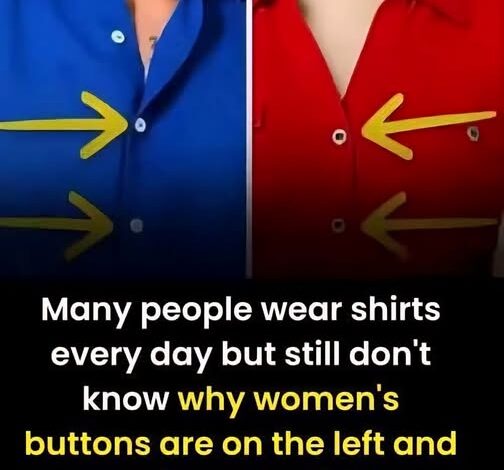
Every morning, millions of people button their shirts without giving a second thought to the tiny row of fasteners running down the front. It’s one of those everyday actions so familiar that it feels almost invisible. Yet hidden within that simple design is a centuries-old tradition that has survived revolutions in fashion, technology, and culture—a detail so ordinary that most people never stop to ask why it exists at all.
Take a closer look at a typical button-up shirt.
If it’s designed for men, the buttons are usually sewn on the right side, with the buttonholes on the left.
If it’s designed for women, the arrangement is typically reversed.
At first glance, the difference seems insignificant.
After all, both shirts perform exactly the same function.
So why weren’t they made the same way from the beginning?
The answer takes us back to a very different world.
Centuries ago, clothing was not produced for convenience. Dressing was often a lengthy process involving layers of garments, intricate tailoring, and rows of carefully sewn buttons. For many wealthy families, getting dressed wasn’t something done alone. Affluent women frequently relied on maids or ladies’ attendants to help them fasten elaborate gowns, corsets, and high-necked dresses.
Because most people are right-handed, it was easier for a right-handed maid standing in front of her employer to fasten buttons that opened in the opposite direction. Placing the buttons on the wearer’s left side made the task quicker and more comfortable for the person doing the dressing.
Men, however, generally dressed themselves.
Since most were also right-handed, having buttons positioned on the wearer’s right side made fastening their own clothing more natural. What began as a practical decision based on everyday routines gradually became a manufacturing standard.
Over time, convenience evolved into convention.
Even as lifestyles changed and household servants became increasingly uncommon, clothing manufacturers continued producing garments with the same button orientation. Generations grew up assuming that was simply how men’s and women’s shirts were supposed to be made.
Eventually, few people questioned it at all.
Like many traditions, the original reason slowly faded from public memory while the custom itself remained firmly in place.
Historians have suggested other possible influences as well.
Some point to military uniforms, noting that many soldiers historically carried weapons with their right hand. A right-over-left overlap may have helped prevent wind from entering the garment while also making it easier to reach weapons or equipment. Others have proposed that horseback riding traditions influenced certain garment designs, particularly for women who often rode side-saddle.
While these theories continue to be discussed, the explanation involving domestic attendants remains one of the most widely cited historical interpretations.
Whatever its precise origin, the distinction became deeply embedded in fashion.
It quietly signaled gender without anyone needing to explain it.
Manufacturers followed the pattern.
Consumers expected it.
Design schools taught it.
Retailers organized clothing around it.
A practical sewing decision gradually transformed into an accepted rule.
Today, however, fashion is changing.
Modern clothing places far greater emphasis on comfort, individuality, and personal expression than on rigid traditions inherited from previous centuries. Stretch fabrics, pull-on designs, magnetic closures, concealed fasteners, and minimalist construction have reduced the importance of button placement in everyday life.
At the same time, many designers are questioning whether this centuries-old distinction still serves a meaningful purpose.
As gender-neutral and unisex clothing becomes increasingly popular, some brands have begun eliminating the traditional button orientation altogether or designing garments that work comfortably regardless of which side the buttons occupy. Rather than reinforcing historical conventions, these collections prioritize fit, function, and versatility.
For many consumers, the change goes almost unnoticed.
Others appreciate it as a subtle reflection of broader cultural shifts toward inclusivity and individual choice.
Still, not every designer is ready to leave the tradition behind.
Some continue to preserve the classic button arrangement not because it remains necessary, but because it connects contemporary clothing to its historical roots. In an industry that often celebrates craftsmanship and heritage, even the smallest details can carry symbolic value.
To them, the direction of a button placket represents more than functionality.
It represents continuity.
A quiet reminder of the generations who wore similar garments long before modern fashion existed.
There is something fascinating about that persistence.
In an age defined by innovation, where clothing can regulate body temperature, repel water, resist wrinkles, and even incorporate smart technology, one tiny design feature has remained largely unchanged for hundreds of years.
Most people never notice it.
Yet it survives.
Not because anyone truly needs it anymore, but because traditions often outlast the circumstances that created them.
Perhaps that is what makes this small detail so intriguing.
Every buttoned shirt carries with it a fragment of history.
A reminder of changing social customs.
Of household routines long forgotten.
Of the ways practical solutions can gradually become cultural expectations.
Whether future generations continue following the traditional arrangement or embrace entirely new designs remains to be seen.
Fashion has always evolved alongside society, reflecting changing ideas about identity, practicality, and self-expression.
But for now, every time you fasten the buttons on a shirt, you’re participating in a custom that quietly links the present to centuries of history—a simple, almost invisible tradition born from everyday life, preserved through habit, and still stitched into countless garments around the world.