Can You Spot the One Hidden Difference?
At first glance, the two pictures look completely identical.
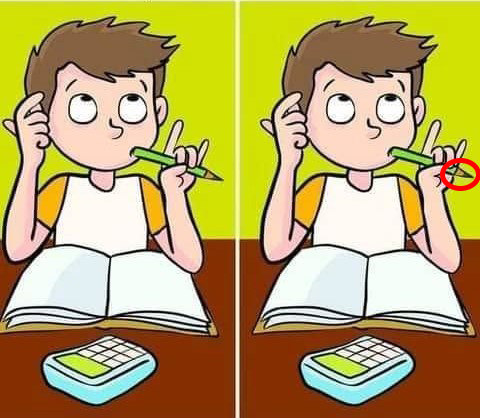
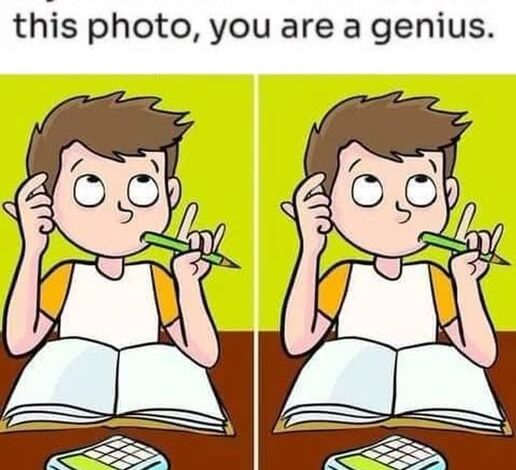
A young boy sits at a wooden desk, leaning over an open book as he struggles through a difficult school problem. His eyes are turned upward, as though he is searching his memory for a formula he almost remembers. A bright green pencil rests firmly in his hand, ready to capture the answer the moment it comes to him.
Everything in the scene appears ordinary.
His brown hair is neatly drawn.
His expression is thoughtful.
His white shirt with orange sleeves looks exactly the same in both pictures.
The open notebook rests in the center of the desk, and a small blue calculator sits near the bottom of the image.
Yet somewhere between the two illustrations, the artist has made one tiny change.
Only one.
Your challenge is to find it before time runs out.
Take a careful look and see whether you can spot the hidden difference in less than ten seconds.
Ready?
Begin now.
The difficulty of this puzzle comes from how familiar the scene feels. Your brain takes in the whole picture almost instantly and decides that everything matches. Once that assumption is made, the smaller details begin to blur together.
That is why visual puzzles like this can be surprisingly challenging.
They do not rely on complicated knowledge or special training. Instead, they test whether you can slow down, ignore your first impression, and inspect a familiar image with fresh eyes.
If you have not found the difference yet, do not rush.
The best strategy is to divide the picture into smaller sections rather than scanning the entire image at once.
Start at the top.
Look closely at the boy’s hair.
Compare the shape of each strand, the outline around his head, and the way the brown sections are arranged. A single missing lock or altered curve can be easy to overlook when the rest of the drawing remains unchanged.
Next, move down to his face.
Examine his eyebrows one at a time.
Do both pictures show the same shape and position?
Compare his eyes carefully. Since he is looking upward, even a slight change in the direction of his gaze could be the hidden difference.
Then check his nose and mouth.
A tiny change in his smile, lip shape, or facial expression might be subtle enough to escape notice during a quick glance.
Still nothing?
Move to his clothing.
The boy is wearing a white T-shirt with bright orange sleeves. Compare the outline of each sleeve and the borders where the orange color meets the white fabric. Look for a shortened line, a missing fold, or a small shift in shape.
Do not assume the difference must involve color.
Sometimes the artist changes only a tiny line or removes a detail that your brain automatically fills in.
Now inspect the boy’s arms and hands.
He is holding a green pencil while working at the desk. Compare the position of his fingers, the length of the pencil, and the direction in which it points. Because hands contain several overlapping lines, they are excellent places for artists to hide small changes.
Count the visible fingers if necessary.
Then compare the pencil carefully from the eraser to the sharpened tip.
If the upper half of the picture appears identical, shift your attention to the desk.
The large open book is the most prominent object in front of the boy, so it may seem like an obvious place to hide the difference. Compare the left and right pages separately.
Look at the outlines.
Study the curved edges.
Check whether the same number of lines appears on each page.
Observe the shadows beneath the paper and the small details near the book’s center.
Repeated patterns are especially good at confusing the brain. When several similar lines appear together, we tend to register the general pattern rather than count each individual mark. That means a missing line or a shortened stroke can remain hidden even when it is directly in front of us.
Now move your eyes toward the bottom of the scene.
The small blue calculator deserves very close attention.
Compare its shape in both pictures.
Does the green display look the same?
Are the white buttons arranged identically?
Count them slowly.
Check the corners, the outline, and the spaces between the buttons. A tiny change in the calculator may be difficult to notice because it occupies such a small part of the overall drawing.
Remember, there is only one difference.
That means once you find something that does not match, there is no need to keep searching for additional changes.
If you are still struggling, step back from the screen for a moment.
Blink a few times.
Then return and compare one small section at a time.
Sometimes staring too long causes the eyes to become less effective. A brief pause can reset your attention and make the altered detail suddenly stand out.
You can also cover one side of the image and study the other for several seconds before switching. This forces your brain to rely on memory rather than allowing both pictures to blend together.
Another useful technique is to move your gaze in a fixed pattern.
Start at the top-left corner and travel slowly across the image.
Then move down slightly and scan back in the opposite direction.
Continue until you reach the bottom.
This method prevents your eyes from jumping repeatedly toward the most noticeable objects while ignoring quieter areas.
Puzzles like this are more than a way to pass the time.
They exercise several mental skills at once.
You must concentrate, compare, remember, and resist making quick assumptions. Even a short challenge encourages the brain to process visual information more carefully.
It can also become a fun competition.
Show the image to your friends or family and set a ten-second timer. Ask everyone to keep the answer secret until the time is up. You may be surprised by who notices the difference first.
Children often perform especially well because they may examine the picture without relying as heavily on assumptions. Adults sometimes recognize the overall scene so quickly that they overlook the altered detail.
If you found the difference immediately, congratulations.
Your attention to detail is impressive.
If it took a little longer, that does not mean your vision is poor. These puzzles are deliberately designed to exploit the way the brain simplifies similar images. The more alike the pictures appear, the more likely your mind is to treat them as identical.
And if you still have not found it, do not give up.
Take one final look at the boy’s face, clothing, pencil, book, and calculator.
The answer is there.
Quietly hidden in plain sight.
The greatest satisfaction comes not from being told where it is, but from the instant your eyes finally catch it and the entire puzzle suddenly becomes obvious.
So clear away distractions, focus on one section at a time, and give yourself one more chance.
Can you spot the single difference before everyone else does?
ANSWER: