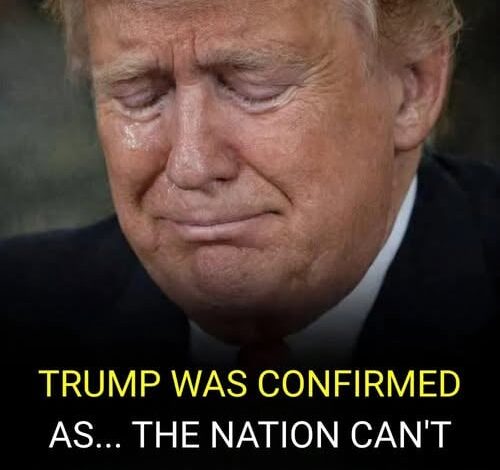
Far from the blinding floodlights of campaign rallies, far from the crowded courtrooms packed with cameras and legal analysts, and far from the endless churn of headlines that seem to follow him wherever he goes, there are moments when Donald Trump appears almost unrecognizable.
Not because he becomes someone different.
But because the noise falls away.
For decades, the public has known him as a figure in motion.
A builder.
A businessman.
A celebrity.
A candidate.
A president.
A political lightning rod.
An individual whose presence often dominates every room, every news cycle, and every conversation he enters.
The image is familiar: the raised hand, the confident declaration, the rapid-fire responses, the unmistakable certainty that has become both his trademark and his shield.
Whether admired or criticized, Trump has long projected momentum.
Action.
Resistance.
Combat.
The sense of a man constantly pushing forward.
Yet every public figure exists in two worlds.
The one the public sees.
And the one they do not.
The first is carefully documented.
Photographed.
Recorded.
Analyzed.
Debated.
The second remains largely invisible.
A collection of quiet moments that rarely become part of the historical record.
Moments when the cameras are absent.
When the crowd disappears.
When the applause ends.
When the arguments stop.
Moments when even the most public people are left alone with their thoughts.
It is in those moments that the image becomes more complicated.
Because beneath every political identity lies a human being.
And human beings, regardless of status or power, carry burdens that are not always visible from the outside.
For someone who has spent much of his life in public view, the weight of those burdens is difficult for most people to fully comprehend.
The public often sees only outcomes.
The speech.
The decision.
The controversy.
The victory.
The defeat.
Rarely does it see the accumulation of responsibility that precedes them.
Rarely does it witness the private cost.
Leadership, especially at the highest levels, creates a peculiar kind of isolation.
Every decision affects millions.
Every choice generates consequences that ripple far beyond the moment in which they are made.
Every action is scrutinized.
Every mistake amplified.
Every success questioned.
Every failure remembered.
And while supporters and critics may argue endlessly about the quality of those decisions, the existence of that responsibility itself is difficult to deny.
The presidency is not merely a title.
It is an experience.
A burden.
A role that changes the people who occupy it, regardless of party or ideology.
Former presidents often speak about this transformation in remarkably similar ways.
The office follows them.
Not physically.
Psychologically.
Emotionally.
Historically.
Long after they leave the White House, the weight remains.
The decisions remain.
The memories remain.
The consequences remain.
History remains.
A president may leave office, but the office never fully leaves the president.
That reality can sometimes be glimpsed in unexpected moments.
A pause between appearances.
A quiet expression.
A distant look during an otherwise ordinary event.
A brief interruption in the performance that public life demands.
Those moments rarely generate major headlines.
They are easy to overlook.
Yet they often reveal something more authentic than the carefully prepared speeches and public statements that dominate political coverage.
Because stillness has a way of exposing what movement conceals.
The public narrative surrounding Trump has often been built around confrontation.
Conflict.
Energy.
Defiance.
His supporters see determination.
His opponents see disruption.
Both groups frequently focus on the spectacle.
The rallies.
The investigations.
The legal battles.
The controversies.
The political warfare that has defined so much of the last decade.
Yet beneath all of that exists a quieter reality.
A reality that is rarely discussed because it does not fit neatly into partisan narratives.
The reality that even the most polarizing figures remain human.
Human beings experience doubt.
Memory.
Regret.
Reflection.
Fatigue.
They revisit decisions.
They replay moments.
They wonder about paths taken and paths abandoned.
They carry private thoughts that never reach microphones.
Political culture often resists this idea.
Modern politics rewards certainty.
Strength.
Confidence.
The appearance of unwavering conviction.
Ambiguity is treated as weakness.
Reflection is sometimes mistaken for hesitation.
Vulnerability is often weaponized.
As a result, public figures learn to present themselves as finished products rather than complicated people.
The performance becomes constant.
Necessary.
Protective.
And over time, the public begins believing that the performance is the whole person.
Yet history repeatedly reminds us otherwise.
The most consequential leaders often possess rich inner lives that remain hidden from public view.
Abraham Lincoln struggled with profound melancholy.
Winston Churchill wrestled with periods of depression he famously called his “black dog.”
Dwight Eisenhower carried enormous stress beneath his calm exterior.
John Kennedy privately managed chronic pain while projecting youthful vigor.
Leadership has always contained a private dimension invisible to those watching from afar.
The public sees decisions.
The individual experiences responsibility.
And responsibility accumulates.
Particularly when the stakes involve war, diplomacy, economics, public health, national security, and the countless other matters that cross a president’s desk.
Every administration leaves behind unresolved questions.
Choices that continue echoing through history.
Supporters may celebrate them.
Critics may condemn them.
But the people who made those decisions must live with them in a way no commentator ever can.
That is true regardless of whether one agrees with the decisions themselves.
The burden exists independent of judgment.
This is why moments of reflection can feel surprisingly powerful.
Not because they change anyone’s political opinions.
But because they momentarily collapse the distance between public figure and private person.
For a brief instant, the machinery of politics disappears.
The slogans disappear.
The talking points disappear.
The endless cycle of reaction and counterreaction disappears.
What remains is something more universal.
A person thinking.
Remembering.
Evaluating.
Carrying the invisible weight of experience.
In Washington, a city built upon performance, such moments are remarkably rare.
Politics rewards activity.
Visibility.
Presence.
Leaders are expected to project confidence continuously.
To keep moving.
Keep speaking.
Keep responding.
Keep fighting.
Stillness is often interpreted as weakness or uncertainty.
Yet stillness can also be a form of honesty.
A pause long enough to acknowledge complexity.
A pause long enough to confront memory.
A pause long enough to feel the full weight of responsibility.
Whether one views Trump as a successful leader, a deeply flawed one, or something in between, the reality of that responsibility remains.
The presidency is not an abstract concept.
It is lived.
Day by day.
Decision by decision.
Crisis by crisis.
The office places extraordinary demands upon those who hold it.
And those demands do not disappear simply because a term ends.
They become part of a person’s history.
Part of their identity.
Part of the story they continue carrying long after public attention shifts elsewhere.
Perhaps that is why such moments resonate.
Not because they provide answers.
Not because they settle debates.
Not because they change minds.
But because they remind us of something politics often encourages us to forget.
Power is exercised by people.
Complicated people.
Imperfect people.
People capable of confidence and uncertainty, conviction and doubt, strength and vulnerability.
People who experience the consequences of their choices in ways outsiders can never fully understand.
The public often encounters leaders through speeches.
Campaigns.
Courtrooms.
Interviews.
Debates.
But those are performances, however genuine they may be.
Reflection belongs to a different category.
It exists beyond persuasion.
Beyond messaging.
Beyond strategy.
In those rare unguarded moments, leadership looks less like theater and more like responsibility.
Less like spectacle and more like burden.
Less like power and more like accountability.
And perhaps that is what makes such images so compelling.
They reveal something politics rarely allows us to see.
Not the candidate.
Not the brand.
Not the symbol.
The person.
A person alone with memory.
Alone with consequence.
Alone with the weight of decisions that history will continue debating long after the moment itself has passed.
In a culture obsessed with performance, those brief glimpses of reflection feel almost startling.
They remind us that leadership is not only what happens at podiums and press conferences.
It is also what happens in silence.
In private thought.
In the quiet spaces where no audience exists.
Because long after the speeches end and the cameras leave, every leader eventually faces the same companion.
Their own conscience.
And there, away from applause and criticism alike, power becomes something simpler.
Not a privilege.
Not a spectacle.
But a responsibility that never fully disappears.