A TikToker tried to gain attention at a biker event, but the reaction wasn’t what they expected

Tomson Morrison thought humiliation was content.
At twenty-two, he had already learned how quickly cruelty could travel when packaged as entertainment. A camera, a loud voice, a shocking idea, and a few seconds of outrage were often enough to turn an ordinary day into a viral moment.
And Tomson lived for viral moments.
His TikTok account had exploded over the past two years, climbing past 847,000 followers through a steady stream of pranks, confrontations, and so-called “social experiments” designed less to reveal truth than to provoke chaos. He knew exactly how to create a reaction. He knew when to shout, when to laugh, when to stare into the camera with fake sincerity, and when to push just far enough that people kept watching even while telling themselves they disapproved.
Outrage was engagement.
Engagement was money.
And money, attention, and recognition had become the only things Tomson knew how to measure.
At first, his videos had been harmless enough. Annoying, maybe. Immature. Loud. But harmless.
Then harmless stopped working.
The internet got bored quickly. Yesterday’s shocking stunt became today’s forgotten clip. Audiences demanded more, algorithms rewarded risk, and Tomson discovered that the easiest way to stay relevant was to become increasingly reckless.
His friend Jordan encouraged it.
Jordan was the one behind the camera most days, grinning as he filmed, whispering ideas, reading comments out loud, and reminding Tomson whenever viewers started dropping.
“Push it harder,” Jordan would say. “They love when people get mad.”
So Tomson pushed.
Harder.
Louder.
Crueler.
Until one Saturday morning, he stood beside a rural roadside diner with a gallon of bright pink paint in his hand and convinced himself he was about to make the best video of his life.
The diner sat alone beside a two-lane highway that cut through a dry stretch of desert country. Its sign buzzed weakly in the morning light, and the gravel parking lot was lined with pickup trucks, dusty sedans, and motorcycles.
The motorcycles were what caught Tomson’s attention.
There were more than a dozen of them parked in a neat row, polished chrome gleaming beneath the sun. Some were old, some newer, but all looked cared for. Leather saddlebags hung from several. Charity ride banners had been strapped to two of the bikes. Small blue ribbons were tied to the handlebars.
Jordan lifted his phone.
“Bro,” he whispered. “Look at this.”
Tomson followed his gaze and smiled.
Outside the diner’s front window, a group of older bikers sat together at pushed-together tables. Most of them were in their sixties and seventies. Gray beards. Weathered faces. Leather vests covered in patches. They laughed over coffee and pancakes, unaware that two young men in the parking lot had just decided to turn them into a spectacle.
The patches on their vests read Desert Eagles MC.
Tomson didn’t know anything about them.
He didn’t know they had been riding together for decades.
He didn’t know they spent most weekends raising money for veterans, hospital bills, disaster victims, and children whose families had run out of options.
He didn’t know that morning’s ride was for a local pediatric care fund.
And he didn’t care.
All he saw was an image.
Old bikers.
Big motorcycles.
Pink paint.
Instant controversy.
“Go live,” he told Jordan.
Jordan’s grin widened.
Within seconds, the livestream began.
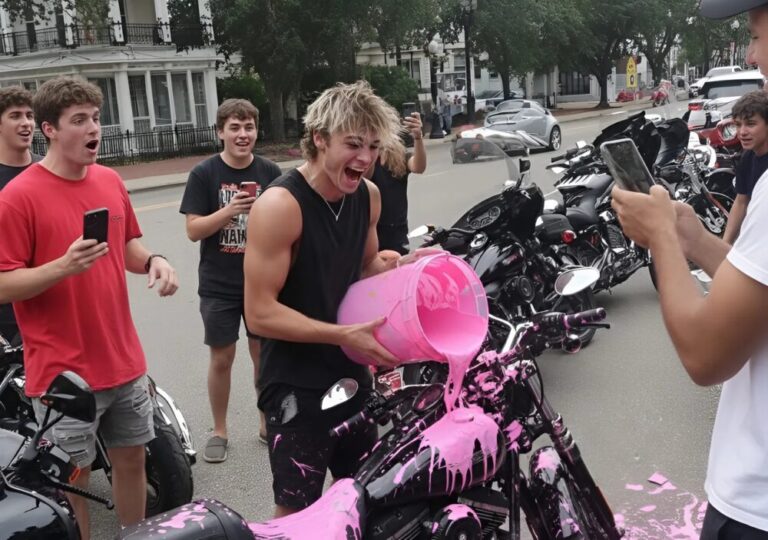
Tomson stepped into frame with the gallon of paint raised beside his face like a trophy.
“What’s up, everybody?” he shouted. “Today we’re doing a little social experiment.”
Jordan laughed behind the phone.
Viewers began joining.
One hundred.
Five hundred.
Two thousand.
Comments raced upward.
What are you doing?
No way.
Bro don’t.
Do it.
DO IT.
Tomson fed off the attention immediately.
“People always talk about these biker dudes like they’re untouchable,” he said, pacing in front of the motorcycles. “Big scary motorcycles, loud engines, pollution, toxic masculinity, all that. So today, we’re making a statement.”
Jordan angled the camera dramatically.
Tomson twisted open the paint.
The color was almost ridiculous beneath the desert sun—bright, glossy, bubblegum pink.
For half a second, even Tomson hesitated.
Then the comments surged.
DO IT.
Legend.
This is insane.
They’re gonna lose it.
Tomson smiled into the camera.
And poured.
The first stream of paint hit the tank of a black motorcycle and ran down its polished side in thick, ugly ribbons.
Jordan shouted, “Ohhh!”
The livestream exploded.
Tomson’s heart raced with triumph.
He moved to the next bike.
Then the next.
Pink paint splashed over chrome, leather seats, handlebars, and saddlebags. It dripped onto tires and pooled on the gravel beneath them. What had been carefully maintained machines became props in a stunt designed for strangers who would forget it by tomorrow.
Inside the diner, no one noticed at first.
The Desert Eagles were finishing breakfast before their ride.
At the head of the table sat Wayne Patterson, sixty-four years old, broad-shouldered, silver-haired, with calm eyes and hands marked by years of labor. His motorcycle was parked third from the end.
A deep blue Harley.
It was more than a motorcycle.
It had been the last gift his wife, Marlene, gave him before cancer took her.
She had saved for it quietly, secretly, stubbornly. When she finally showed it to him, she had been too weak to stand for long, but she still laughed when he cried.
“You better ride it somewhere good,” she had told him.
So he did.
Every charity ride.
Every memorial ride.
Every hospital fundraiser.
Every mile he rode for someone who needed help, Wayne felt as if Marlene rode with him.
That morning, as he lifted his coffee, the waitress approached the table with an expression that drained the warmth from the room.
“Wayne,” she said softly. “You all need to come outside.”
The bikers turned.
Through the window, they saw Tomson pouring paint over the motorcycles.
For several seconds, no one moved.
Then chairs scraped backward.
“What the hell?” one rider growled.
Another shoved away from the table.
But Wayne stood slowly.
“Wait.”
The others looked at him as if he had lost his mind.
“Wayne, that kid is destroying our bikes.”
“I said wait.”
His voice was low.
Not weak.
Not uncertain.
Final.
The group stopped.
Wayne looked through the glass at the young man laughing into his phone.
He saw the paint spilling over chrome.
He saw Jordan filming.
Then he saw the blue Harley.
Marlene’s Harley.
Pink paint ran down its tank like a wound.
Something in Wayne’s chest tightened so sharply he had to breathe through it.
One of the men beside him, Luis, shook with anger.
“Let me handle this.”
“No,” Wayne said.
“They deserve—”
“They deserve consequences,” Wayne interrupted. “Not our rage.”
Outside, Tomson was thriving.
The livestream had reached tens of thousands. Comments poured in so fast Jordan could barely read them.
“They’re inside!” Jordan said, laughing. “They see you!”
Tomson turned toward the diner windows and spread his arms.
“Come on out, gentlemen!” he shouted. “We’re just making art!”
His followers loved it.
Tomson felt untouchable.
Then the diner door opened.
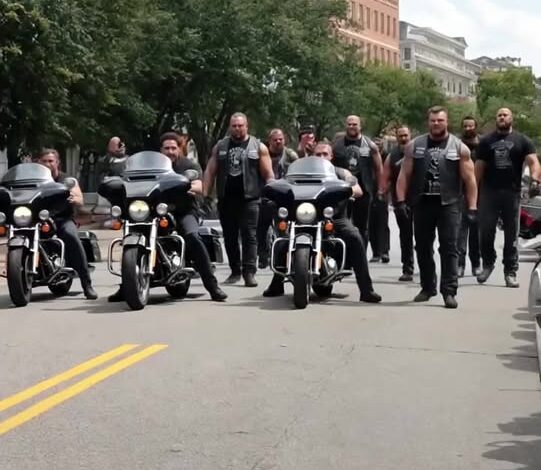
The Desert Eagles stepped outside.
The parking lot changed instantly.
Even through the shield of the phone, Tomson felt it.
These were not actors.
Not internet characters.
Not cartoon villains.
They were men.
Old, yes.
But solid.
Weathered.
Present.
They walked toward him without rushing.
At the front was Wayne.
His face revealed no rage, though rage would have been easier for Tomson to understand. Instead, Wayne looked at the damaged motorcycles with a quiet sadness that made the air heavier than yelling would have.
Tomson lifted his phone higher.
“Here they come, chat.”
Wayne stopped a few feet away.
“What’s your name, son?”
Tomson laughed.
“You can call me T-Mo.”
“I asked your name.”
“That is my name online.”
Wayne studied him.
“That’s not the same thing.”
For the first time, Tomson had no immediate answer.
Jordan kept filming.
Wayne turned and looked at his motorcycle.
The blue Harley stood coated in streaks of pink.
“My wife gave me that bike,” he said.
The parking lot quieted.
Even Jordan lowered the camera slightly.
Wayne continued, his voice steady.
“She bought it for me before she died. Saved for it while she was sick and never told me. Said she wanted me to keep riding after she was gone. Said every mile I rode helping somebody would count as one she got to ride too.”
Tomson’s smile faltered.
Wayne looked back at him.
“You didn’t pour paint on a motorcycle. You poured paint on a memory.”
No one spoke.
Tomson glanced toward Jordan, waiting for his friend to laugh, to cut the tension, to turn it back into content.
Jordan didn’t.
Luis stepped forward, fists clenched.
Wayne lifted one hand.
Luis stopped, breathing hard.
Tomson forced a scoff.
“Look, man, it’s just paint. It’ll wash off.”
Wayne nodded slowly.
“Maybe.”
He pulled out his phone and began taking photos of the damage.
One bike.
Then another.
Then another.
“You’re not going to do anything?” Tomson asked, confused by the lack of explosion.
Wayne looked at him.
“I am doing something.”
He took another photo.
“I’m documenting it.”
The livestream comments began shifting.
Bro this got awkward.
That’s messed up.
His wife died?
Not funny anymore.
Tomson saw the tone changing and panic flickered beneath his ribs.
This wasn’t how it was supposed to go.
The bikers were supposed to shout.
Threaten.
Swing.
Prove the stereotype.
Give him the clip.
Instead, Wayne turned the camera back on Tomson without touching him at all.
“Real name,” Wayne said.
Tomson swallowed.
“T-Mo.”
Wayne’s eyes hardened slightly.
“One day you’re going to learn that a username can’t stand in court for you.”
The Desert Eagles cleaned what they could in silence. Some of the paint had already begun drying in the heat. Some would require professional repair. Leather seats were stained. Chrome was scratched from gravel kicked up during the mess.
Still, the bikers did not strike him.
They did not chase him.
They did not give him the violence he had come looking for.
That, somehow, made it worse.
As they eventually rode away, one by one, the charity banners still attached to their damaged motorcycles, Tomson stood in the parking lot holding a half-empty paint can and feeling something he did not want to name.
Shame.
He buried it quickly.
Posted edited clips.
Tried to frame himself as bold, misunderstood, provocative.
But the internet had already turned.
Not everyone, of course.
Some still cheered.
Some always would.
But enough people had seen Wayne’s face.
Enough had heard the story about Marlene.
Enough had recognized cruelty when it stood there covered in pink paint pretending to be commentary.
For two weeks, Tomson avoided thinking about the Desert Eagles.
Then the desert made him think about them.
He and Jordan had driven out late to film another video near an abandoned mining road, hoping a creepy overnight challenge would repair the damage to Tomson’s fading reputation. The plan was simple: drive into the desert, film scary footage, act terrified, post dramatic clips by morning.
The plan failed when Jordan’s old SUV broke down miles from the main road.
At first, they laughed.
Then they cursed.
Then they realized neither phone had signal.
By midnight, the temperature dropped hard.
The desert, warm and harmless by day, became vast and indifferent in darkness. Wind moved across the open land. The road behind them disappeared into blackness. Their water supply consisted of one half-empty bottle and a melted iced coffee.
Jordan tried starting the engine again.
Nothing.
Tomson wrapped his arms around himself.
“This is bad.”
Jordan looked at him.
“No kidding.”
Hours passed.
Their jokes vanished.
Their confidence went with them.
Tomson checked his phone again and again, as if desperation could create signal.
Nothing.
For the first time in a long time, there was no audience.
No comments.
No filters.
No username.
Just Tomson Morrison in the dark, scared and cold, realizing how little his follower count mattered when no one could hear him.
Then headlights appeared on the horizon.
At first, they were tiny.
Then brighter.
More than one.
A low rumble carried through the desert night.
Jordan stood.
“Is that… motorcycles?”
Tomson’s blood went cold.
The lights came closer.
Chrome glinted.
Engines growled.
And then the Desert Eagles MC rolled out of the darkness like ghosts from the road he had tried to forget.
Tomson stepped backward.
“Oh no.”
Jordan whispered, “We’re dead.”
The motorcycles stopped in a semicircle around the broken SUV.
Engines cut off one by one.
Silence returned.
Wayne Patterson removed his helmet.
For a long moment, he simply looked at Tomson.
Tomson could not speak.
He expected anger.
He expected revenge.
Part of him almost felt he deserved it.
Wayne walked toward him carrying a blanket.
“You boys cold?”
Tomson blinked.
“What?”
Wayne held out the blanket.
“Temperature drops fast out here.”
Neither Tomson nor Jordan moved.
Luis appeared with bottled water.
Another rider opened a toolkit near the SUV.
Someone else checked the road behind them with a flashlight.
The Desert Eagles moved with calm efficiency, as if rescuing stranded people in the middle of nowhere was simply what one did when one found them.
Tomson stared at the blanket in Wayne’s hand.
“I don’t understand.”
Wayne sighed.
“You don’t have to understand to take it.”
Tomson took the blanket.
His hands shook.
“Why are you helping us?”
Wayne looked toward the dark desert.
“Because you need help.”
“But after what I did?”
Wayne’s jaw tightened, but his voice remained calm.
“What you did was wrong. Cruel too. But leaving two boys stranded in the desert to freeze doesn’t make it right. It just makes the world meaner.”
Tomson looked down.
For once, he had no performance ready.
Wayne continued.
“My wife used to say kindness is only easy when nobody has hurt you. The hard part is choosing it when they have.”
The words struck Tomson harder than any punch could have.
The bikers gave them water.
Wrapped them in blankets.
Got the SUV running long enough to move it closer to the road.
One of the men radioed for assistance from a nearby service station.
As they worked, Tomson listened.
He heard them talk about the charity ride he had nearly ruined. About the children they had visited afterward. About hospital bills, veterans in need, families who could not afford medical equipment, and small towns where the Desert Eagles quietly showed up whenever someone needed support.
These were not the people he had mocked in his livestream.
Or rather, they were.
He simply had never bothered to see them.
At dawn, with the sky turning pale over the desert, Tomson approached Wayne.
“I’m sorry,” he said.
Wayne looked at him.
This time, Tomson did not hide behind a username.
“My name is Tomson Morrison. And I’m sorry.”
Wayne held his gaze for a long moment.
“Sorry is a start.”
Tomson nodded.
“What comes after?”
“Accountability.”
That was the beginning.
Not forgiveness.
Not friendship.
Not yet.
But a beginning.
The first video Tomson posted afterward was not dramatic.
No shouting.
No music.
No fake moral framing.
Just him, sitting in front of the camera, telling the truth.
He explained what he had done.
He used Wayne’s real name only with permission.
He admitted the stunt had not been a social experiment.
It had been vandalism.
It had been cruel.
It had been content at someone else’s expense.
Then he posted footage the Desert Eagles allowed him to film—not of damage, not of confrontation, but of their work.
A fundraiser for a child needing surgery.
A ride delivering groceries to veterans.
A group of leather-vested men fixing a wheelchair ramp for a widow who could not afford repairs.
An afternoon at a children’s hospital where kids pressed their hands against motorcycle seats and laughed at the sound of engines.
At first, his audience was confused.
Some mocked him.
Some left.
Some accused him of going soft.
But others stayed.
Then new people came.
People who cared less about shock and more about story.
Tomson changed slowly.
Awkwardly.
Imperfectly.
He still made mistakes.
He still reached for the easy joke sometimes.
But now he caught himself more often.
He listened more.
Asked before filming.
Learned names.
Learned histories.
Learned that people are not props just because a camera is pointed at them.
Months passed.
His follower count dipped, then steadied, then grew again—not as fast as before, but deeper.
His page changed.
The bio that once read Professional Chaos Creator became something else.
Stories that matter.
Wayne teased him about it.
“Little dramatic, isn’t it?”
Tomson smiled.
“Yeah. But accurate.”
Nearly a year after the paint incident, the Desert Eagles gathered for another charity ride. This one supported children facing serious illnesses and their families.
The motorcycles gleamed in the morning sun.
Wayne’s blue Harley had been repaired, though if you looked closely, one tiny trace of pink remained near the underside of the tank.
He had chosen not to remove it.
“A reminder,” he told Tomson once.
“Of what?”
Wayne had smiled.
“That people can make ugly messes. And sometimes, if they’re lucky, they get the chance to clean them up.”
At the event, children gathered around the bikes with wide eyes. Parents took photos. Volunteers handed out food. Riders laughed, lifted kids carefully onto seats, and let them hold helmets nearly as big as their torsos.
Tomson filmed quietly from the side.
Not interrupting.
Not performing.
Just documenting.
A little girl in a purple jacket approached Wayne shyly. She had lost her hair during treatment, but her smile was bright enough to stop conversations around her.
Wayne knelt to her height.
“Well, hello there.”
She touched the patch on his vest.
“Are you the motorcycle angels?”
Wayne’s expression softened.
“Motorcycle angels?”
She nodded seriously.
“My mom said you help people.”
The riders around them fell quiet.
Tomson lowered his camera.
The girl noticed him then and pointed.
“You’re with them too?”
Tomson looked at Wayne.
Then at the child.
For a moment, he did not know how to answer.
Wayne placed a hand on his shoulder.
“He’s learning,” Wayne said.
The girl smiled as if that was enough.
And maybe it was.
Later that afternoon, Tomson posted the clip.
He did not add dramatic music.
He did not exaggerate.
He did not make himself the center of it.
He simply wrote:
A year ago, I thought these men were content. I was wrong. They were teachers. I just didn’t know I needed a lesson.
The video went viral.
But this time, Tomson did not watch the numbers first.
He watched the comments from people sharing stories of strangers who had helped them.
Of veterans who rode for lost friends.
Of parents whose children had been supported by charity groups.
Of people who had changed because someone showed them mercy when punishment would have been easier.
The Desert Eagles continued riding every weekend.
They raised money.
Visited hospitals.
Escorted funeral processions.
Delivered supplies.
Showed up when people called.
They did not become heroes because Tomson filmed them.
They had been doing the work long before he arrived with paint in his hand.
But because of what happened, more people saw them.
More people donated.
More people volunteered.
More people understood that appearances rarely tell the whole story.
As for Tomson, he never forgot the desert.
The darkness.
The cold.
The sound of those motorcycles arriving when he least deserved rescue.
That was the moment his life split into before and after.
Before, he believed attention was the same as importance.
After, he understood that being seen meant nothing if you refused to truly see others.
The paint washed off most of the motorcycles.
The videos eventually stopped trending.
The internet moved on, as it always does.
But the lesson remained.
Cruelty can go viral in seconds.
Kindness takes longer.
It moves quietly.
Through choices.
Through restraint.
Through a man refusing to answer vandalism with violence.
Through bikers stopping in the desert to help the very person who humiliated them.
Through a young man finally realizing that a camera can either exploit people or honor them.
In the end, Tomson Morrison did not become better because he was shamed.
He became better because the people he wronged showed him a version of strength he had never understood.
Not loud.
Not performative.
Not fueled by applause.
Real strength.
The kind that protects instead of punishes.
The kind that helps even when anger would be justified.
The kind that turns a ruined morning at a roadside diner into the beginning of a different life.
And somewhere on a desert highway, every weekend, the Desert Eagles still ride.
Chrome shining.
Engines rumbling.
Hearts steady.
Carrying with them the memory of those they loved, the people they helped, and the belief that mercy—when chosen freely—can change a person more deeply than revenge ever could.