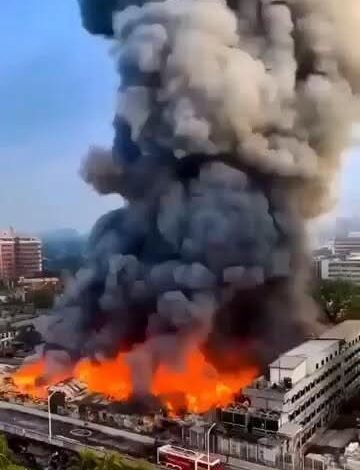
The ground shook without warning.
In a matter of seconds, entire communities along the China–Myanmar border were thrust into chaos as a powerful 7.7-magnitude earthquake ripped through the region. Homes trembled violently, roads cracked, and buildings that had stood for decades were reduced to piles of rubble. Families fled into the streets searching for safety, while countless others found themselves separated from loved ones amid the confusion and fear.
Now, in the aftermath of one of the region’s most destructive natural disasters in recent years, the focus has shifted from survival to recovery—a task that will require extraordinary determination, resources, and time.
Across affected areas, scenes of devastation have replaced the routines of everyday life. Neighborhoods once filled with bustling markets, schools, and family gatherings now bear visible scars of the disaster. Emergency shelters have sprung up where homes once stood, and rescue teams continue to work around the clock in locations where damaged structures and unstable conditions create constant risks.
For many residents, the uncertainty remains overwhelming.
Families continue searching for information about missing relatives. Others wait anxiously for updates about the condition of their homes, businesses, and communities. Every passing hour brings new assessments, new discoveries, and a clearer understanding of the earthquake’s immense impact.
In response, authorities from both China and Myanmar launched extensive emergency operations almost immediately after the quake struck.
Search-and-rescue teams were among the first to arrive, navigating dangerous conditions in hopes of locating survivors trapped beneath collapsed buildings. Medical personnel established emergency treatment centers to care for the injured, while local officials coordinated evacuations and temporary housing for displaced residents.
The scale of the response reflects the scale of the challenge.
Engineers have been dispatched to inspect critical infrastructure, including bridges, highways, hospitals, power facilities, and communication networks. These inspections are essential not only for assessing damage but also for determining which structures remain safe for public use.
In many locations, aftershocks have complicated those efforts.
Rescue crews often find themselves working under difficult conditions, knowing that unstable debris and continued seismic activity pose ongoing threats. Yet despite these dangers, teams continue their work with remarkable dedication, driven by the possibility of finding survivors and restoring a sense of security to affected communities.
At the same time, humanitarian organizations are preparing large-scale relief efforts designed to address the urgent needs of thousands of displaced residents.
Food distribution programs are being organized.
Clean drinking water is being transported into impacted areas.
Medical supplies, emergency equipment, and temporary shelters are being deployed to locations where local resources have been overwhelmed.
Particular attention is being given to remote mountainous regions, where damaged roads and difficult terrain have made access especially challenging. Reaching these isolated communities remains one of the most urgent priorities for aid organizations and government agencies alike.
Restoring transportation routes has become a critical objective.
Without functioning roads and bridges, delivering emergency assistance becomes significantly more difficult. Communication systems are also being repaired as quickly as possible to reconnect separated families and ensure that accurate information reaches those who need it most.
Yet amid the destruction, stories of resilience continue to emerge.
Rescue workers have reported successful recoveries of survivors from collapsed structures, offering moments of hope during an otherwise difficult period. Families separated during the earthquake have been reunited after hours—or in some cases days—of uncertainty.
Each reunion serves as a reminder that even in the midst of tragedy, hope endures.
Utility crews have also begun restoring electricity, water service, and communications in some of the affected regions. While progress remains gradual, every repaired power line and reopened roadway represents an important step toward normalcy.
These achievements may seem small compared to the scale of the disaster, but for those affected, they are powerful symbols of recovery.
The road ahead, however, will not be easy.
Thousands of families now face the daunting challenge of rebuilding homes, businesses, schools, and community institutions. Many have lost possessions accumulated over a lifetime. Others face months of uncertainty as reconstruction plans take shape.
For local economies, the impact may be felt long after the immediate crisis has passed.
Businesses disrupted by the earthquake must recover.
Public infrastructure must be repaired or rebuilt.
Entire communities will need support as they work to restore daily life.
Recovery from a disaster of this magnitude rarely happens quickly.
In some areas, rebuilding efforts may continue for years.
That reality has prompted officials, humanitarian organizations, and local leaders to begin planning not only for emergency relief but also for long-term reconstruction. Their goal is not simply to replace what was lost but to help communities emerge stronger, safer, and more resilient against future disasters.
Collaboration has become a defining feature of these efforts.
Government agencies, emergency responders, volunteers, nonprofit organizations, and local residents are working side by side to address immediate needs while laying the foundation for recovery. Their shared commitment reflects a common understanding: rebuilding requires more than resources—it requires unity.
As additional damage assessments are completed and rescue operations continue, the primary mission remains unchanged.
Protect lives.
Support survivors.
Restore critical services.
Help communities move forward.
The earthquake has left an undeniable mark on the region, affecting countless individuals and reshaping entire communities. Yet it has also revealed something equally powerful: the resilience of the human spirit.
In the face of destruction, people continue to help neighbors, support strangers, and work tirelessly toward recovery. Emergency responders continue risking their own safety to assist others. Aid workers continue delivering essential supplies. Families continue finding strength in one another.
Those acts of determination offer hope for what comes next.
The months ahead will undoubtedly bring challenges, setbacks, and difficult decisions. But they will also bring opportunities for healing, rebuilding, and renewal.
While the scars of this disaster may remain visible for years to come, so too will the extraordinary efforts of those who refused to give up.
And as communities across the China–Myanmar border begin the long process of recovery, one thing is already clear: their commitment to rebuilding is every bit as powerful as the forces that tried to tear them apart.