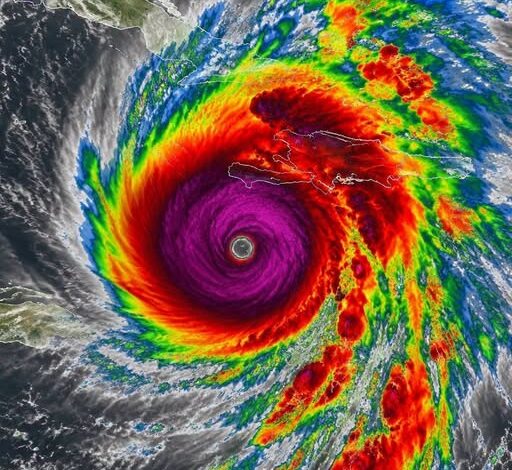
What began as another storm on the weather map has become a race against the clock.
Hurricane Melissa’s explosive intensification into a powerful Category 5 hurricane has transformed routine weather updates into urgent warnings for millions of people along its potential path. Forecasters are monitoring every movement of the storm, aware that even a slight change in direction could dramatically alter which communities face the strongest winds, the highest storm surge, and the greatest risk of destruction.
No forecast line can fully capture the danger.
The hurricane’s eye may mark the center of the storm, but its impacts extend far beyond that narrow track. Hurricane-force winds can tear apart homes, uproot trees, and cripple power grids, while torrential rainfall may trigger widespread flooding far inland. Along the coast, towering waves and life-threatening storm surge have the potential to overwhelm neighborhoods, wash out roads, and reshape shorelines in a matter of hours.
That is why emergency officials repeatedly stress that residents should never focus solely on whether they are directly in the eye’s projected path.
Hazardous conditions often stretch for many miles from the center, and last-minute shifts are common enough that no one in a threatened area should assume they are safe simply because the forecast has changed by a few miles.
As Melissa moves closer, emergency managers are working against time.
Local officials are urging families to review evacuation plans before orders are issued, identify the safest routes out of vulnerable areas, and leave early if evacuation becomes necessary. Waiting until the last minute can mean sitting in heavy traffic, encountering closed roads, or facing rapidly deteriorating weather conditions that make travel dangerous.
Preparation also begins at home.
Residents are being encouraged to fuel their vehicles before long lines develop at gas stations, charge phones and backup batteries, gather enough food, drinking water, medications, and essential supplies to last several days, and secure outdoor furniture or loose objects that could become dangerous projectiles in high winds.
For those living in flood-prone or coastal areas, protecting important documents and understanding local emergency alerts can be just as important as boarding up windows or bringing outdoor belongings inside.
Yet for many families, the greatest challenge isn’t gathering supplies.
It’s living with uncertainty.
Some will make the difficult decision to evacuate, locking their front doors without knowing whether their homes will still be standing when they return.
Others may wrestle with whether to leave elderly relatives, treasured possessions, or the communities they’ve spent a lifetime building.
Every approaching hurricane forces deeply personal decisions that cannot be measured by weather maps alone.
The emotional weight of those choices is often as difficult as the storm itself.
Still, emergency officials consistently emphasize one message above all others:
Preparation saves lives.
Panic rarely helps, but taking sensible precautions before conditions worsen can make an enormous difference. Listening to trusted weather updates, following evacuation instructions when they are issued, and acting early rather than waiting for certainty are among the most effective ways to protect yourself and those you love.
As Hurricane Melissa continues its approach, forecasts will evolve, and its exact path may still change.
What should not change is the importance of being ready.
Storms of this magnitude leave little room for hesitation once dangerous conditions arrive. The actions taken today—reviewing emergency plans, assembling supplies, securing property, and knowing when to leave—may determine how safely families weather the days ahead.
When the winds finally begin to rise, preparation becomes the strongest protection.
And in the face of a powerful hurricane, that readiness can mean the difference between enduring the storm and being overwhelmed by it.