Broke Single Dad Found a Massive Stash of Cash and the Sheriff Came Knocking the Next Day to Change His Life Forever

The officers didn’t arrive with flashing lights, raised voices, or handcuffs.
They arrived carrying boxes.
That was the first thing that confused me.
Large cardboard boxes balanced carefully in gloved hands. Plastic grocery bags hanging from wrists. Heavy winter coats folded over uniformed arms. One deputy even struggled slightly beneath the weight of a giant package of paper towels tucked awkwardly against his chest.
For one strange second, standing in the doorway of my little yellow house, I honestly thought they had the wrong address.
Because police officers don’t usually show up at homes like mine bringing kindness.
They usually come bringing bad news.
Late notices.
Questions.
Problems.
And after the kind of years I’d been living through, my body had forgotten how to prepare for anything else.
The evening air smelled like wet pavement and wood smoke drifting from somewhere farther down the block. Rain clouds hung low and heavy over the neighborhood while cold November wind rattled the loose aluminum siding near our porch steps.
Inside the house, one of my triplets was coughing again.
I could hear Lily’s cartoon playing softly from the living room television while the twins argued quietly over crayons at the kitchen table. The entire house smelled like canned tomato soup, laundry detergent, and exhaustion.
Real exhaustion.
The kind that settles so deeply into your bones you stop recognizing yourself in mirrors.
My name is Hannah Mercer.
I was thirty-one years old, divorced, raising triplets, working two jobs, and surviving almost entirely on calculations.
How much gas remained.
How many days bread could stretch.
Which bill could wait another week without getting shut off.
People talk about poverty like it’s one dramatic event.
It isn’t.
It’s math.
Constant, humiliating math.
Three months earlier, the transmission in my car failed.
Two weeks after that, my youngest got pneumonia.
Then overtime hours disappeared at the garage where I handled office paperwork during the day while cleaning a diner three nights a week after closing.
Every problem arrived already holding hands with another one.
That was life lately.
So when I opened the door and found three deputies standing there surrounded by boxes, panic hit me instantly.
My first thought was the kids.
Always the kids.
“Is something wrong?” I asked immediately.
The sheriff standing closest to me removed his hat slowly.
Older man.
Silver mustache.
Kind eyes that looked strangely emotional for someone standing on my porch.
“No, ma’am,” he said softly. “Actually… we came to thank you.”
That made even less sense.
Behind him, another deputy carefully lowered two grocery bags onto the porch swing.
I stared at the food automatically.
Milk.
Bread.
Fresh fruit.
Real groceries.
Not discount clearance items balanced against coupons and prayer.
The sheriff noticed where my eyes went.
“May we come in?” he asked.
I stepped aside numbly.
The deputies entered quietly, almost respectfully, carrying boxes through the narrow hallway while trying not to bump into peeling paint or the broken shoe rack beside the door.
The living room looked painfully small once all those supplies started appearing inside it.
Winter coats.
Boots.
Blankets.
Laundry detergent.
Diapers.
Canned goods.
Gift cards taped carefully inside envelopes.
One deputy carried in a brand-new space heater still inside the packaging.
Another set down bags overflowing with groceries that looked expensive enough to belong in someone else’s kitchen entirely.
Fresh meat.
Orange juice.
Coffee.
Cereal with actual cartoon mascots instead of generic labels.
I stood frozen near the couch while my triplets peeked nervously from the hallway.
Then my mother walked out from the spare bedroom.
She moved slowly because arthritis punished her hardest in cold weather.
The moment she saw the boxes, she stopped completely.
“What is all this?” she whispered.
The sheriff looked toward her gently.
“This belongs to the honest mechanic in the yellow house,” he said.
And suddenly I understood.
Two days earlier, I found the wallet.
It happened near the gas station on Miller Road after my diner shift ended around midnight.
Rain hammered the pavement so hard visibility barely reached the headlights. I was exhausted, cold, and calculating whether the gas tank held enough fuel to survive until payday.
Then I spotted the wallet lying near the curb beside the pump.
Thick brown leather.
Heavy.
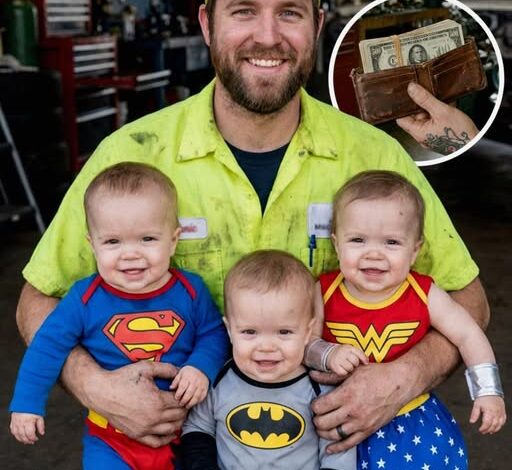
Inside sat nearly three thousand dollars in cash.
I counted twice because my brain refused to believe it.
Three thousand dollars.
Do you know what three thousand dollars looks like to someone drowning financially?
It looks like heat staying on.
Groceries without panic.
Medicine without bargaining.
A transmission repair.
Breathing room.
For one terrible moment, I just sat there gripping the steering wheel while rain battered the windshield and temptation crawled through every exhausted corner of me.
Nobody saw me pick it up.
Nobody would know.
That’s what poverty does to your morality sometimes.
Not because poor people are worse.
Because desperation makes survival feel louder than principles.
Then I opened the wallet farther.
Inside was an old photograph.
A white-haired man holding a little girl on his shoulders near a fishing dock somewhere.
Both laughing.
And suddenly the money stopped looking anonymous.
It belonged to somebody.
Somebody probably terrified right now.
I drove straight to the sheriff’s office.
The deputy on overnight duty looked shocked when I handed it over untouched.
“You didn’t take anything?” he asked.
I laughed tiredly.
“Wouldn’t matter if I did,” I answered. “I’d still know.”
That should have ended the story.
Instead, apparently the wallet belonged to retired mechanic Gary Whitaker.
And Gary Whitaker was the sheriff’s father.
The sheriff looked around my living room quietly while my children slowly approached the grocery bags in disbelief.
My mother picked up a thick pink winter coat carefully like it might disappear if held too tightly.
Her hands trembled.
“This is too much,” I whispered immediately.
“No,” the sheriff answered softly. “What you did was too much.”
I shook my head.
“It was just a wallet.”
The older deputy beside him finally spoke.
“No, ma’am. Most people never returned the money.”
That silence afterward felt enormous.
Because he was probably right.
And the awful truth was that part of me understood exactly why.
The sheriff cleared his throat gently.
“My father’s eighty-two,” he explained. “Vietnam veteran. Retired mechanic. That wallet held his pension cash and money he’d been saving for surgery deposits.”
He paused.
“When the station called saying someone returned every dollar untouched… he cried.”
I looked away immediately because suddenly my own eyes burned too.
“He kept saying nobody does that anymore,” the sheriff continued quietly. “Then he found out where you lived.”
One of the deputies handed my children coloring books and stuffed animals while another began assembling the space heater near the wall outlet.
Normal acts.
Small acts.
Yet every single one landed inside me like emotional impact.
Because when you spend years barely surviving, kindness starts feeling fictional.
My youngest daughter tugged gently on my sleeve.
“Mommy,” she whispered, “are we in trouble?”
That question nearly broke me completely.
Because children raised around struggle learn fear before security.
I knelt quickly beside her.
“No baby,” I whispered back. “Not this time.”
The sheriff’s expression changed after hearing that.
Sadder somehow.
Then he handed me an envelope.
Inside were gas cards, grocery gift cards, and prepaid utility assistance vouchers from local churches and businesses.
Apparently Gary told everyone in town about “the honest mechanic lady with the triplets.”
People donated within twenty-four hours.
The sheriff rubbed the back of his neck awkwardly.
“My father hasn’t slept properly since losing that wallet,” he admitted. “Said he couldn’t stop thinking about the woman who returned it while probably needing it herself.”
That sentence cracked something open inside me.
Not because it was inaccurate.
Because it was true.
I sat down hard on the couch and started crying in front of three uniformed strangers.
Not polite tears.
Real ones.
The kind pulled from years of fear, stress, exhaustion, and pretending I was managing better than I actually was.
I cried because the rent was late.
Because the kids needed boots.
Because I’d skipped dinners pretending not to be hungry.
Because surviving had become so constant I forgot what relief felt like.
Nobody interrupted me.
Nobody looked embarrassed.
My mother sat beside me quietly holding the pink coat against her chest while tears rolled down her face too.
The sheriff waited until I finally caught my breath.
Then he said something I still think about constantly.
“My dad said you reminded him the world still has decent people in it.”
Later that evening, after the deputies left, I drove out to Gary Whitaker’s little farmhouse beyond county road twelve.
The kids stayed with my mother.
I needed to say thank you properly.
Gary answered the door wearing suspenders, old jeans, and grease stains that looked permanently built into his hands after decades of mechanic work.
The moment he saw me, he smiled softly.
“You found me.”
I stood there awkwardly clutching a pie from the grocery store because gratitude suddenly made me feel twelve years old again.
“You didn’t have to do all that,” I said immediately.
Gary shook his head.
“Yes,” he answered quietly. “I did.”
We sat on his porch while evening settled across the fields.
The air smelled like pine needles and chimney smoke.
“I almost kept it,” I admitted finally.
Gary looked at me calmly.
“But you didn’t.”
“No.”
He nodded once.
“That’s the important part.”
I stared out toward the darkening road.
“That money would’ve changed everything for us.”
Gary leaned back slowly in his chair.
“Maybe for a month,” he answered. “But what you chose instead changed something bigger.”
I didn’t fully understand him then.
I do now.
Because the money in that wallet could have paid overdue bills.
It could have bought temporary survival.
But returning it changed the direction of my life entirely.
A local mechanic shop owner heard the story and offered me stable office work with health insurance.
The church connected us with winter assistance programs.
One deputy’s wife helped arrange donated clothes for the triplets.
Gary himself became almost family afterward.
Not because I performed some heroic act.
Because integrity has a strange way of traveling farther than desperation expects.
Before I left that night, I thanked Gary one last time.
He just smiled quietly and shook his head.
“No,” he said. “Thank you.”
“For what?”
“For reminding an old man not everyone does the wrong thing when life gets hard.”
Driving home beneath cold November stars, I thought about the wallet again.
About temptation.
About fear.
About the rain pounding my windshield while I debated who I wanted to become.
And somewhere between the empty highway and the little yellow house waiting for me at the end of the road, I finally understood something important.
Integrity had cost me before.
It had meant sacrifice.
Delay.
Going without.
But this time, integrity carried me somewhere I never expected.
Straight through fear.
Past scarcity.
Into a moment where the world, just for once, answered honesty with kindness.
And when I walked back through my front door that night and saw my triplets asleep beneath brand-new blankets while groceries filled our kitchen for the first time in months…
I realized something even bigger.
The money inside that wallet might have helped us survive.
But returning it reminded my children — and eventually myself — that even in the hardest seasons of life, we still get to decide what kind of people we become when nobody is watching.