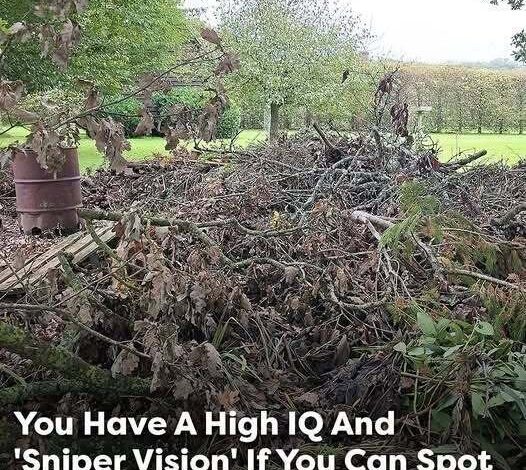
At first, it looks like nothing.
No hidden animal. No clever trick. No obvious clue waiting to be discovered.
Just a tangled mess of branches stretching in every direction, a chaotic patchwork of twigs, bark, leaves, and shadows that seems completely ordinary. Yet that seemingly simple photograph has managed to do something remarkable: it has captivated thousands of people across the internet, turning a quiet woodland scene into one of the latest viral visual challenges.
What began as a single image shared among puzzle enthusiasts quickly exploded across social media platforms, discussion forums, and online communities dedicated to brainteasers and optical illusions. Viewers were presented with a straightforward challenge: find the hidden spaniel concealed somewhere within the photograph.
The task sounded easy enough.
Then people opened the image.
Minutes passed.
Nothing.
They zoomed in. They zoomed out. They scanned every corner of the picture. They searched every branch, every shadow, every cluster of leaves. Yet despite knowing a dog was supposedly right there in plain sight, many could not find it.
For some, the experience became almost maddening.
Comment sections quickly filled with reactions ranging from amusement to outright disbelief. Some viewers confidently declared that there was no dog in the image at all. Others accused the puzzle of being a prank designed to waste people’s time. Many admitted they had stared at the photograph for five, ten, or even fifteen minutes before finally locating the hidden animal.
And perhaps the most common reaction of all was frustration.
People wanted to solve it.
They were certain the answer had to be obvious.
Yet the more they searched, the more elusive the spaniel seemed to become.
That growing sense of challenge is exactly what transformed the image from a simple photograph into an internet phenomenon.
Unlike many visual puzzles that rely on editing tricks or digital manipulation, this challenge draws its power from something much more fascinating: the limitations of human perception. The dog is not hidden behind an object. It is not obscured by special effects. It is sitting in the open, visible to anyone looking at the picture.
The problem is that our brains do not see the world as cameras do.
Every second, the human mind processes enormous amounts of visual information. To keep up, the brain relies on shortcuts, automatically filtering details and grouping objects into recognizable patterns. Most of the time, these mental shortcuts help us navigate the world efficiently. But occasionally they work against us.
This image is a perfect example.
The spaniel’s fur blends almost seamlessly with its surroundings. The shades of brown, gray, and tan closely resemble the colors of the tree bark and fallen leaves. The texture of the dog’s coat mirrors the rough, uneven appearance of the branches around it. Instead of standing apart from the environment, the animal becomes visually absorbed into it.
As a result, the brain often interprets the dog as part of the scenery rather than as a separate object.
Viewers find themselves looking directly at the spaniel without realizing it.
Again and again.
The more cluttered an image becomes, the harder it can be for the brain to isolate meaningful shapes. Every branch competes for attention. Every shadow creates uncertainty. Every overlapping texture adds another layer of visual confusion.
The hidden dog takes advantage of all of it.
Interestingly, the challenge reveals just how differently people process information. Some individuals spot the spaniel within seconds. Their eyes naturally lock onto subtle patterns that distinguish the dog from the surrounding branches. Others can stare at the image for extended periods without making any progress.
Neither group is necessarily more observant than the other.
Rather, they are relying on different visual strategies.
Some people focus on details. Others unconsciously search for larger shapes. Some examine textures. Others scan for recognizable outlines. These differences in perception help explain why one person may immediately find the answer while another remains completely baffled.
Those who eventually succeed often describe a nearly identical experience.
At first, they see only chaos.
Then something shifts.
A shape emerges.
A curve that did not seem important suddenly resembles an ear. A shadow begins to look like part of a face. Scattered visual fragments abruptly connect into a recognizable image.
And then there it is.
The spaniel.
What had been invisible moments earlier now appears unmistakable.
The transformation feels almost magical.
Many viewers immediately wonder how they missed something so obvious. Some laugh at themselves. Others feel relieved. A surprising number return to the comments section simply to announce that they finally found it.
That sudden realization reflects a well-known phenomenon in cognitive psychology. Once the brain identifies the correct pattern, it becomes difficult to see the image any other way. What was once hidden now seems impossible to overlook.
The dog hasn’t changed.
The photograph hasn’t changed.
Only your perception has.
This type of challenge belongs to a larger family of visual puzzles often called “hidden object” or “sniper” challenges. Similar viral images have challenged viewers to locate owls hidden in tree bark, leopards camouflaged among rocks, frogs concealed in forest floors, and foxes blending into autumn landscapes.
Again and again, these puzzles capture public attention for the same reason.
They create a miniature journey.
First comes curiosity.
Then confusion.
Then frustration.
Then determination.
And finally, the reward.
That emotional progression is surprisingly powerful. The moment of discovery triggers a genuine sense of satisfaction, encouraging people to share the challenge with friends, family members, and coworkers. Soon, the puzzle becomes less about finding the hidden object and more about comparing experiences.
“How long did it take you?”
“Did you need a hint?”
“Where exactly is it?”
Entire conversations emerge around a single photograph.
Online communities have developed countless strategies for tackling these visual mysteries. Some users recommend zooming out to see broader patterns. Others suggest narrowing focus to one section at a time. Some even claim that slightly blurring their vision helps them recognize larger shapes that would otherwise be lost among the details.
There is no universally correct method.
The variety of approaches highlights something fascinating about human cognition: different minds often arrive at the same solution through entirely different paths.
Beyond entertainment, puzzles like this offer an unexpected mental workout. Researchers who study visual cognition have long noted that hidden-object challenges engage skills related to concentration, pattern recognition, attention control, and problem-solving. In a world increasingly dominated by endless scrolling and constant digital distractions, these puzzles force people to slow down and focus intensely on a single task.
For a few minutes, the outside world fades away.
The only thing that matters is finding the answer.
Perhaps that explains why challenges like the hidden spaniel continue to spread so rapidly online. They tap into something deeply human—a desire to solve mysteries, uncover secrets, and make sense of complexity. They remind us that discovery often requires patience and that the most rewarding answers are not always immediately visible.
Thousands of people can look at the exact same photograph and experience the same cycle of confusion, determination, and triumph. Despite differences in age, background, or location, they all become participants in the same small adventure.
And that may be the real secret behind the image’s success.
The photograph is not merely a picture of a dog hidden among branches. It is a demonstration of how perception shapes reality. It reveals how easily the mind can overlook what is directly in front of it and how satisfying it feels when scattered clues finally come together.
In the end, the spaniel is more than a cleverly camouflaged animal.
It is a reminder that sometimes the most interesting discoveries are hiding in plain sight, waiting patiently for someone willing to slow down, look closer, and see what everyone else has missed.