In a culture where celebrity relationships are often treated like temporary headlines — intensely celebrated one month and publicly dissected the next — moments of quiet affection can feel surprisingly powerful.
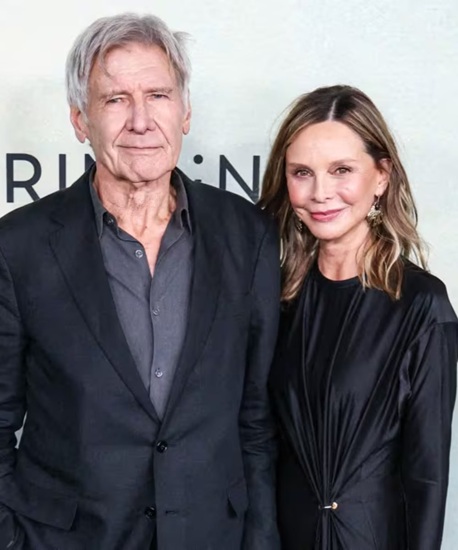
That is exactly why the recent images of Harrison Ford and Calista Flockhart arriving together in Los Angeles resonated so strongly online.
The photographs themselves were simple.
No red carpet.
No coordinated publicity campaign.
No carefully staged glamour.
Just two people stepping off a plane after travel, moving through an airport runway environment while photographers captured a brief, spontaneous kiss between them.
Yet sometimes the smallest gestures reveal the deepest truths.
According to reports from entertainment outlets including the Daily Mail, paparazzi photographed the couple sharing a quick affectionate moment while navigating the airport together. Within hours, the images spread rapidly across social media, drawing reactions not because they were dramatic, but because they felt unexpectedly sincere.
In an era saturated with performative visibility, sincerity stands out.
Harrison Ford, now 83 years old, appeared relaxed and entirely unconcerned with the attention surrounding him. Dressed casually in dark blue jeans and a light blue T-shirt, he looked less like one of the most recognizable actors in film history and more like an ordinary traveler returning home after a long journey.
Calista Flockhart, 61, carried the same understated energy.
Wearing beige trousers and a soft gray sweater, she projected comfort and ease rather than celebrity polish. There was no visible attempt to transform the airport into a fashion moment or orchestrated public appearance. Both looked tired in the familiar, human way travelers often do after flights:
slightly rumpled,
comfortable,
focused on simply getting home.
And perhaps that normalcy became the emotional center of the entire moment.
Because despite decades of fame between them, the photographs suggested something surprisingly grounded:
two people entirely comfortable inside each other’s presence after many years together.
The kiss itself lasted only seconds.
But what observers responded to was not physical affection alone.
It was the atmosphere surrounding it.
Nothing about the interaction appeared exaggerated or self-conscious. There was no dramatic posing toward cameras, no visible awareness of creating a public narrative. Instead, the moment felt instinctive — the kind of brief affection exchanged naturally between long-term partners who have built familiarity deep enough that tenderness no longer requires performance.
That distinction matters in celebrity culture.
Public relationships often become distorted under constant visibility. Couples can begin looking more like brands than people, carefully curating intimacy for audiences while protecting real emotional life behind layers of image management.
Ford and Flockhart have largely avoided that dynamic throughout their relationship.
For years, they have maintained an unusually private partnership compared to many Hollywood couples. Interviews rarely dwell heavily on their personal life. Public appearances together tend to feel understated rather than promotional. They rarely engage in overt displays designed specifically for headlines or viral attention.
Because of that privacy, moments like this naturally attract interest.
People become curious about what long-lasting love looks like behind fame.
And perhaps especially in Hollywood, where public relationships often appear fragile under pressure, stability itself becomes fascinating.
Their story together began in the early 2000s.
By the time they met, both already carried long-established identities within entertainment culture. Harrison Ford was not simply famous — he was iconic. Decades of film history surrounded him through roles that had become permanently embedded in global pop culture:
Indiana Jones,
Han Solo,
thrillers,
dramas,
action films spanning generations of audiences.
Meanwhile, Calista Flockhart had achieved major recognition through television success, particularly during the late 1990s and early 2000s when her performances brought her enormous public attention and acclaim.
Neither entered the relationship searching for career advancement or public validation through the other.
That maturity likely mattered enormously.
Relationships formed later in life often operate differently than youthful romances shaped heavily by uncertainty or identity formation. Older couples frequently approach partnership with greater emotional clarity:
understanding personal priorities,
valuing stability,
recognizing the importance of peace over spectacle.
Ford and Flockhart eventually married in 2010 after years together, creating a partnership that has now lasted well over a decade.
And throughout those years, they have largely resisted becoming consumed by celebrity culture’s more exhausting rhythms.
Observers frequently describe them as low-profile and grounded.
They spend significant time away from Hollywood’s social spotlight, preferring quieter routines and private family life over constant public exposure. Their appearances together often feel refreshingly ordinary:
walking through airports,
attending occasional events,
supporting one another professionally without excessive fanfare.
This quieter approach may actually be part of why their relationship appears so resilient.
Because constant exposure can place extraordinary strain on intimacy.
When every disagreement, appearance, or interaction becomes public property, relationships often lose the protected emotional space necessary for genuine connection to survive comfortably.
Ford and Flockhart seem to understand this instinctively.
They allow the public occasional glimpses.
Not unrestricted access.
And those glimpses consistently communicate something remarkably steady.
Mutual ease.
Comfort.
Companionship.
Not intensity manufactured for cameras.
That emotional steadiness becomes increasingly meaningful as audiences grow more skeptical of celebrity narratives generally. Modern media environments constantly expose performative behavior, staged vulnerability, and relationships that seem designed more for branding than emotional reality.
As a result, people respond strongly whenever public figures appear authentically connected without trying too hard to prove it.
The airport photographs captured precisely that feeling.
A moment so ordinary it became quietly moving.
No luxury yacht.
No dramatic declarations.
No glamorous magazine spread.
Just a brief kiss between spouses after traveling together.
Yet emotionally, that simplicity carried enormous symbolic weight.
Because long-term affection often expresses itself through small gestures rather than dramatic displays:
a hand resting briefly on someone’s back,
shared eye contact,
inside jokes,
comfortable silence,
the instinct to move toward each other naturally even after years together.
These details reveal intimacy more convincingly than spectacle ever can.
And perhaps that is why the images spread so rapidly online.
People are hungry for evidence that enduring love still exists.
Not perfect love.
Not fantasy.
Real companionship sustained over time.
Especially among public figures constantly exposed to temptation, pressure, scrutiny, and demanding schedules, relationships lasting decades begin feeling almost countercultural.
The fascination surrounding Harrison Ford and Calista Flockhart is not really about celebrity gossip.
It is about emotional endurance.
About seeing two people continue choosing one another quietly after fame has already offered them every possible distraction.
And there is something comforting about that.
Particularly because aging itself remains strangely underrepresented in celebrity culture. Hollywood often glorifies youth while treating long-term partnership and visible aging as less marketable narratives.
Yet moments like this challenge that idea gently.
Here was an 83-year-old actor still visibly affectionate toward his wife.
Here was a 61-year-old woman entirely comfortable sharing ordinary intimacy publicly without performance or self-consciousness.
No attempt to appear younger than they are.
No attempt to transform affection into spectacle.
Just closeness.
That emotional authenticity resonates precisely because it feels increasingly rare.
In many ways, the public reaction to these photographs says as much about collective longing as it does about the couple themselves.
People want reassurance that relationships can survive fame, aging, grief, career changes, public pressure, and time itself.
They want reminders that companionship can deepen rather than disappear over decades.
And perhaps most importantly, they want proof that love does not always need to announce itself loudly to remain meaningful.
Sometimes it exists most clearly inside ordinary moments:
walking beside someone after a long flight,
sharing quiet conversation,
reaching instinctively toward the person who still feels like home after years together.
For Harrison Ford and Calista Flockhart, that airport runway kiss lasted only seconds.
But for many people watching from a distance, it represented something far larger:
the enduring appeal of relationships built not around performance, but around familiarity, trust, and the quiet comfort of simply continuing life side by side.
And in a world increasingly obsessed with spectacle, perhaps that kind of understated affection feels more romantic than grand gestures ever could. :::