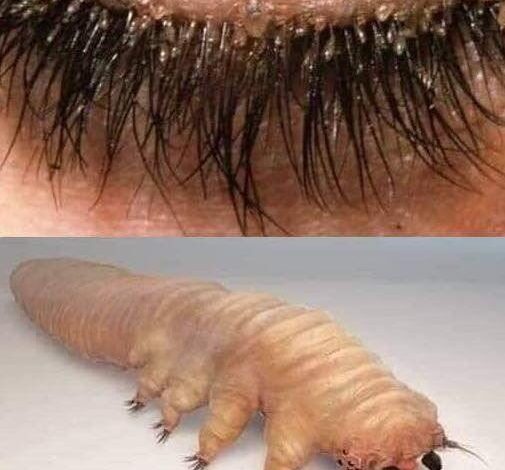
The idea sounds horrifying at first: tiny creatures living on your face while you sleep.
Yet for most people, that’s already true.
Microscopic Demodex mites inhabit the skin of nearly every adult human, settling quietly into hair follicles and oil glands, especially around the eyelashes and eyelids. Invisible to the naked eye, they feed on oils and dead skin cells, spending their entire lives unnoticed in one of the most delicate areas of the body.
Usually, they cause no harm at all.
In fact, their presence is so common that doctors consider them part of the normal ecosystem of human skin. Most people will go through life never realizing they share their face with these microscopic organisms.
The problem begins when balance breaks down.
As people age, immune systems weaken, oil production changes, or hygiene routines become inconsistent, Demodex populations can multiply beyond normal levels. What was once harmless quietly becomes irritating, inflaming the sensitive tissue around the eyes and triggering a condition called blepharitis.
And blepharitis can be surprisingly miserable.
At first, the symptoms often seem small enough to ignore:
slightly itchy eyelids,
mild redness,
dryness that comes and goes.
But over time, irritation can intensify into something far more disruptive:
burning sensations,
swelling,
crusting along the lash line,
watery eyes,
blurred vision,
a constant gritty feeling, as though sand or dust is trapped beneath the eyelids.
Some people wake up with lashes stuck together in the morning. Others notice eyelashes thinning or falling out entirely. The eyes become increasingly sensitive to light, screens, wind, or contact lenses. Simple daily activities start feeling exhausting because the discomfort never fully disappears.
What makes the condition especially frustrating is how easily it disguises itself as something else.
Many people assume they simply have dry eyes.
Or allergies.
Or irritation from makeup, pollen, stress, or lack of sleep.
Even doctors may initially treat those possibilities first because the symptoms overlap so heavily. Months can pass before someone finally sits in an eye specialist’s chair while lashes are examined closely enough to reveal the real culprit.
And for many patients, hearing the explanation produces two reactions at once:
disgust,
and relief.
Disgust because the idea of mites living near the eyes feels deeply unsettling on an instinctive level.
Relief because at last, the irritation finally has a name.
That emotional contradiction is common whenever people learn about microscopic life living on the human body. We tend to imagine ourselves as separate from nature rather than ecosystems within it. But the skin, gut, scalp, and even eyelashes all host invisible organisms constantly — bacteria, fungi, mites — most of which exist peacefully unless balance shifts.
Demodex becomes a problem not simply because mites exist, but because overgrowth overwhelms the body’s ability to keep irritation under control.
Fortunately, treatment is usually far less dramatic than the diagnosis sounds.
In most cases, improvement begins with something surprisingly simple:
consistent eyelid hygiene.
Daily cleansing helps reduce oil buildup and debris that allow mite populations to thrive. Warm compresses loosen crusts and soothe inflammation. Gentle cleansing of the lash line — often with fragrance-free cleansers, diluted tea tree formulations, or specialized eyelid wipes recommended by eye doctors — gradually lowers the number of mites while calming irritated tissue.
The process requires patience more than intensity.
Because the eyelids are delicate, harsh scrubbing or aggressive products can worsen inflammation instead of helping. The goal is balance restored gently over time, not sterilization.
And that distinction matters psychologically too.
Many people react to the diagnosis by wanting to “eliminate” every mite completely. But complete elimination is neither realistic nor necessary. Demodex organisms exist naturally on healthy skin. The objective is simply returning the ecosystem to a healthier equilibrium where irritation subsides and the eyes function comfortably again.
When symptoms persist, ophthalmologists or eye specialists may recommend additional treatments:
medicated cleansers,
prescription ointments,
anti-inflammatory therapies,
or procedures targeting stubborn infestations directly.
More importantly, specialists can rule out other serious conditions that mimic blepharitis, including infections, autoimmune disorders, chronic dry eye disease, or allergic reactions.
That medical evaluation matters because untreated inflammation around the eyes can eventually affect vision quality and long-term eye comfort if allowed to continue unchecked.
Still, beyond the medicine and hygiene routines, there is something strangely humbling about the whole condition.
A reminder that the human body is never as controlled or isolated as people imagine.
Invisible ecosystems exist everywhere:
on skin,
inside pores,
beneath eyelashes.
Most of the time, life continues peacefully without anyone noticing. Then one imbalance — aging, stress, illness, exhaustion — suddenly reveals how delicate that balance always was.
And perhaps that is why learning about Demodex feels so psychologically unsettling at first.
Not simply because mites sound unpleasant.
Because they expose how much of life operates quietly beyond conscious awareness.
Tiny organisms living beside us.
Inflammation building slowly.
Symptoms dismissed as “just dryness” until discomfort finally forces attention.
Yet there is comfort in the simplicity of the solution too.
Not panic.
Not shame.
Care.
Gentle routines.
Cleanliness.
Medical guidance when needed.
Consistency instead of fear.
Most people dealing with Demodex-related blepharitis improve significantly once the condition is recognized and treated properly. The burning eases. The itching fades. The eyes begin feeling like eyes again instead of constant sources of irritation.
And perhaps the deeper lesson hidden inside the diagnosis is this:
sometimes the body asks for attention long before it asks for alarm.
The small symptoms matter.
The irritation matters.
The subtle discomfort deserves listening.
Because healing often begins not with dramatic intervention, but with finally noticing what the body has been quietly trying to say all along.