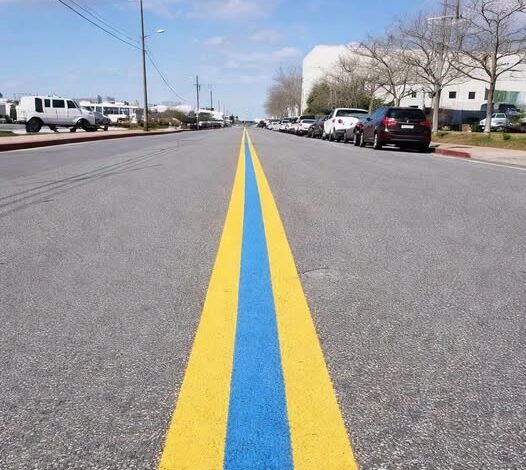
Most drivers will never think twice about the painted lines beneath their tires. They mark lanes, guide traffic, and quietly disappear into the background of everyday life. But in Ocean City, Maryland, one line has become something more than a traffic marker. Running through the streets in a distinctive shade of blue, it leads directly to the city’s police department while carrying a message that reaches beyond its practical purpose.
At first glance, it is simply a painted stripe woven between the familiar yellow center lines. Yet for many residents, it has become a visible expression of appreciation for the officers who serve their community every day. It is a reminder that behind every patrol car, every emergency call, and every overnight shift is a person who leaves home not knowing exactly what the next few hours may bring.
Mayor Rick Sheehan has described the blue line as both functional and symbolic.
On a practical level, it helps identify the route to the police station, making it easier for visitors, residents, and emergency responders to locate the department quickly when time matters. In a busy coastal community that welcomes large numbers of tourists throughout the year, clear wayfinding can serve a genuine public purpose.
But for many people, the symbolism has proven just as meaningful.
Supporters see the blue line as a quiet acknowledgment of the work officers perform, often outside public view. While many interactions between police and the community happen without incident or recognition, officers routinely respond to traffic collisions, domestic disputes, missing persons reports, medical emergencies, and situations where uncertainty is part of the job description. Each shift brings responsibilities that can change in an instant.
For families of law enforcement officers, that reality is deeply personal.
Every goodbye before a shift carries an unspoken hope that it will end with a safe return home. Every late-night phone call can bring a moment of anxiety before the voice on the other end is recognized. Those experiences rarely appear in headlines, but they shape the lives of countless spouses, children, parents, and friends who quietly share the burdens of public service.
The blue line has therefore become, for many residents, a visible expression of gratitude.
Rather than a grand monument or formal ceremony, it is something encountered in ordinary moments—during the morning commute, on the way to work, or while driving through town. Its simplicity is part of its message. Appreciation does not always require speeches or celebrations. Sometimes it is communicated through small gestures that remind people their work has not gone unnoticed.
At the same time, symbols such as the thin blue line have generated differing perspectives in various communities across the United States.
For many, the symbol represents respect for law enforcement officers and recognition of the risks they face while serving the public. Others have viewed it differently, particularly in the context of broader national debates surrounding policing and criminal justice. Those differing interpretations have led to conversations about how public symbols are understood and experienced by different members of the community.
In Ocean City, supporters of the roadway project emphasize its local purpose.
To them, it reflects appreciation for the officers who serve their town and reinforces the close relationship they believe exists between the police department and the community. They view the painted route not as a political statement, but as a practical guide paired with a gesture of civic recognition.
Whether similar projects appear elsewhere remains to be seen.
Every community has its own history, priorities, and conversations about how best to recognize public servants while fostering trust between law enforcement and the people they serve. What resonates strongly in one town may inspire different responses in another.
What is undeniable is that the blue line has sparked discussion about the often-overlooked people behind the badge. It invites residents to pause, if only for a moment, and consider the individuals who answer emergency calls at every hour of the day and night, often without knowing what awaits them when they arrive.
In the end, the painted stripe stretching through Ocean City is more than a guide to a building. For many who drive across it, it serves as a reminder that communities are strengthened not only by the work of those who serve, but also by the willingness of neighbors to recognize that service. Whether seen as a symbol of gratitude, a practical landmark, or both, the line quietly reflects a simple idea: appreciation is most meaningful when it becomes part of everyday life rather than something remembered only on special occasions.