At just five years old, Martha Mason’s childhood was shattered by a fever that seemed ordinary at first. Within days, her neck became painfully rigid, her throat burned with every breath, and the strength slowly drained from her small body. Before anyone could fully understand what was happening, she found herself lying beneath the bright lights of a hospital, staring at a ceiling she would come to know far too well. Around her echoed the steady rhythm of doctors’ footsteps and the relentless hiss of a massive steel machine that would soon become both her prison and her lifeline.
The diagnosis was polio.
In the early 1950s, those six letters carried unimaginable fear. Parents dreaded the disease that could strike healthy children without warning, leaving them paralyzed—or worse. For Martha, the virus attacked the muscles responsible for breathing, stealing something most people never think twice about. She could no longer draw air into her lungs on her own.
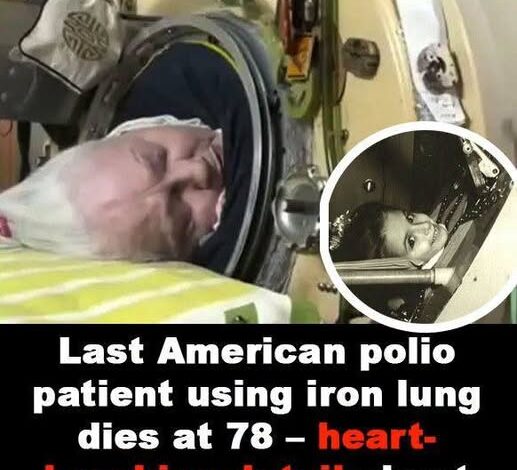
The only reason she survived was because doctors placed her inside an iron lung, a towering metal cylinder that surrounded nearly her entire body. Through carefully controlled changes in air pressure, the machine forced her chest to rise and fall, breathing for her every second of every day.
The prognosis was devastating.
Physicians quietly told her family that she was unlikely to survive beyond her twentieth birthday. Even if she did, they believed her future would be painfully limited. A normal education, meaningful work, independence, friendships, and love all seemed hopelessly out of reach.
Martha chose not to believe them.
She could have surrendered to bitterness. She could have accepted that the machine defined the boundaries of her life. Instead, she decided that while polio had taken her freedom of movement, it would not take her curiosity, her imagination, or her determination.
Learning became her first act of defiance.
Unable to attend school like other children, she refused to let her education end. Teachers adapted lessons so she could participate from her bedroom, communicating through an intercom system that connected her to the outside world. It was an unconventional classroom, but Martha approached every lesson with remarkable persistence, determined to prove that intelligence had nothing to do with physical mobility.
Her world may have been measured in the length of a steel cylinder, but her mind traveled wherever books could carry it.
As the years passed, she developed a deep love for writing. Poetry became a place where she could express emotions too complicated for ordinary conversation. Songs allowed her imagination to wander beyond hospital walls. She discovered that words possessed a freedom no illness could ever imprison.
Family, friends, and loyal caregivers surrounded her with compassion, but it was often the quiet companionship of her beloved beagles that filled the room with warmth. Their gentle presence brought laughter into days that might otherwise have been consumed by routines of medicine and machinery. They never saw the iron lung first. To them, Martha was simply the person they loved.
While the world outside changed at a breathtaking pace, life inside her room evolved more slowly.
Medical science advanced dramatically. The terrifying epidemics that had once emptied swimming pools and playgrounds faded into history after vaccines transformed public health. Massive iron lungs gradually disappeared from hospitals, replaced by compact ventilators that were quieter, lighter, and far more sophisticated.
Most patients transitioned to the newer technology without difficulty.
Martha tried.
Again and again, doctors tested modern ventilators, hoping they would finally replace the aging machine that had sustained her for decades. Every attempt ended the same way. Her body simply could not adapt. The newer equipment could not generate the precise breathing pattern her damaged lungs required.
The old iron lung, cumbersome and outdated as it seemed, remained the only machine capable of keeping her alive.
So while museums collected these enormous cylinders as relics of another era, Martha continued living inside one.
She became something no one had expected—a living bridge between modern medicine and one of America’s most frightening medical crises. Generations grew up without ever seeing an iron lung outside of history books, yet Martha reminded the world that polio was not ancient history for everyone. For her, it remained part of every hour, every breath, and every tomorrow.
Life inside the machine demanded extraordinary resilience.
Power outages became emergencies. Ice storms threatened more than inconvenience. Every mechanical failure carried terrifying consequences. Backup plans had to be rehearsed. Caregivers remained constantly vigilant because even a brief interruption could place her life at risk.
Still, she rarely allowed those dangers to overshadow her outlook.
Visitors often remembered her humor before they remembered the machine. Conversations drifted toward books, current events, family stories, and dreams rather than illness. Martha refused to let every interaction revolve around what she had lost. Instead, she focused on what remained possible.
That quiet optimism became one of her greatest achievements.
Then came another invisible enemy.
When the COVID-19 pandemic swept across the world, respiratory illness suddenly became everyone’s concern. For Martha, whose survival depended entirely on mechanical breathing assistance, the threat was especially frightening. A virus that attacked healthy lungs posed an even greater danger to someone whose lungs had already been devastated decades earlier.
Like millions of others, she faced the uncertainty with courage.
She had already spent a lifetime overcoming impossible odds. She understood isolation long before lockdowns existed. She knew perseverance before the rest of the world learned the word in daily headlines.
In the end, after seventy-eight remarkable years, her journey came to a close.
Her passing marked far more than the loss of one extraordinary woman. It represented the quiet end of an era that had shaped American history. The iron lung, once a haunting symbol of overflowing hospital wards and frightened families, had nearly vanished from public memory. With Martha’s death, the last person in the United States who depended on that iconic machine was gone.
Yet her legacy was never really about the iron lung.
It was about refusing to let a diagnosis dictate the value of a life. It was about proving that courage does not always appear in dramatic moments but often reveals itself in countless ordinary days lived with extraordinary determination. It was about finding purpose despite unimaginable limitations and discovering freedom where others saw only confinement.
Doctors believed she would never reach adulthood.
Instead, she spent nearly eight decades showing the world that life is measured not by the space we occupy, but by the strength with which we choose to live. When the steady rhythm of her iron lung finally fell silent, it closed the final chapter of America’s battle with polio—but the story of Martha Mason’s resilience will continue inspiring generations long after that sound has faded.