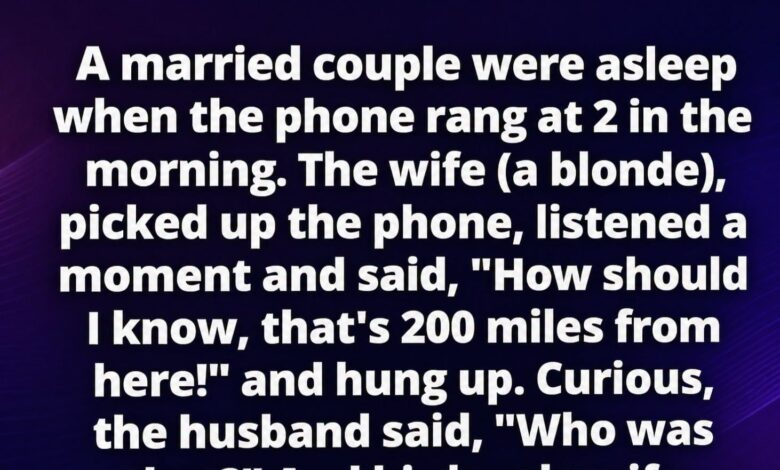
The telephone rang in the middle of the night.
Not a gentle chirp from a cellphone on a nightstand, but the sharp, mechanical ring of an old landline—the kind of sound designed to wake an entire house and convince everyone that something terrible had happened.
He opened one eye.
Darkness filled the bedroom except for the faint red glow of the clock.
2:17 a.m.
The phone rang again.
Beside him, his wife stirred beneath the blankets.
“Phone,” he mumbled.
She made a sound somewhere between a groan and a threat.
It rang a third time.
“You get it,” she whispered.
“It’s on your side.”
That settled the matter.
With the weary resentment of someone being personally betrayed by telecommunications technology, she pushed herself upright and reached toward the nightstand.
Her hair was everywhere.
She squinted into the darkness, fumbling past a glass of water before finally finding the receiver.
“Hello?”
Her voice was thick with sleep.
He closed his eyes again.
Maybe it was one of the children.
Maybe a relative had an emergency.
Maybe someone had dialed the wrong number.
At two in the morning, there weren’t many possibilities that began pleasantly.
For several seconds, his wife said nothing.
Then her posture changed.
She sat straighter.
“What?”
He opened his eyes.
Whatever sleep remained in her voice had disappeared.
She listened again.
Her expression shifted from confusion to irritation.
Then, suddenly, she exploded.
“How should I know? That’s 200 miles from here!”
She slammed the receiver down.
The crack echoed through the bedroom.
He stared at her.
She stared at the phone.
Silence returned.
The clock ticked.
Somewhere outside, a car passed along the distant road.
His wife dropped back against her pillow, yanked the blanket toward her shoulder, and closed her eyes as though the entire incident required no further discussion.
He waited.
Ten seconds.
Twenty.
His curiosity was now fully awake even if the rest of him wasn’t.
Finally, he turned toward her.
“Who was that?”
No answer.
“Honey?”
She opened one eye.
“What?”
“Who called?”
She sighed.
“Nobody.”
“Nobody called us at two seventeen in the morning?”
“Apparently.”
He pushed himself onto one elbow.
“What did they want?”
She rolled onto her back.
“I don’t know.”
“You just yelled that something was two hundred miles away.”
“I know.”
“What’s two hundred miles away?”
She looked at him.
For a moment, her expression was perfectly serious.
Then he noticed it.
A tiny movement at the corner of her mouth.
Not quite a smile.
But close.
He narrowed his eyes.
“What?”
She settled deeper into the pillow.
“Some weirdo.”
“What weirdo?”
“Some guy.”
“Okay. And what did some guy want?”
She paused.
Then, in the calmest voice imaginable, she said:
“He asked if the coast was clear.”
He stared at her.
Once.
Twice.
Then the meaning landed.
The nearest coast was roughly two hundred miles away.
He tried not to laugh.
He failed.
It began as a snort.
Then his shoulders started shaking.
“Oh, come on,” she muttered.
“You actually told him it was two hundred miles away?”
“What was I supposed to say?”
“He meant—”
“I know what he meant now.”
That made him laugh harder.
She turned toward him with mock indignation.
“I had been asleep.”
“Clearly.”
“Someone calls at two in the morning and asks me about the coast, I’m going to give him geographical information.”
He buried his face in the pillow.
She smacked his shoulder.
“It’s not that funny.”
It was.
And she knew it.
Within seconds, she was laughing too.
The absurdity of it filled the room.
Some mysterious caller—perhaps attempting to ask whether someone was nearby, perhaps trying to determine whether it was safe to speak—had chosen one of the oldest expressions imaginable.
Is the coast clear?
And instead of receiving the discreet answer he apparently expected, he had awakened a woman from a dead sleep and accidentally requested a midnight geography lesson.
There was something perfect about it.
No setup.
No carefully rehearsed punchline.
No comedian waiting for applause.
Just exhaustion, confusion, and one spectacularly literal answer.
Eventually their laughter faded.
He reached toward the clock.
“Two twenty-one.”
“Wonderful.”
“Think he’ll call back?”
“He’d better not.”
“What if he needs an update on coastal conditions?”
She gave him a look.
“Go to sleep.”
He lay back down.
For perhaps thirty seconds, neither spoke.
Then he whispered:
“Two hundred miles.”
She kicked him beneath the blanket.
“Stop.”
He started laughing again.
Years later, that was the part of the story he always remembered most clearly.
Not who the caller might have been.
They never found out.
Not why he had called their number.
That remained a mystery too.
What stayed with him was the sight of his wife sitting upright in the darkness, hair tangled, barely awake, delivering that furious answer with absolute confidence.
“How should I know? That’s 200 miles from here!”
It became one of those family stories that improved every time it was told.
At dinners, someone would mention strange phone calls.
He would glance toward his wife.
She would immediately know what was coming.
“Don’t.”
“Did I ever tell you about the night someone called our house—”
“Oh, for heaven’s sake.”
“—and asked my wife if the coast was clear?”
Everyone would look confused.
Then interested.
She would fold her arms.
“I was half asleep.”
He would continue anyway.
“And she tells the guy, ‘How should I know? That’s two hundred miles from here!'”
Laughter.
Every time.
And every time, she would protest.
“He woke me up!”
As though that made it less funny.
It made it better.
Because the humor wasn’t really about someone misunderstanding an expression.
It was about how quickly an ordinary moment can become unforgettable when life accidentally writes the punchline for you.
There was another reason the story endured.
His wife never allowed herself to become the fool in it.
She owned the joke.
She told it herself.
Sometimes she even delivered the ending better than he did.
When people teased her for taking the question literally, she’d shrug.
“Well, if you’re going to call strangers in the middle of the night asking about the coast, you deserve whatever answer you get.”
And that usually earned the biggest laugh.
Because she was right.
The unknown caller had created the situation.
He had interrupted two sleeping people with a cryptic question and apparently expected immediate cooperation.
Instead, he received an irritated woman who, for one glorious moment, treated an idiom as a request for navigation.
Maybe he hung up confused.
Maybe embarrassed.
Maybe laughing.
Nobody knew.
But the couple never forgot him.
Or rather, they never forgot what his question gave them.
A story.
One of those ridiculous little memories that somehow survives longer than important conversations.
Years can erase entire weeks from memory. Birthdays blur together. Vacations become photographs whose details require explanation. Arguments that once felt enormous eventually disappear completely.
But sometimes you remember a telephone ringing at 2:17 in the morning.
You remember your wife’s messy hair.
You remember the red numbers glowing on the clock.
You remember the receiver slamming down.
And you remember lying in the darkness trying desperately not to laugh.
That’s the strange generosity of ordinary life.
It rarely announces which moments will become precious.
Sometimes memory chooses weddings and births.
Sometimes it chooses milestones.
And sometimes it chooses a sleepy woman answering a ridiculous question from a stranger.
The caller wanted to know whether the coast was clear.
He never got the answer he wanted.
But he gave two people a punchline they would carry for years.
And somewhere two hundred miles away, the coast remained exactly where it had always been.