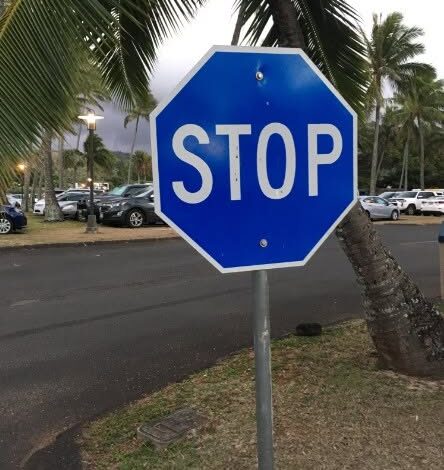
At first glance, it looks like a mistake.
A stop sign… but blue.
Most drivers have spent their entire lives recognizing one simple rule: stop signs are red. That color is so deeply embedded in our minds that seeing a blue version can feel confusing, almost as if someone printed the wrong sign.
But that unusual color is more than a curiosity.
It raises an important question about how we respond when the world doesn’t look exactly the way we expect.
Do we trust the rules we’ve memorized?
Or do we trust our judgment?
The answer could matter far more than many people realize.
Why Stop Signs Are Red
The familiar red stop sign isn’t just a tradition.
Its design is established through the Manual on Uniform Traffic Control Devices (MUTCD), the federal standard that governs traffic signs on public roads throughout the United States.
The octagonal shape.
The white border.
The bold white letters.
And, most importantly, the red background.
Together, these elements create one of the most recognizable road signs in the world.
Drivers don’t have to stop and think about what it means.
They know instantly.
Red has long been associated with danger, urgency, and commands requiring immediate attention. It naturally captures the eye and signals that action is required.
That consistency is one reason traffic systems work so effectively.
When every driver recognizes the same visual language, roads become safer for everyone.
So Why Are Some Stop Signs Blue?
The answer is surprisingly simple.
Blue stop signs are almost never installed on public roads.
Instead, they are commonly found on private property.
Business parking lots.
Apartment complexes.
Industrial facilities.
Private neighborhoods.
School campuses.
Corporate offices.
Large warehouses.
These locations often need traffic control, even though they don’t fall under the same regulations that govern public streets.
Because private property owners have greater flexibility, they sometimes choose blue signs that match company branding or distinguish their roads from nearby public streets.
The result is a sign that looks familiar—but isn’t officially recognized as a government traffic control device.
Does That Mean You Can Ignore It?
Technically, a blue stop sign usually doesn’t carry the same legal authority as an official red stop sign installed on a public roadway.
But that doesn’t mean it should be ignored.
Quite the opposite.
Private property owners establish traffic rules to protect drivers, pedestrians, employees, customers, and visitors.
A parking lot filled with vehicles backing out of spaces can be just as dangerous as a city intersection.
A distribution center with forklifts and delivery trucks requires careful traffic management.
A residential community with children playing nearby depends on drivers moving slowly and cautiously.
The blue sign may not be backed by the same traffic laws.
But the risks are still real.
Safety Doesn’t Depend on Color
Imagine approaching a blue stop sign inside a crowded shopping center parking lot.
You decide not to stop because you know it isn’t an “official” stop sign.
At that exact moment, another driver enters the intersection believing everyone will stop.
A collision follows.
Even if the sign itself isn’t enforceable under public traffic laws, insurance companies, property owners, and civil courts may still consider whether you acted reasonably.
Choosing not to stop simply because the sign was blue is unlikely to erase responsibility if someone is injured.
The safest decision remains the simplest one.
Stop.
It takes only a few seconds.
Those seconds may prevent an accident that changes lives forever.
The Psychology Behind the Confusion
Blue stop signs are interesting because they challenge automatic thinking.
Most drivers rely heavily on pattern recognition.
We don’t consciously analyze every traffic sign we encounter.
We recognize familiar shapes and colors almost instantly.
That’s why the blue version feels so unusual.
Our brains immediately notice that something doesn’t match the pattern we’ve learned.
For a brief moment, uncertainty replaces instinct.
That hesitation highlights just how powerful visual consistency is in everyday life.
When familiar signals change, even slightly, people pause.
Sometimes that’s exactly what private property owners hope to achieve.
A driver who notices an unusual sign is often more alert than one operating entirely on autopilot.
Private Property Has Its Own Rules
Many people assume traffic laws apply exactly the same way everywhere.
In reality, private property often operates differently.
Shopping centers establish parking rules.
Hospitals designate emergency access lanes.
Universities control campus traffic.
Factories regulate vehicle movement inside secure facilities.
While local laws still apply in many situations, property owners also create additional rules designed to improve safety within their own spaces.
Blue stop signs are one example of that flexibility.
They aren’t intended to replace official traffic signs on public roads.
Instead, they help organize movement where public traffic regulations don’t always reach.
When in Doubt, Choose Caution
One of the simplest driving principles has nothing to do with colors or regulations.
When you’re uncertain, slow down.
Pause.
Look carefully.
Proceed only when it’s safe.
That approach protects everyone—regardless of whether the sign is red, blue, or something you’ve never seen before.
Defensive driving isn’t about winning arguments over technicalities.
It’s about preventing accidents before they happen.
Sometimes the safest decision is also the easiest one.
The Bigger Lesson
The blue stop sign reminds us that not every important rule comes from a law book.
Some exist because experience has shown they keep people safe.
Whether a sign carries official legal authority or simply reflects the wishes of a property owner, the purpose is often the same: reducing unnecessary risk.
Ignoring that purpose because of an unusual color can have consequences far beyond receiving a traffic citation.
It can affect lives.
Final Thoughts
The next time you encounter a blue stop sign, don’t assume it has no meaning.
While it may not be an official traffic control device recognized on public roads, it still serves an important function where it’s installed.
Private businesses, residential communities, schools, and industrial facilities use these signs to guide traffic and help prevent accidents.
Ultimately, safe driving isn’t determined by the exact shade of a sign.
It’s determined by the choices drivers make when they approach it.
When uncertainty appears, caution is almost always the better decision.
Because at the end of the day, colors may define a sign’s legal status.
But your actions determine whether everyone arrives safely.