What began as an ordinary Saturday at the children’s museum became the day one quiet little girl found a way to ask for help without saying a single word.
The museum buzzed with excitement from the moment the doors opened.
Children darted between interactive exhibits, parents snapped photos beside colorful displays, and volunteers guided families through hands-on science experiments, art stations, and climbing structures. Everywhere Marcus Vance looked, there were smiling faces and endless energy.
As head of museum security, he had watched thousands of families pass through those doors.
Most visits blended together.
This one never would.
Marcus had spent nearly twenty years in law enforcement before accepting the quieter position at the museum. Old habits never disappeared completely. Even in a place built for learning and fun, he naturally noticed details most people overlooked.
That afternoon, one child immediately caught his attention.
She couldn’t have been older than seven.
While other children laughed, climbed, and explored every exhibit they could find, she stayed close to the walls, speaking only when absolutely necessary.
Her name, according to the visitor wristband, was Maya.
She barely smiled.
She flinched whenever adults spoke loudly.
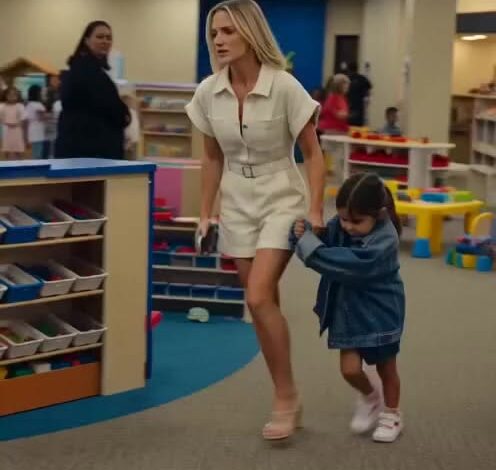
Most noticeably, despite the summer heat outside, she wore a heavy denim jacket zipped almost completely to her neck.
Marcus didn’t assume anything.
Children have favorite clothes.
Some dislike crowds.
Some are naturally shy.
Still, he quietly kept an eye on her while continuing his normal rounds.
A short while later, he noticed Maya stumble while stepping off a small platform inside one of the exhibits.
She quickly caught herself.
As she did, her sleeve slipped upward.
For only a second.
It was enough.
Marcus noticed dark bruises around her wrist.
Not one bruise.
Several.
His expression remained calm as he approached.
“Hey there,” he said gently.
“Are you okay?”
Before Maya could answer, a woman hurried over.
“She’s fine.”
The woman smiled politely.
“I’m Veronica.”
“My daughter is just clumsy.”
Marcus nodded politely.
“Good to hear.”
Veronica laughed lightly.
“And she refuses to take off that jacket, no matter how hot it gets.”
The explanation sounded reasonable.
Maybe it was true.
Still…
Something continued bothering him.
Years of experience had taught him that no single detail proves anything.
But several small details together sometimes tell a different story.
As the afternoon continued, Marcus saw Maya again.
This time she sat alone inside the museum’s giant alphabet block area.
Children normally built castles or towers there.
Maya wasn’t building either.
Instead, she carefully searched through dozens of oversized wooden letters.
She ignored every colorful block except those she seemed to need.
One by one, she placed them on the floor.
Marcus slowed his pace.
From across the room he quietly watched.
After several minutes, the blocks formed three simple words.
HELP ME PLEASE.
His heart skipped.
Before he could reach her, three younger children charged into the play area.
Laughing loudly, they accidentally knocked the blocks apart.
Letters scattered in every direction.
The message disappeared.
Marcus hurried over.
By then Maya had already begun collecting blocks again.
Instead of rebuilding in the open, she crawled beneath a low display shelf where fewer people would notice.
Once again she arranged the letters carefully.
This time the message was longer.
SHE HURTS ME.
Marcus felt the hairs on the back of his neck stand up.
He stayed where he was.
He didn’t want to frighten her.
Slowly, Maya looked up.
Their eyes met.
Without speaking, she nodded once.
Then she reached for more blocks.
A third message appeared.
NOT MY MOM.
Marcus immediately radioed the museum supervisor.
“I need you in the discovery room.”
His voice remained calm.
“But come now.”
Just then Veronica appeared around the corner.
“There you are.”
She smiled toward Maya.
“Time to go.”
Maya quietly stood.
Before leaving, she quickly grabbed several more blocks.
Working faster than Marcus thought possible, she arranged one final sequence.
Not words this time.
Numbers.
Then letters.
An address.
Seconds later Veronica took Maya’s hand and walked toward the exit.
Marcus memorized the address before calling local authorities.
He explained everything.
The bruises.
The behavior.
The block messages.
The address.
Police arrived within minutes.
Rather than making immediate accusations, detectives opened a child welfare investigation based on Marcus’s observations.
Museum supervisors also came forward with something unexpected.
Earlier in the afternoon, one employee had noticed Maya’s unusual block arrangements and snapped several photographs simply because they seemed creative.
Those pictures still existed.
Each image contained an automatic timestamp.
Together they documented every message exactly as Marcus had described.
The photographs became valuable evidence establishing the sequence of events before law enforcement became involved.
Later that evening, investigators visited the address Maya had arranged with the blocks.
The investigation expanded quickly.
Authorities interviewed neighbors, examined living conditions, reviewed medical records, and spoke with multiple adults connected to the child.
As more information emerged, child protection officials became involved alongside detectives.
Maya was placed under temporary protective care while professionals conducted a thorough evaluation.
The case eventually reached family court.
Marcus testified about everything he had observed inside the museum.
He didn’t claim certainty.
He simply explained what he saw.
The bruises.
The unusual behavior.
The messages.
The photographs.
The judge reviewed witness testimony alongside medical evaluations and documentation gathered during the investigation.
Temporary protective measures remained in place while authorities completed their work.
Months later, Marcus hardly recognized Maya when she returned to the museum.
This time she ran through the front doors with the excitement every child should have.
She laughed with other children.
She climbed every exhibit.
She smiled constantly.
Near the end of the visit she walked over to Marcus.
Without saying much, she placed a single wooden alphabet block into his hand.
The letter printed on it was “M.”
“For Marcus,” she whispered.
“And for Maya.”
Marcus smiled.
“I’ll keep it forever.”
She hugged him quickly before running back to join the other children.
That small block remained on Marcus’s desk long after the case was over.
Not because it reminded him of a difficult investigation.
But because it reminded him that children don’t always ask for help with words.
Sometimes they draw.
Sometimes they play.
Sometimes they arrange toy blocks on a museum floor.
Adults may not always understand those messages immediately.
But taking the time to notice them can change a child’s future forever.
The experience reinforced something Marcus had learned throughout his career.
Protecting children rarely begins with dramatic rescues.
More often, it begins with paying attention.
With listening.
With refusing to ignore small signs simply because they seem easy to explain away.
Every situation deserves careful, professional evaluation.
And sometimes, the smallest voice in the room finds the most remarkable way to be heard.