Robert De Niro’s savage four-word message for Trump – amid the president’s threat to have him deported

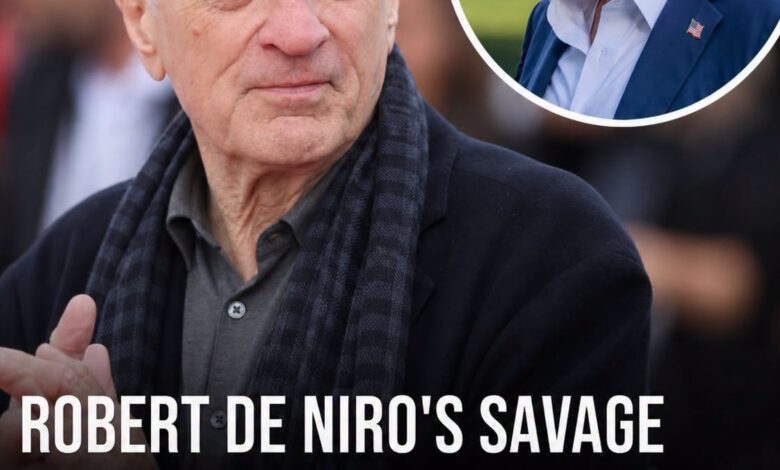
Robert De Niro and Donald Trump have been insulting each other for years.
On the surface, the feud can look almost absurdly simple.
One of America’s most famous actors despises one of America’s most polarizing political figures.
Trump responds in kind.
Another speech.
Another insult.
Another headline.
But the argument has grown larger than either man.
It has become a struggle over something far more emotional:
Who gets to define America?
De Niro does not speak about Trump as though he is merely another politician with bad policies.
His language is more personal than that.
He speaks like someone who believes something fundamental has been violated.
The America he invokes is not simply a government.
It is an idea.
A constitutional order.
A belief that power should be restrained.
That elections matter.
That institutions matter.
That no individual should become larger than the rules governing everyone else.
When De Niro talks about wanting to “take our country back” or wanting to feel able to love the country without fear for what it is becoming, the language sounds remarkably similar to language used across the political spectrum.
That is part of what makes the clash so revealing.
Both sides believe something has been taken.
They disagree completely about what.
Trump’s movement has long argued that American institutions were captured by elites who stopped listening to ordinary citizens.
From that perspective, the media is hostile.
Federal agencies are politicized.
Cultural institutions are contemptuous.
Washington protects itself.
The country needs disruption because normal politics no longer produces normal accountability.
De Niro looks at much of that same disruption and sees danger.
Where Trump’s supporters may see a man willing to break a corrupted system, De Niro sees a man willing to break democratic norms because those norms limit him.
That difference cannot be solved by exchanging more insults.
It begins with competing definitions of the crisis itself.
For De Niro, the threat comes from concentrated political power, contempt for democratic restraints, and the normalization of behavior he believes would once have disqualified a national leader.
For Trump and his supporters, the threat often comes from entrenched institutions that they believe wield enormous power while claiming neutrality.
Both stories begin with distrust.
They simply point distrust in opposite directions.
That is why the feud feels so combustible.
De Niro is not arguing:
“I prefer another tax policy.”
He is arguing from fear.
Trump is not responding:
“I respectfully disagree.”
He responds from combat.
His political language has always been built around opponents.
Enemies.
Losers.
Crooked figures.
Corrupt institutions.
People trying to destroy him.
People trying to destroy the country.
The distinction between criticism and hostility becomes very thin.
So when a celebrity as famous as De Niro publicly attacks him, Trump does not treat it as ordinary dissent.
He treats the critic as part of the opposition ecosystem.
That response is politically effective with supporters who already believe the cultural establishment despises them.
Hollywood has symbolic value in populist politics.
It represents money.
Status.
Progressive culture.
Media influence.
People who can lecture the public while living very differently from the public.
De Niro may see himself as a citizen using his voice.
Some Trump supporters see an enormously privileged celebrity telling millions of ordinary voters that their political choice is morally unacceptable.
Those interpretations collide before either man even begins speaking.
This is one reason celebrity political activism produces such intense reactions.
Fame gives artists enormous reach.
It does not automatically give them political authority.
De Niro has every right to criticize a president, former president, candidate, party, or political movement.
So does every citizen.
But audiences are also free to ask why an actor’s opinion should carry more political weight than anyone else’s.
The answer may simply be:
It shouldn’t.
His fame makes the microphone louder.
Not the argument automatically better.
That distinction matters because political culture increasingly confuses visibility with expertise.
A famous actor can make a thoughtful constitutional argument.
A famous actor can also make a poor political argument.
The profession does not settle the matter.
Evaluate the claim.
Not the celebrity.
The same principle applies to Trump.
Political office, electoral success, or an enormous following does not make every accusation accurate.
Power amplifies speech.
It does not certify it.
That is why the personal insults on both sides can become distractions.
They attract attention precisely because insults are easier to process than institutional questions.
Call someone stupid.
Call someone evil.
Call someone deranged.
Now nobody has to spend ten minutes discussing executive power.
Or judicial independence.
Or prosecutorial discretion.
Or immigration.
Or election administration.
Or the proper relationship between a president and the bureaucracy.
Personal conflict turns constitutional disagreement into entertainment.
And entertainment is something both De Niro and Trump understand exceptionally well.
One built a career performing characters.
The other built much of his public identity through branding, television, spectacle, and political rallies.
Both know that attention has rhythm.
A memorable line wins the clip.
Nuance rarely does.
The result is an argument in which millions of Americans feel something emotionally true even when the words become excessive.
De Niro’s supporters hear him expressing fear they share.
They believe Trump represents a genuine threat to democratic institutions, norms, and political decency.
His anger feels proportionate because their fear is proportionate.
Trump’s supporters hear De Niro and see another establishment figure sneering at a movement that millions of voters chose freely.
To them, the outrage proves the very elitism Trump promised to confront.
Each side interprets the other’s anger as evidence.
That creates a dangerous feedback loop.
De Niro attacks Trump harshly.
Trump supporters say:
“See how much the establishment hates us.”
Trump attacks critics harshly.
De Niro’s side says:
“See how intolerant he is of dissent.”
Each reaction strengthens the story the other side already believed.
Eventually, conversation becomes almost impossible because every criticism confirms the opposing worldview.
This is how political conflict turns tribal.
The question stops being:
Is this particular claim correct?
It becomes:
Whose side are you on?
That is a much more dangerous question for a democracy.
Democracy depends on opponents accepting each other’s legitimacy even while believing the other side is wrong.
You can think someone’s tax plan is disastrous.
You can believe their immigration policy is cruel.
You can believe their foreign policy is reckless.
You can think they should lose every election they contest.
But if you begin believing the people who support them do not belong in the country, politics changes character.
Opponents become contaminants.
Dissent becomes betrayal.
Elections become existential.
Losing becomes almost impossible to accept.
This is where rhetoric about people needing to “leave” the country becomes especially corrosive.
America has never required agreement as the price of citizenship.
Its entire political system assumes disagreement.
That is what elections are for.
That is what opposition parties are for.
That is what newspapers, protests, speeches, lawsuits, and legislative fights are for.
A person can despise a president and remain patriotic.
A person can support a controversial political movement and remain American.
Patriotism is not permanent applause for whoever currently holds power.
If it were, democracy would become obedience.
That is why De Niro’s invocation of the Constitution matters.
He is grounding patriotism in institutions rather than personality.
His basic claim is that loving America can require opposing a leader you believe threatens its rules.
That idea is not inherently partisan.
Conservatives have used it.
Liberals have used it.
Dissidents throughout American history have used it.
But there is another side to constitutional patriotism.
If democracy means anything, citizens also have to respect the political agency of people whose votes they dislike.
Millions of Americans did not support Trump because Robert De Niro failed to explain democracy clearly enough.
They made political judgments based on their own experiences, priorities, fears, beliefs, and sometimes grievances.
Calling those voters stupid, hateful, brainwashed, or illegitimate may feel emotionally satisfying.
Politically, it can deepen the exact alienation that fueled Trump’s rise.
That doesn’t mean every grievance deserves endorsement.
Some beliefs are false.
Some political rhetoric is discriminatory.
Some conduct deserves condemnation.
But understanding why people vote a certain way is not the same as approving of their choice.
Democracy requires curiosity about opponents precisely because they do not disappear when insulted.
This is where De Niro’s anger, however sincere, risks becoming counterproductive.
If the goal is persuading people who are uncertain about Trump, moral fury may help some and alienate others.
People rarely enjoy being told they are complicit in destroying their country.
Even if you believe that accusation is true, persuasion requires understanding how the listener will hear it.
Trump has mastered the opposite strategy.
He converts criticism of himself into criticism of his supporters.
Attack me, and you’re attacking them.
Prosecute me, and you’re persecuting them.
Mock me, and you’re mocking them.
That identification is politically powerful.
It explains why attacks from Hollywood figures can sometimes strengthen rather than weaken him.
His supporters do not necessarily hear:
“Robert De Niro condemns Donald Trump.”
They may hear:
“People like Robert De Niro despise people like us.”
Once politics reaches that emotional level, facts become difficult to separate from identity.
This is why the argument over “taking the country back” is so fascinating.
Back from whom?
De Niro might answer:
From a political movement he believes threatens constitutional norms.
Trump might answer:
From elites who betrayed ordinary Americans.
Progressives might answer:
From corporations and billionaires.
Conservatives might answer:
From bureaucracies and cultural institutions.
Almost every political movement claims at some point that the country has been stolen.
The phrase works because belonging is one of the strongest human emotions.
Nobody wants to believe they are a guest in their own nation.
So politicians and activists repeatedly frame elections as restoration.
Return.
Recovery.
Reclamation.
But a country cannot permanently belong to only the people who win.
That is the difficult democratic truth both sides are tempted to forget.
America belongs to people who hate Trump.
It belongs to people who love him.
It belongs to immigrants who became citizens yesterday and families who have lived there for generations.
It belongs to people who kneel during an anthem and people who consider that act offensive.
It belongs to people who distrust government and people who work for it.
A constitutional democracy survives not because everyone agrees on what America means.
It survives because people continue sharing it while arguing.
That is far less emotionally satisfying than “take our country back.”
Sharing requires tolerating the presence of people whose vision may occasionally prevail over yours.
It means losing elections.
Winning others.
Watching policies you hate become law.
Challenging them through lawful institutions.
Organizing.
Voting.
Persuading.
Then trying again.
The alternative is politics as permanent emergency.
Every election becomes “the last chance.”
Every opponent becomes an existential threat.
Every loss becomes proof the system is illegitimate.
Eventually, people begin asking why democratic restraint should matter when everything supposedly hangs in the balance.
That is when rhetoric stops being merely rhetoric.
De Niro’s concern about democratic norms deserves serious consideration.
So does the distrust fueling Trump’s support.
Ignoring either half of the equation guarantees misunderstanding.
Trump did not create every grievance that produced his movement.
De Niro did not create every fear surrounding Trump.
Both are expressions of deeper fractures.
Economic.
Cultural.
Institutional.
Geographic.
Generational.
Informational.
Americans increasingly inhabit different realities.
They consume different media.
Trust different authorities.
Interpret the same event through incompatible frameworks.
One side sees prosecution.
The other sees persecution.
One sees protest.
The other sees disorder.
One sees necessary institutional restraint.
The other sees an unelected establishment sabotaging voters.
Once common facts disappear, political debate becomes almost impossible.
That may be the real story behind the De Niro-Trump feud.
Not two famous men yelling across America’s political divide.
Two famous men demonstrating how wide the divide has become.
De Niro looks at Trump and sees the possible destruction of the America he loves.
Trump looks at critics like De Niro and sees members of an establishment that wants to take power away from the people who support him.
Both narratives say:
They’re taking your country.
And millions listen.
Perhaps the healthier question is not:
Who gets to take America back?
It is:
How do Americans keep sharing a country when they disagree this deeply about what threatens it?
There is no celebrity quote capable of answering that.
No rally insult.
No viral clip.
The answer requires slower work.
Institutions that deserve trust.
Elections people believe are administered fairly.
Government that produces visible results.
Media willing to distinguish reporting from tribal entertainment.
Politicians willing to tell supporters uncomfortable truths.
Citizens capable of criticizing opponents without denying their citizenship.
And a public willing to recognize that outrage is not the same thing as argument.
None of that means becoming indifferent.
There are moments when democracy requires anger.
Corruption should provoke anger.
Abuses of power should.
Violence should.
Attempts to undermine lawful political processes should.
But anger becomes politically useful only when it clarifies what must be protected.
Otherwise, it simply creates more heat.
De Niro’s strongest argument is therefore not that Trump is personally offensive.
Millions already know his personality.
Some dislike it.
Some enjoy it.
Some tolerate it because they care about other issues.
The deeper argument must concern institutions, conduct, policies, and consequences.
Likewise, Trump’s strongest answer cannot simply be that De Niro is a washed-up celebrity or another hostile liberal.
If the criticism is wrong, answer the substance.
What powers should presidents have?
How should political opponents be treated?
What limits should constrain executive authority?
What does loyalty to the Constitution require?
Those are questions worthy of a country.
Personal insults are much easier.
That is why we get so many of them.
Years from now, nobody may remember every exchange between Robert De Niro and Donald Trump.
The specific insults will blur.
The clips will become artifacts of another political era.
But the conflict they represented may remain important.
Two visions of patriotism.
Two definitions of betrayal.
Two groups of Americans convinced the other side is endangering the nation.
That is larger than either man’s personality.
And it carries a warning.
The moment a political movement decides that only its supporters truly love the country, everyone else becomes suspect.
The moment dissent automatically equals disloyalty, democracy begins losing the disagreement it needs in order to function.
De Niro has every right to stand before cameras and say he fears Donald Trump.
Trump has every right to answer him.
Citizens have every right to reject either man’s argument.
That freedom is not evidence America has failed.
It is evidence of the system De Niro says he wants to protect and Trump says he wants to restore.
The challenge is remembering that system belongs to opponents too.
Perhaps the most patriotic sentence available in a deeply divided country is therefore not:
“Take America back.”
It is something harder.
“America is ours together, even when I think you’re profoundly wrong.”
That sentence will never produce the same applause.
It offers no villain.
No clean victory.
No satisfying exile for the other side.
But democracies are not built for emotional satisfaction.
They are built to prevent political disagreement from becoming political ownership.
Robert De Niro and Donald Trump can keep fighting over what America means.
So can everyone else.
The danger begins when either side decides the argument is over because the people on the other side no longer count as Americans.
That is the line worth watching.
Not the insult.
Not the celebrity feud.
The line between disagreement and exclusion.
Because America has survived furious political fights before.
What it cannot safely become is a country where everyone is trying to save democracy by imagining half the electorate outside of it.