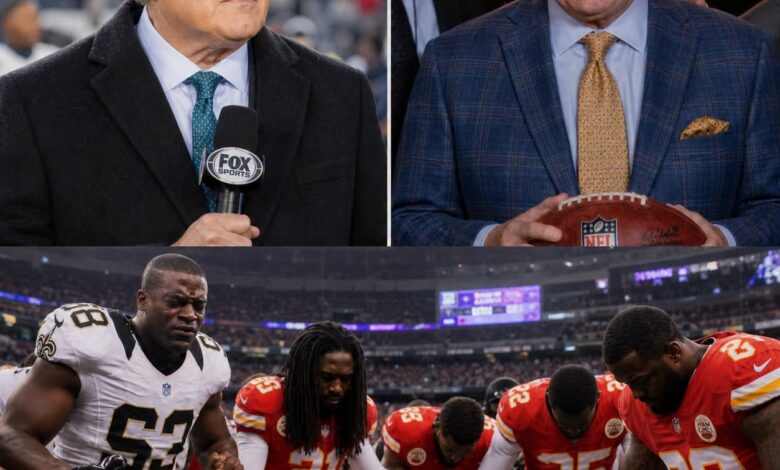
For decades, Terry Bradshaw knew exactly what people expected when the cameras turned toward him.
A grin.
A joke.
A little chaos.
Maybe a story that made his fellow broadcasters shake their heads before everyone started laughing.
It was the personality America had come to know long after the final whistle of his football career.
The quarterback who once stood beneath the brightest lights in professional football had transformed himself into something different: an entertainer who seemed incapable of taking himself too seriously.
Then his body gave him something he couldn’t laugh away.
Cancer.
Not once.
Twice.
And suddenly the man whose public identity had been built around strength, noise, and humor found himself living through an intensely private struggle.
The first diagnosis came after doctors discovered bladder cancer.
For Bradshaw, it meant entering a world where championships and television ratings carried no authority.
Hospital corridors do not care about Super Bowl rings.
Cancer cells do not care how famous the patient is.
In an examination room, Terry Bradshaw became what millions of other people have become before him:
A patient waiting for someone in a white coat to explain what happens next.
That shift alone can be frightening.
Athletes spend their careers learning to trust their bodies.
They train them.
Push them.
Punish them.
Recover.
Go again.
Pain becomes information.
Fatigue becomes something to negotiate with.
In football especially, toughness is often measured by how successfully someone can ignore what hurts.
Cancer does not play by those rules.
You cannot intimidate it.
You cannot throw through it.
You cannot study film and discover its defensive weakness.
The body that once felt like equipment suddenly becomes uncertain territory.
Bradshaw underwent treatment.
And eventually, there was reason for relief.
But relief after cancer is complicated.
The outside world hears words like “treated” and imagines a finish line.
Patients often discover something less clean.
Follow-up appointments.
Scans.
Blood tests.
Waiting rooms.
The strange anxiety that can arrive before results.
Every unfamiliar sensation can suddenly acquire significance.
A pain that once would have been ignored becomes a question.
A lump becomes a possibility.
The future starts arriving in smaller increments.
Then came another diagnosis.
This time, it was Merkel cell carcinoma.
A rare and aggressive form of skin cancer.
The cancer appeared in his neck.
Imagine the emotional whiplash.
You have already faced the word once.
Already gone through treatment.
Already allowed yourself to believe that perhaps the frightening chapter is closing.
Then another doctor gives you another diagnosis.
Another cancer.
Another set of questions.
Another moment when the future becomes uncertain.
For Bradshaw, surgery became part of the answer.
But something else happened during this period that revealed just how strange public life can become when illness enters it.
He kept working.
Millions of viewers saw him on television without knowing the full story unfolding away from the studio.
They saw the familiar Bradshaw.
The football analyst.
The entertainer.
The man making jokes with his colleagues.
What they did not see were the private medical conversations.
The incisions.
The recovery.
The uncertainty.
The moments when laughter ended because there were no cameras left to entertain.
That contrast is one of the most unsettling parts of celebrity.
Audiences see continuity.
The person appears on Sunday.
Therefore everything must be normal.
But a television appearance is only a few hours carved out of an entire human life.
Someone can smile while frightened.
They can perform while recovering.
They can make other people laugh while privately waiting for medical results.
Bradshaw understood performance better than most.
He had been performing under pressure since his playing days.
But this was different.
Football pressure had rules.
A clock.
A scoreboard.
An opponent.
Cancer offered none of those comforts.
At first, Bradshaw did not make his diagnoses a major public story.
That choice deserves consideration.
Famous people live inside an unusual expectation.
The public often assumes that because someone has shared parts of their life, the rest should also be available.
Illness exposes the absurdity of that expectation.
A diagnosis belongs first to the person receiving it.
Before it becomes an inspirational story, a headline, a television segment, or a social-media discussion, it is somebody’s private fear.
Bradshaw needed time to live inside that reality before explaining it to strangers.
Eventually, however, viewers noticed something.
During a television appearance, he appeared to struggle physically.
The reaction came quickly.
People speculated.
Some worried.
Others made assumptions about his health.
Bradshaw decided to explain.
And when he did, the familiar jokes temporarily gave way to something much more vulnerable.
He told people that he had been diagnosed with bladder cancer.
He explained that he had received treatment.
Then he revealed the second diagnosis.
Merkel cell carcinoma.
Another cancer.
Another treatment.
Suddenly, moments viewers had interpreted from the outside had context.
Bradshaw had not simply been getting older on television.
He had been recovering.
The body audiences were casually evaluating had been through something they knew nothing about.
There is an important lesson in that.
People are extraordinarily confident when interpreting visible weakness.
Someone looks tired.
They must be unhealthy.
Someone gains weight.
Someone loses weight.
Their speech sounds different.
Their movement changes.
Something must be wrong.
Sometimes something is wrong.
But observers rarely possess enough information to know what.
Bradshaw’s disclosure reminded viewers that behind a public appearance can be a medical history nobody is entitled to guess.
When he finally discussed the cancers, he didn’t present himself as invincible.
That may have been the most striking part.
This was Terry Bradshaw.
A Hall of Fame quarterback.
A man associated with one of the most physically punishing eras of professional football.
He had spent his life in a culture where toughness was often synonymous with silence.
You got hit.
You stood up.
You returned to the huddle.
You didn’t advertise fear.
Yet cancer required a different vocabulary.
Fear was real.
Uncertainty was real.
Gratitude was real.
Faith was real.
Bradshaw spoke about people praying for him.
He thanked those who had supported him.
There was no need to pretend the experience had been easy.
That honesty quietly redefined toughness.
Because toughness is not always refusing to admit something hurts.
Sometimes toughness is admitting exactly how frightening something is and continuing anyway.
That distinction matters far beyond football.
Men, particularly older generations of men raised around traditional ideas of masculinity, can feel enormous pressure to minimize illness.
Don’t complain.
Don’t worry the family.
Don’t look weak.
Keep working.
Handle it.
But serious illness does not become less serious because someone refuses to name it.
In some cases, silence can even delay the conversations and medical attention that matter most.
Bradshaw’s willingness to discuss his diagnoses therefore carried significance beyond celebrity news.
Here was a man whose entire public mythology had been constructed around physical strength acknowledging that his body had frightened him.
And nothing about that confession made him weaker.
If anything, it made the old definition of strength look incomplete.
The football version of courage is easy to recognize.
The quarterback stands in the pocket while defenders charge toward him.
He knows the hit is coming.
He throws anyway.
Medical courage is quieter.
It can look like entering a doctor’s office.
Signing a surgical consent form.
Waiting for pathology results.
Allowing someone you love to see that you are scared.
Returning for another scan when every instinct wants to avoid discovering what it might show.
There is no cheering crowd for most of those moments.
No scoreboard announces that you made it through another appointment.
No trophy appears when the doctor gives you encouraging news.
You simply go home.
Then you keep living.
Bradshaw did.
He returned to the studio.
The familiar laughter returned too.
But after the disclosure, viewers could see something else behind it.
History.
Scars.
The knowledge that the person laughing had recently been forced to consider possibilities much darker than the next football score.
That did not make every television appearance a victory parade.
Nor should it.
One of the strangest burdens placed on cancer survivors is the expectation that they transform illness into inspiration.
They are supposed to emerge wiser.
Stronger.
More grateful.
Almost heroic.
Real recovery can be far messier.
A person can be thankful and frightened at the same time.
They can receive encouraging news and still worry before the next appointment.
They can return to work without feeling that the experience has disappeared.
Survival is not necessarily the erasure of fear.
Sometimes it is learning how to live while knowing fear exists.
Bradshaw’s return to ordinary broadcasting captured that beautifully.
He didn’t need dramatic music.
He didn’t need to enter the studio while everyone applauded his courage.
There was something more meaningful in simply seeing him resume the life he valued.
Talk football.
Laugh.
Argue about teams.
Make a ridiculous joke.
Move on to the next segment.
Ordinary life can become extraordinary after illness threatens to remove it.
A Sunday in a television studio might once have felt routine.
After cancer, routine can feel like a privilege.
His story also illustrates why follow-up care matters.
Cancer treatment is not always a single event followed by permanent certainty.
Patients may need ongoing surveillance and medical guidance depending on the cancer, treatment, and individual circumstances.
That reality can be emotionally exhausting.
Every checkup carries two possibilities.
Reassurance.
Or another beginning.
Bradshaw had already experienced the shock of confronting a second, unrelated cancer.
That makes continued medical care more than an abstract recommendation.
It becomes part of living forward.
But Bradshaw’s story should not be turned into a simplistic formula.
Faith helped him.
Humor helped him.
Medical treatment helped him.
Support helped him.
Another patient’s experience may look completely different.
There is no morally correct emotional response to cancer.
Some people become outspoken.
Others remain private.
Some lean heavily on faith.
Others do not.
Some want every friend nearby.
Others need solitude.
Courage does not require copying somebody else’s coping mechanism.
What Bradshaw demonstrated was permission to be more than one thing at once.
Strong and scared.
Funny and exhausted.
Famous and vulnerable.
Grateful and uncertain.
A survivor without pretending survival erased everything that came before it.
Perhaps that is why his disclosure resonated.
Fans thought they knew Terry Bradshaw.
They knew the championships.
The Steelers.
The television career.
The laugh.
The jokes.
The personality large enough to fill a studio.
Then, briefly, they saw the man behind all of it.
Not diminished.
Human.
There is something powerful about watching a former professional athlete acknowledge that the hardest opponent he faced could not be blocked by an offensive line.
His body had carried him through tackles, injuries, age, and decades in the public eye.
Then it required care of a completely different kind.
Doctors instead of coaches.
Treatment plans instead of playbooks.
Follow-up scans instead of game film.
Patience instead of aggression.
The old athlete’s instinct says:
Fight.
Medicine sometimes asks for something more complicated.
Trust.
Let someone help.
Wait.
Recover.
Come back tomorrow.
That may be the quietest form of discipline Bradshaw ever had to learn.
And when he eventually spoke about what happened, he gave viewers something more valuable than another story about beating adversity.
He gave them an example of vulnerability without surrender.
Cancer had frightened him.
He said so.
He had needed treatment.
He received it.
He valued the prayers and support around him.
He acknowledged them.
Then he returned to his life.
There was no need to pretend the experience hadn’t marked him.
Scars are not evidence that nothing happened.
They are evidence that something did.
That distinction may be the most important part of his story.
For much of his life, Terry Bradshaw’s toughness was visible.
People could watch it.
A defender hit him.
He got up.
A game turned ugly.
He kept playing.
A stadium screamed.
He remained in command.
The toughness required by illness was mostly invisible.
It happened away from stadiums.
Away from applause.
Away from the easy certainty of wins and losses.
It happened in hospital rooms and private conversations.
And when he finally brought that experience into public view, he did not need to transform it into another performance.
He simply told the truth.
He had cancer.
Then he faced another cancer.
He was treated.
He was grateful to still be standing.
For a man famous for filling silence with laughter, perhaps the strongest moment came when he stopped joking long enough to let people see the fear beneath it.
Then, eventually, he laughed again.
Not because cancer had become insignificant.
Not because vulnerability had vanished.
Because life had continued.
That is the victory.
Not returning to who you were before illness.
Sometimes there is no going back.
The body remembers.
The family remembers.
The next medical appointment remembers.
The person looking in the mirror remembers.
The victory is discovering that the changed version of you can still have a life worth returning to.
Terry Bradshaw went back beneath the studio lights carrying something viewers had not seen before.
Not another championship.
Not another television achievement.
Something quieter.
The knowledge that strength does not always roar.
Sometimes strength sits in a hospital room and admits it is afraid.
Sometimes it accepts help.
Sometimes it prays.
Sometimes it waits for the results.
And sometimes, when Sunday finally arrives, it puts on a microphone, walks back onto the set, and finds another reason to laugh.