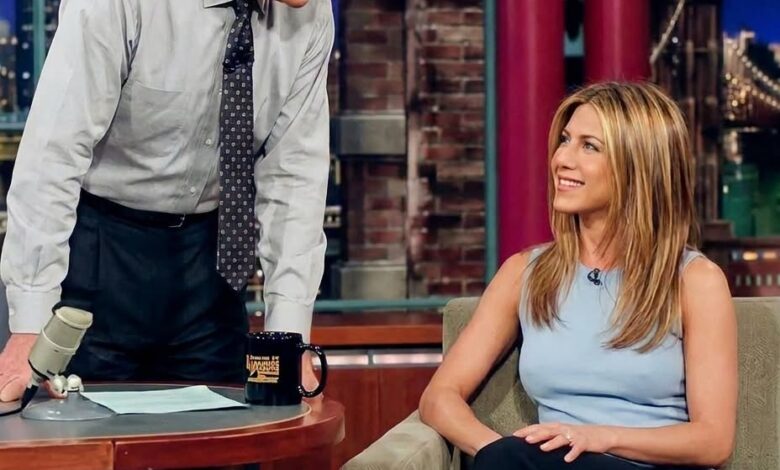
The audience laughed.
That may be the most uncomfortable part to remember.
Not the question.
Not the flirtation.
Not even the moment Jennifer Aniston’s expression seemed to change for half a second before she smiled again.
The laughter.
Hundreds of people in a television studio received their cue and responded exactly as expected.
The host pushed.
Jennifer smiled.
The crowd roared.
The conversation moved on.
At the time, millions watching at home probably thought nothing of it.
This was late-night television.
This was celebrity banter.
This was what happened when a beautiful actress sat across from a charismatic host who knew how to turn almost anything into a joke.
Then the clips resurfaced years later.
And suddenly, they didn’t feel quite as funny.
The words hadn’t changed.
Jennifer’s expressions hadn’t changed.
The audience’s laughter was exactly where it had always been.
What changed was us.
We had acquired a different vocabulary.
Boundaries.
Power dynamics.
Consent.
Workplace pressure.
The social expectation that women remain pleasant even while uncomfortable.
Once those ideas entered the frame, moments previously dismissed as harmless entertainment became harder to watch without asking questions.
Was she enjoying this?
Was she simply being professional?
Could she have objected without becoming the story herself?
And perhaps most revealing:
Why did nobody seem to ask those questions at the time?
Jennifer Aniston occupied a strange position in American culture.
She wasn’t simply famous.
For years, she was presented as familiar.
Approachable.
Funny.
Beautiful without seeming intimidating.
The woman audiences imagined they understood because they had watched Rachel Green stumble through relationships every week on Friends.
Celebrity magazines documented her hair.
Her clothes.
Her romances.
Her marriage.
Her divorce.
Her supposed heartbreak.
Her supposed pregnancies.
Her supposed loneliness.
An enormous industry developed around interpreting Jennifer Aniston.
Everyone seemed to know what she wanted.
What she regretted.
Who she loved.
How she felt.
Her body became public discussion.
Her relationships became communal property.
And then she would sit down for an interview and be expected to smile while someone asked about it.
That expectation matters.
Because celebrity interviews are not conversations between equals in the ordinary sense.
They are performances.
The guest has something to promote.
A film.
A television series.
A project.
The host controls the room.
The desk.
The cameras.
The rhythm.
Often the audience.
If the host makes a joke, laughter follows.
If the guest resists too strongly, the mood changes.
And nobody wants to be accused of ruining the mood.
Especially not a woman whose public image depends partly on being likable.
That creates an invisible trap.
Laugh, and people assume you’re comfortable.
Object, and you risk becoming “difficult.”
Remain silent, and the silence itself can be turned into another joke.
Smile awkwardly, and everyone keeps going.
There is no perfect response.
That is why old interview clips can be deceptive.
A smile does not necessarily prove enjoyment.
But neither can viewers confidently diagnose discomfort from every glance or gesture decades later.
Body language is not a transcript of someone’s mind.
Context matters.
So does restraint.
The point is not to rewrite every old celebrity interview as a hidden trauma.
The point is to notice the environment in which certain behavior was considered normal.
And much of it was.
For decades, television routinely treated women’s discomfort as entertainment.
Hosts asked actresses about their bodies.
Their underwear.
Their sex lives.
Whether they had gained weight.
Whether they were pregnant.
Whether they wanted children.
Whether they had been dumped.
Whether they were sleeping with a co-star.
Questions that would sound astonishing in many professional environments became acceptable because the woman being questioned was famous.
Then came the second expectation:
Be a good sport.
That phrase covered a remarkable amount of territory.
A good sport laughs.
A good sport doesn’t embarrass the host.
A good sport understands that it’s only a joke.
A good sport knows what she signed up for.
A good sport keeps the segment moving.
What nobody asked often enough was why being professional required absorbing somebody else’s lack of restraint.
Jennifer became exceptionally skilled at navigating that world.
Watch enough interviews and you can see the craft involved.
A joke.
A deflection.
A smile.
A change of subject.
Sometimes a playful comeback sharp enough to reclaim control without destroying the atmosphere.
That ability was often described as charm.
And it was charming.
But charm can also be labor.
The audience sees a woman effortlessly handling an awkward situation.
What it doesn’t see is the calculation that may be happening underneath.
How firmly can I push back?
How do I stop this without making it worse?
Is the camera on me?
Am I supposed to laugh?
Will tomorrow’s headline say I “lashed out”?
That is emotional work.
Women in public life became extraordinarily practiced at it because the consequences of refusing could be disproportionate.
A male celebrity who shut down an intrusive question might be described as private.
A woman could be called cold.
Difficult.
Humorless.
Oversensitive.
A diva.
That double standard trained behavior.
It also trained audiences.
We learned to interpret compliance as consent.
If she laughed, everything was fine.
If the crowd laughed, the joke worked.
If the segment continued, no boundary had been crossed.
But television is exceptionally good at manufacturing social permission.
Audience laughter tells viewers how to interpret a moment before they have time to interpret it themselves.
Someone says something inappropriate.
The crowd erupts.
Your brain receives a message:
This is funny.
Not threatening.
Not uncomfortable.
Funny.
Then the guest smiles.
Confirmation.
Move along.
Years later, remove the cultural assumptions and the same exchange can feel completely different.
Suddenly the laughter sounds enormous.
The smile looks smaller.
The imbalance becomes visible.
This is why resurfaced clips provoke such intense reactions online.
People are not merely watching celebrities from the past.
They are watching themselves.
Their culture.
Their old assumptions.
Things they once accepted without examination.
That can produce guilt.
But guilt isn’t particularly useful if it ends with:
“Everyone back then was terrible.”
Culture is rarely that simple.
Standards evolve unevenly.
People participate in systems without consciously understanding what those systems normalize.
Some jokes were mutually enjoyed.
Some flirtation was genuine.
Some guests were completely comfortable.
Others may not have been.
The lesson isn’t that every interaction must be retroactively prosecuted according to today’s expectations.
It is that yesterday’s normal deserves examination.
Because today’s normal will eventually receive the same treatment.
The better question is:
What are we laughing at now that people will find disturbing later?
That is harder.
It requires applying moral attention before social permission changes.
It requires noticing the person inside the performance.
Jennifer Aniston is especially interesting in this context because her public persona was built around apparent ease.
She seemed capable of handling anything.
Tabloid obsession.
Relationship questions.
Rumors.
Jokes about aging.
Endless scrutiny of her appearance.
She rarely gave audiences the dramatic breakdown they had been trained to expect.
So her composure became part of the product.
But composure can be misunderstood.
We often treat someone’s ability to handle discomfort as proof that the discomfort was acceptable.
Those are completely different things.
A person can navigate an inappropriate situation brilliantly.
That doesn’t make the situation appropriate.
A woman can laugh at an intrusive question.
That doesn’t automatically make the question respectful.
A celebrity can remain gracious while someone crosses a boundary.
Grace does not retroactively move the boundary.
This distinction matters beyond Hollywood.
Most people have experienced a smaller version of it.
The inappropriate joke at work.
The relative asking a deeply personal question at dinner.
The stranger commenting on your body.
The boss teasing you in front of colleagues.
Everyone laughs.
You laugh too.
Not because it was funny.
Because refusing to laugh would create another problem.
The moment passes.
Hours later, you think:
Why did I smile?
Because human beings are social animals.
We instinctively manage danger, tension, status, and belonging.
Sometimes laughter means amusement.
Sometimes it means:
Please let this moment end.
That is why audiences should be cautious about treating visible politeness as unlimited permission.
The responsibility for respecting boundaries cannot rest entirely on the person whose boundary is being tested.
“She could have said something” is not always the defense people imagine.
Maybe she could have.
But ask what saying something would have cost.
Especially on television.
Imagine Jennifer stopping a host cold.
“Don’t talk to me like that.”
The audience goes quiet.
The clip goes viral.
Now the headline isn’t about the movie she’s promoting.
It is:
JENNIFER ANISTON EXPLODES AT HOST.
Commentators debate whether she overreacted.
People analyze her tone.
Others accuse her of being unable to take a joke.
The original behavior becomes secondary.
Her response becomes the controversy.
Women understand that equation because many have lived versions of it.
That doesn’t mean they are powerless.
It means power sometimes operates through consequences rather than explicit commands.
Nobody has to say:
“You must laugh.”
The environment teaches you.
That is why old entertainment culture deserves scrutiny at the level of systems, not merely villains.
One host didn’t invent these expectations.
One actress didn’t create them.
One audience didn’t sustain them alone.
Producers wanted entertaining television.
Networks wanted ratings.
Tabloids wanted provocative material.
Audiences wanted access to celebrities.
Hosts were rewarded for getting reactions.
Guests were rewarded for remaining charming.
Everyone participated in an economy where boundaries could become content.
That doesn’t erase individual responsibility.
It explains why the pattern was so durable.
And the pattern was larger than Jennifer Aniston.
Look through old interviews with female celebrities and you can find moments that now seem almost surreal.
Young actresses answering questions about their bodies.
Pop stars being interrogated about virginity.
Women being asked whether pregnancy rumors are true.
Teenagers fielding questions no teenager should have been expected to answer publicly.
The audience laughs.
The host smiles.
The guest survives the segment.
Then everyone goes home.
Years later, the footage remains.
That archival permanence creates an unusual form of accountability.
Television preserves not only what people said.
It preserves what everyone considered normal.
You can hear the applause.
Watch the reaction.
Observe how quickly discomfort gets converted into entertainment.
That makes old footage culturally valuable even when it is uncomfortable.
Not because we need endless outrage about the past.
Because it gives us evidence of how norms operate.
They rarely announce themselves.
Nobody enters a studio and says:
“Tonight we will demonstrate a power imbalance.”
They tell a joke.
Everybody laughs.
That is how normalization usually looks.
Ordinary.
Entertaining.
Easy to ignore.
Until it isn’t.
The danger now is believing we’ve completely solved the problem.
We haven’t.
The format has changed.
Instead of only talk-show hosts, celebrities now face podcasts, livestreams, social media, comment sections, paparazzi videos, and millions of amateur investigators.
The appetite for access has not disappeared.
In some ways, it has intensified.
A celebrity no longer needs to sit across from a host to have her boundaries tested.
People can analyze photographs from her driveway.
Zoom into her body.
Speculate about pregnancy.
Diagnose her mental state.
Track her relationships.
Demand statements about rumors.
Then call silence suspicious.
The technology changed.
Entitlement survived.
That is why the lesson from old clips cannot simply be:
Hosts should behave better.
Audiences have responsibilities too.
Attention is currency.
Clicks reward intrusion.
Shares reward humiliation.
Outrage can reward the same content it claims to condemn.
If millions repeatedly circulate a woman’s uncomfortable moment because they are furious it happened, the moment is still being consumed.
That tension has no easy solution.
But awareness matters.
We can ask:
Why am I watching this?
What am I assuming?
Did this person choose to share this?
Am I treating somebody’s discomfort as entertainment simply because a camera captured it?
Those questions interrupt the old reflex.
They make room for something television culture often lacked:
The possibility that the person on screen does not owe us everything.
Jennifer Aniston’s career survived decades of scrutiny.
She remained successful.
Funny.
Recognizable.
Professionally resilient.
But resilience should never become an excuse for what someone was required to endure.
That principle applies everywhere.
Don’t measure whether behavior was acceptable by how successfully the recipient handled it.
People survive inappropriate situations all the time.
They joke.
Deflect.
Smile.
Change the subject.
Keep working.
Their competence does not absolve everyone else.
Perhaps this is what makes resurfaced footage feel so strange.
We are watching someone perform two roles simultaneously.
The celebrity came to promote something.
The woman had to manage the room.
Sometimes she did it so smoothly that the second job became invisible.
Now we can see it.
Or at least we are more willing to look for it.
That is progress, provided we don’t replace one kind of certainty with another.
We should not pretend we know exactly what Jennifer felt in every old interview unless she has told us.
We can, however, evaluate the behavior we can actually see.
We can ask whether the question respected reasonable boundaries.
Whether the joke depended on embarrassment.
Whether the guest had meaningful room to refuse.
Whether audiences were encouraged to laugh at something we would no longer find acceptable.
Those questions don’t require mind-reading.
They require attention.
And perhaps that is the real value of looking backward.
Not punishment.
Practice.
Old footage lets us practice recognizing dynamics we once overlooked so that we might recognize them faster the next time.
Because there will be a next time.
Different celebrity.
Different host.
Different platform.
Different joke.
The crowd will probably laugh.
The person at the center may smile.
And for a moment, everything will look normal.
That is precisely when attention matters most.
Look beyond the applause.
Notice who controls the conversation.
Notice who keeps changing the subject.
Notice who has to turn discomfort into humor so everyone else can remain comfortable.
And remember that the loudest reaction in the room is not necessarily the most important one.
Sometimes the truth of a moment is sitting quietly beneath the laughter.
A tightened expression.
A pause.
A careful smile.
A person doing everything possible to keep the situation moving.
We cannot return to those old studios and change what happened.
We cannot withdraw yesterday’s laughter.
But we can learn from why it sounded so natural at the time.
And perhaps the most meaningful reckoning is not declaring ourselves better than the people who laughed before us.
It is becoming harder to instruct.
Harder to cue.
Harder to convince that somebody else’s discomfort is harmless simply because everyone around us is having a good time.
The next time the room erupts, we can listen for something quieter.
The person who isn’t laughing.
The person trying to move on.
The person whose politeness is being mistaken for permission.
Because culture changes when enough people stop waiting for the laugh track to tell them how a moment is supposed to feel.