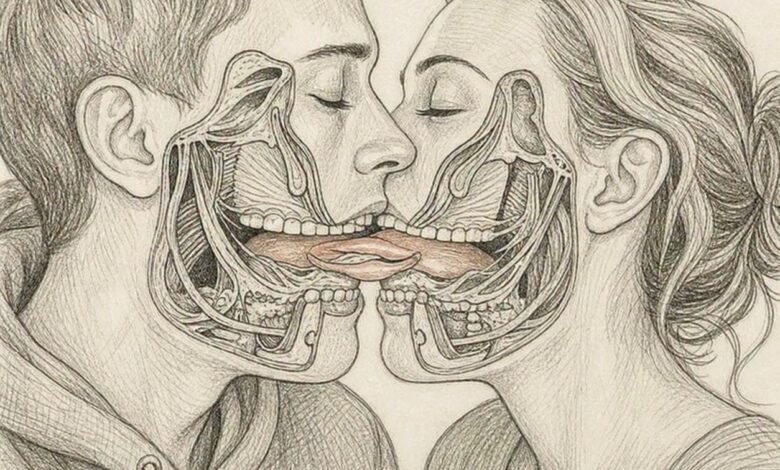
A kiss can last only a few seconds and still leave your entire body behaving as though something important just happened.
Your heartbeat changes.
Your breathing shifts.
Your attention narrows until the room seems quieter.
And when a kiss becomes deeper, with both partners willingly bringing their tongues into the exchange, something surprisingly complicated unfolds beneath what appears to be a simple act of affection.
It isn’t just the lips.
It isn’t just the tongue.
And it certainly isn’t one magical “love chemical” suddenly flooding the brain.
Kissing is a whole-body experience shaped by touch, smell, taste, expectation, emotion, memory, attraction, and—perhaps most importantly—the person standing in front of you.
That is why the exact same physical action can feel electrifying with one person and completely ordinary with another.
The biology matters.
But meaning matters too.
Your Mouth Is Extremely Sensitive
The lips and tongue contain a dense network of sensory receptors.
They are remarkably good at detecting subtle differences in pressure, temperature, texture, and movement.
During a deep kiss, the nervous system receives a rapidly changing stream of information.
How firmly is the other person kissing?
Are they moving closer or pulling away?
Is the rhythm comfortable?
Does their body seem relaxed?
Are they responding to you?
All of this information reaches the brain remarkably quickly.
Yet you usually aren’t consciously analyzing it.
You don’t think:
Pressure increased by approximately twenty percent.
You simply feel:
They’re into this.
Or:
Something feels awkward.
Or:
Slow down.
Or perhaps:
Don’t stop.
That is one reason kissing can feel like communication.
Two people are continuously responding to each other without needing to speak.
One moves.
The other answers.
One pauses.
The other notices.
A good kiss isn’t something one person performs on another.
It’s something two people create together.
Then the Brain Joins In
Pleasurable physical contact can engage brain systems involved in reward, motivation, attachment, and emotional processing.
Neurochemicals including dopamine and oxytocin are often discussed in connection with attraction and bonding.
But popular explanations sometimes oversimplify this into something like:
“Kissing releases oxytocin, therefore kissing creates love.”
Human relationships aren’t that mechanical.
Oxytocin participates in social bonding and other biological processes, but no single chemical can explain why someone falls in love, trusts another person, or feels emotionally safe.
Context changes everything.
Who is kissing you?
Did you want the kiss?
Do you trust them?
What happened five minutes earlier?
What history exists between you?
Are you excited?
Nervous?
In love?
Unsure?
Your brain interprets touch through all of those circumstances.
A wanted kiss from someone you deeply trust can feel comforting and intensely intimate.
The same physical contact from someone you don’t want touching you can feel invasive.
The nerves may detect touch in both situations.
Meaning determines the experience.
Why Does Your Heart Beat Faster?
People often notice physical changes during romantic kissing.
Breathing may become quicker or deeper.
Heart rate can increase.
You may feel warm.
Your attention may become intensely focused on your partner.
Some of this is related to general physiological arousal.
Your nervous system recognizes that something emotionally significant is happening.
That doesn’t necessarily mean every deep kiss represents profound love.
Sometimes people kiss because they’re attracted to each other.
Sometimes because they’re curious.
Sometimes because they’re already deeply bonded.
Sometimes because they’re discovering whether chemistry exists at all.
The body can become excited before the relationship has acquired a definition.
That’s perfectly human.
Chemistry Is More Than a Metaphor
People often describe a great kiss by saying:
“We had chemistry.”
That phrase is surprisingly appropriate, although not in the mystical way it sometimes sounds.
When you’re physically close to someone, you receive enormous amounts of sensory information.
Their scent.
Their taste.
Their warmth.
Their movements.
Their breathing.
How they respond when you move closer.
How comfortable you feel being that close.
Your brain integrates these signals with everything you already know about the person.
Then somehow, from that enormous pile of information, comes a wonderfully simple verdict:
Yes.
No.
Maybe.
Or:
Oh wow.
This is why technique can only take someone so far.
You can memorize every supposed rule about kissing and still have no chemistry with a particular person.
Meanwhile, two people who genuinely want each other may find their rhythm without thinking much about technique at all.
Connection isn’t choreography.
A Kiss Can Say Things Words Struggle to Say
Think about the difference between a quick goodbye kiss and the kiss between two people who haven’t seen each other for months.
The anatomy is the same.
The emotional experience isn’t remotely similar.
One might say:
“See you tonight.”
The other might say:
“I missed you more than I knew how to explain.”
A kiss after an argument can mean:
“I’m still here.”
A first kiss can ask:
“Is this happening between us?”
A kiss between longtime partners might communicate something quieter:
“I still choose you.”
That’s why romantic kissing has such cultural power.
It can compress complicated emotions into a small physical gesture.
Desire.
Trust.
Relief.
Longing.
Playfulness.
Reassurance.
Affection.
None requires a spoken sentence.
But there is an important condition beneath all of them.
Both people have to want the moment.
Consent Makes Intimacy Possible
People sometimes imagine consent as something formal that interrupts romance.
In reality, mutual willingness is part of what makes romantic touch enjoyable.
You can often feel responsiveness during a kiss.
Someone moves closer.
Returns the kiss.
Touches you affectionately.
Their body relaxes.
They remain engaged.
But assumptions aren’t perfect.
If you’re uncertain, checking in is completely reasonable.
“Is this okay?”
“Can I kiss you?”
“Want me to slow down?”
Those questions don’t destroy chemistry when asked naturally.
For many people, they increase trust.
And consent remains changeable.
Someone can want to kiss you and then want to stop.
Someone can enjoy one kind of kissing and dislike another.
Being in a relationship does not create permanent permission.
Marriage doesn’t either.
Intimacy works best when both people remain participants rather than one person becoming the audience for the other’s desires.
There Is No Universal “Perfect Kiss”
People like different things.
Some prefer slow, gentle kisses.
Others enjoy greater intensity.
Some love tongue kissing.
Some barely enjoy it.
Some people are extremely affectionate but don’t particularly care about kissing at all.
None of these preferences automatically says anything about how deeply someone loves their partner.
This is worth remembering because romantic culture sometimes turns kissing into a test.
“If they really love me, they’ll kiss me this way.”
“If there’s chemistry, the first kiss must be incredible.”
“If my partner doesn’t want to kiss tonight, something must be wrong.”
Real relationships are more complicated.
People get tired.
People become stressed.
Medications can affect desire.
Illness matters.
Pregnancy can change preferences.
Relationships move through different seasons.
A disappointing kiss is sometimes just a disappointing kiss.
You don’t need to turn every physical interaction into a referendum on the relationship.
Hygiene Matters Without Becoming an Obsession
Because kissing involves close contact and saliva, some infections can spread through kissing.
Cold sores caused by herpes simplex virus are an obvious example.
The virus responsible for infectious mononucleosis can also spread through saliva.
Other illnesses may spread through respiratory droplets or close contact.
That doesn’t mean kissing should become frightening.
Human intimacy has never been sterile.
Basic awareness is enough for most people.
If you’re actively sick, giving your partner some space may be sensible.
If you have an active cold sore, avoiding kissing until it has healed can reduce transmission risk.
Good oral hygiene helps too.
Brush your teeth.
Care for your gums.
Stay reasonably hydrated.
Address persistent dental problems.
Not because a romantic partner requires perfection, but because taking care of your mouth is part of taking care of yourself.
And please don’t turn ordinary human breath into a catastrophe.
Everyone occasionally eats garlic.
Everyone wakes up with morning breath.
Intimacy includes discovering that the person you adore remains biologically human.
Why Kissing Can Feel Different in Long Relationships
At the beginning of a relationship, kissing may carry enormous anticipation.
Everything is new.
You’re still learning the other person’s body language.
There is uncertainty.
Does this person want me?
Where is this going?
That uncertainty can intensify excitement.
Years later, the same couple may kiss differently.
Perhaps less dramatically.
But familiarity can create another kind of intimacy.
You know how they move.
You recognize their scent instantly.
You know the difference between the kiss that means “good morning” and the one that means “stay here.”
That familiarity isn’t necessarily evidence that passion disappeared.
Sometimes it means affection has acquired a language.
A quick kiss while someone makes coffee may contain an entire relationship inside it.
Shared rent.
Private jokes.
Arguments survived.
Illnesses endured.
Trips remembered.
Ordinary Tuesday mornings.
Love isn’t always fireworks.
Sometimes it is someone kissing your forehead while looking for their keys.
And Sometimes a Kiss Really Does Bring the Spark Back
Long-term couples often become efficient.
Schedules replace spontaneity.
Conversations become logistical.
Did you pay that bill?
Who’s buying groceries?
What time are we leaving?
Did you call the plumber?
Physical affection can become equally efficient.
A quick kiss.
A hug.
Goodnight.
There is nothing inherently wrong with that.
But deliberately slowing down can remind partners that they are not merely running a household together.
They’re still two people capable of attraction and tenderness.
A longer kiss can interrupt routine.
Not because kissing possesses magical relationship-saving properties.
Because attention does.
For a few seconds, you’re not answering emails.
You’re not thinking about laundry.
You’re not planning tomorrow.
You’re paying attention to another person.
That can be remarkably powerful.
The Best Kisses Aren’t Performances
Popular culture has given people strange anxieties about kissing.
Am I good at it?
Am I using too much tongue?
Not enough?
Where do my hands go?
Am I breathing strangely?
What if our noses bump?
Here’s the reassuring truth:
Occasionally, noses bump.
Teeth sometimes collide.
Someone laughs.
Someone needs to breathe.
A kiss can be slightly awkward and still wonderful.
In fact, intimacy becomes much easier when neither person believes they’re being graded.
The goal isn’t technical perfection.
It’s responsiveness.
Pay attention.
If your partner slows down, notice.
If they move closer, notice.
If something makes them uncomfortable, adjust.
If you don’t know what they enjoy, communicate.
Great intimacy is less about knowing every move beforehand and more about being interested in the person you’re sharing it with.
Why One Kiss Can Stay in Your Memory for Years
You may forget hundreds of ordinary kisses.
Then one remains astonishingly clear.
The first kiss with someone you eventually loved.
The last kiss before a long separation.
The reunion.
The unexpected kiss that changed a friendship.
The quiet one during a frightening period when neither person knew what to say.
Why do these moments stick?
Emotion strengthens memory.
When an event carries significance, the brain is more likely to preserve surrounding details.
You may remember the room.
The weather.
A song playing nearby.
What the person smelled like.
What you were wearing.
Not because their lips contained some extraordinary biological ingredient.
Because the moment meant something.
That’s the piece biology alone cannot explain.
The mouth provides sensation.
The nervous system carries information.
The brain processes reward and emotion.
But human beings provide the story.
And stories transform sensation into memory.
The Most Important Part Happens Before the Kiss
Not the breath mint.
Not the technique.
Not some supposedly perfect angle.
Trust.
A truly intimate kiss requires vulnerability.
You close distance.
You allow another person into one of your most personal physical spaces.
For a moment, you’re close enough to notice everything.
That can feel thrilling precisely because it also makes you vulnerable.
When both people feel safe, respected, and wanted, vulnerability becomes connection.
That may be why a deep kiss can feel so affirming.
It isn’t simply:
“I find you attractive.”
Sometimes it is:
“I am comfortable this close to you.”
“I trust you with this part of me.”
“I want to be here.”
Those messages cannot be measured by heart rate or hormone levels.
But they are often what people remember.
Years later, you probably won’t remember exactly how many seconds the kiss lasted.
You won’t know what your oxytocin level was.
You won’t remember the precise movement of your tongue.
You’ll remember who was there.
How they looked at you beforehand.
Whether you felt safe.
Whether you wanted them closer.
Whether you smiled afterward.
That is what turns physical contact into intimacy.
The biology creates sensation.
Desire creates energy.
Trust creates safety.
Consent creates freedom.
And emotion gives the whole thing meaning.
A kiss doesn’t have to be dramatic to contain all of that.
Sometimes it happens in a kitchen before work.
Sometimes in a parked car.
Sometimes at an airport after months apart.
Sometimes between two people who have kissed each other thousands of times.
The setting changes.
The message can remain beautifully simple:
I’m here.
You’re here.
And for this moment, we choose to be close.