My Dad Never Let Me Near His Truck, but the Day I Opened It, I Found a Note inside That Read: ’Please Come Back’

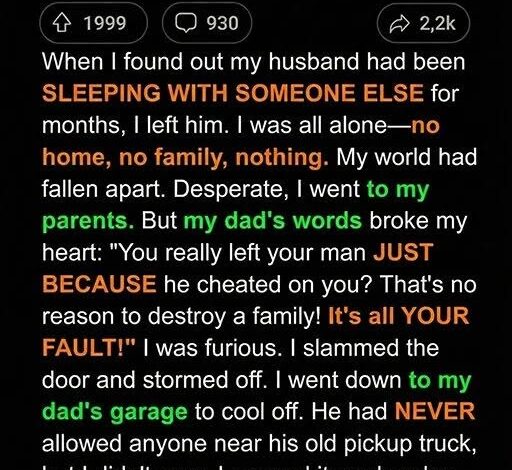
The rain started just as I turned onto the gravel road leading to my parents’ house.
Not a storm. Nothing dramatic. Just a steady gray drizzle tapping against the windshield, soft and persistent, like the sky was trying to say something it didn’t have the courage to speak aloud.
The tires crunched over the familiar stones, and the sound pulled memories from places I thought I had sealed shut. Summer evenings. Bare feet on the porch. My mother calling me in before dark. My father’s old pickup rumbling into the driveway after work.
The house appeared through the rain exactly as I remembered it.
Pale blue siding.
White trim.
A porch light glowing warmly against the dull afternoon.
The wind chimes moved gently in the breeze, their soft metallic notes drifting through the damp air.
Everything looked unchanged.
Preserved.
Almost unreal.
But I had changed.
At thirty years old, I felt older than I ever imagined possible. Not because of time, but because of what betrayal does to a person. It ages something inside you. It takes the future you trusted and splits it open without warning.
A suitcase sat in the back seat.
One suitcase.
That was all I had managed to bring.
No apartment.
No job lined up.
No plan that made any sense.
Only the truth I could no longer pretend away.
Jonah had cheated on me.
Not once.
Not in a moment of weakness.
For months.
I had not called my parents before coming. I told myself it was because I didn’t want to worry them, but the truth was simpler: I was afraid.
Afraid my mother’s voice would break me.
Afraid my father’s would harden me.
Afraid I would turn the car around and return to a marriage where trust had already died.
So I parked in the driveway and sat there, gripping the steering wheel while the rain blurred the house in front of me.
Before I could gather the courage to get out, the front door opened.
My mother stepped onto the porch.
“Marianne?”
Her voice caught on my name as if she wasn’t sure I was real.
Then she was moving toward me, arms open, slippers darkening in the rain. I barely had time to step out before she wrapped me in the kind of embrace only a mother can give—the kind that doesn’t ask for explanations before offering shelter.
“Come inside,” she whispered. “You’re soaked.”
I held onto her longer than I meant to.
She smelled like laundry soap and cinnamon, exactly the same as always, and for one unbearable moment I felt six years old again, crying after a nightmare.
Inside, the house was warm and heavy with memory. Family photos lined the mantle. Crocheted blankets rested neatly over the sofa. The living room smelled of old books and polished wood.
My father sat in his recliner, arms crossed, eyes fixed on the television.
He didn’t look at me.
“You don’t call anymore,” he said.
My mother stiffened. “Henry.”
“I didn’t know where else to go,” I said.
He grunted but didn’t respond.
The silence pressed against me until I couldn’t bear it.
“I left Jonah,” I said. “He cheated on me. For months.”
My mother’s face changed. Pain flickered across it, quick but unmistakable. She reached for my hand.
“Sit down,” she said softly. “I’ll make tea.”
She moved into the kitchen with practiced calm. Kettle. Chamomile. Honey. Lemon. That was how my mother handled disaster. She turned pain into warmth and placed it in front of you in a mug.
My father followed more slowly, leaning against the counter.
“So he made a mistake,” he said.
I looked up at him.
“A mistake?”
“That doesn’t mean you tear apart your whole life.”
The room went still.
“He lied to me,” I said. “Again and again. I can’t trust him.”
My father’s jaw tightened.
“Marriage isn’t just about trust. It’s about endurance. You work through things.”
Something inside me cracked.
This was the man who had raised me to believe honesty mattered. The man who had told me reputation meant nothing without integrity. The man who said character was what you did when no one was watching.
And now he was telling me to stay quiet.
To absorb betrayal.
To call it marriage.
“I need air,” I said, pushing back my chair.
I walked into the garage before either of them could stop me.
The smell hit me immediately—oil, dust, cold metal, old wood. The rain drummed softly on the roof, and in the far corner sat my father’s faded red pickup.
It had been there forever.
Rust curled along the edges. The bumper still carried the dent from a deer he hit when I was a child. That truck had always been forbidden territory.
No one touched it.
No one opened it.
No one asked why.
But that day, the rear hatch wasn’t locked.
I stared at it for a long moment.
Then I lifted it.
Inside, beneath an old rubber mat, my fingers brushed against something solid. I pulled the mat back and found a hidden compartment.
My heart began to pound.
Inside lay a single yellowed envelope.
It was addressed to my parents’ home in careful handwriting.
The return name meant nothing to me.
But beneath the address, written in darker ink, were six words that stole the air from my lungs.
Please come back. I still love you.
Ten minutes later, I was driving again.
The address led me two towns over, down narrow roads bordered by empty fields and bare trees. The envelope sat on the passenger seat like a living thing, heavy with everything my family had never said.
The house was small but tidy. Blue paint chipped near the porch steps, but the shutters were clean and white. Someone still cared for it.
A woman answered the door.
She had silver hair, gentle eyes, and a face lined by years of surviving things quietly.
When she saw the envelope in my hand, she didn’t ask who I was.
“I wrote that,” she whispered.
Her name was Evelyn.
And over the next hour, she told me the story my father had hidden for decades.
He had met her while working out of town.
He had told her he was separated.
He had promised her a future.
He had made her believe she was loved honestly.
Then one day, he simply disappeared.
The letter had been her final attempt to reach him.
A goodbye.
A plea.
A record of the man he had been before he returned home and became my father again.
I drove back in silence.
By the time I reached the house, the rain had stopped.
My parents were waiting in the kitchen.
I placed the envelope on the table.
My father went pale.
My mother closed her eyes.
“You knew,” I said.
She didn’t deny it.
“I forgave him,” she whispered. “I had children. A home. A life. I chose to survive.”
My father said nothing.
For once, he had no lesson to offer.
I looked at them both, and the anger inside me settled into something clearer.
“I’m not you,” I said quietly. “I can’t stay where trust has been broken and call that strength.”
No one answered.
In the morning, I packed my suitcase again.
My mother stood on the porch, holding herself tightly.
“I love you,” I told her.
Tears filled her eyes.
“I love you too.”
Then I looked at my father.
For a moment, I saw not the man who raised me, but the man who had taught me what silence can cost.
I got into my car and drove away as sunlight rose over the fields.
That letter had exposed my father’s past.
But more importantly, it had revealed my future.
I could repeat the same story.
Or I could end it.
And for the first time in months, with the road opening ahead of me, I knew exactly which life I was choosing.