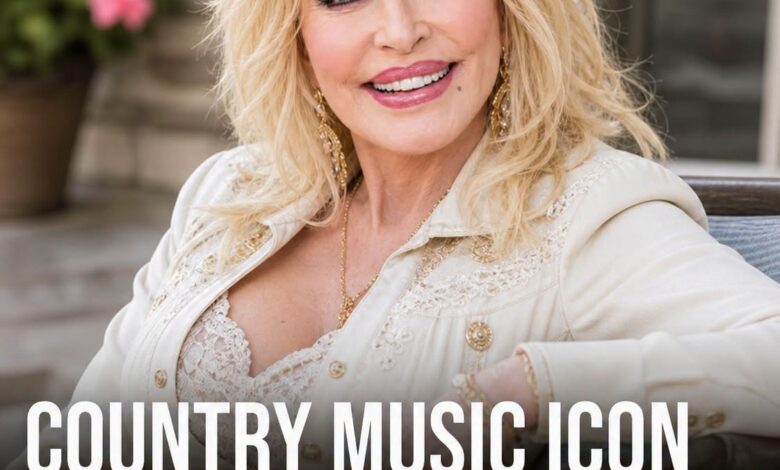
For decades, Dolly Parton walked onto stages covered in rhinestones, sequins, feathers, lace, and enough sparkle to catch the light from the back row.
But there was one detail fans kept noticing.
Her arms were almost always covered.
Even when the dress was glamorous and revealing elsewhere, Dolly frequently chose long sleeves, sheer fabric, gloves, or carefully designed layers. Over time, the consistency sparked endless speculation.
Was she hiding something?
The answer, according to Dolly herself, was far less scandalous—and much more personal.
Underneath some of those famous sleeves were scars and delicate tattoos, both connected to the way her body healed.
Dolly explained that she had a tendency to develop keloid scar tissue. For some people, an injury or surgical incision does not heal into a thin, flat mark. Instead, the body produces excess scar tissue, creating a raised area that can become noticeable and sometimes change color.
In Dolly’s case, she said some scars developed a purplish appearance.
For a woman whose public image had been constructed with extraordinary attention to detail, the marks bothered her.
So she did something characteristically Dolly.
She turned them into art.
Rather than covering herself in the bold, dark tattoos people might have expected from the rumors surrounding her, Dolly described her tattoos as soft and feminine.
Butterflies.
Flowers.
An angel.
Pastel colors.
Little pieces of beauty placed where something painful had happened before.
“I don’t have the real heavy, dark tattoos,” she once explained publicly, pushing back against the legend that she was secretly tattooed from neck to wrist.
The reality was gentler.
Her tattoos were personal decorations, sometimes positioned over scars that she preferred not to see.
That makes the long sleeves feel different.
They weren’t evidence of some shocking secret life.
They were part fashion, part privacy, and perhaps part armor.
And armor suited Dolly Parton remarkably well.
Her entire visual identity was built around taking things that might have embarrassed someone else and exaggerating them until they became sources of power.
She grew up poor.
She never pretended otherwise.
She grew up admiring women whose dramatic makeup and towering hair were sometimes dismissed by other people as cheap or excessive.
Instead of distancing herself from that aesthetic when she became famous, Dolly embraced it.
The hair became higher.
The heels became taller.
The rhinestones became brighter.
If people were going to stare, she would give them something worth staring at.
“I know I’m artificial,” she joked in different ways throughout her career, “but I’m real where it counts.”
That contradiction became central to her appeal.
Almost everything about Dolly’s appearance looked carefully manufactured.
Yet very little about her personality felt fake.
She could stand beneath stage lights wearing a blonde wig, false eyelashes, enormous jewelry, and a dress sparkling like a chandelier, then speak with startling simplicity about poverty, loneliness, faith, ambition, or heartbreak.
The decoration never concealed the person.
It introduced her.
Her tattoos seem to fit naturally into that philosophy.
A scar said something happened to her body.
A flower placed over it said she still got to decide what it meant.
A butterfly could transform an unwanted mark into something chosen.
An angel could occupy the place where pain had once written its own signature.
There is a quiet power in that.
Not because scars need to be hidden.
They don’t.
And not because anybody should feel obligated to turn an imperfect part of their body into something conventionally beautiful.
But Dolly made a choice about her own skin.
That was what mattered.
She did not owe the public access to every scar simply because she was famous.
She didn’t owe anyone bare arms.
She didn’t owe an explanation for every wardrobe decision.
For years, people examined photographs and tried to solve the “mystery” of Dolly Parton’s sleeves.
Meanwhile, Dolly kept doing something much more interesting.
She worked.
She wrote songs at a pace that seemed almost impossible.
She turned observations, memories, fears, arguments, childhood experiences, and heartbreak into music.
Long before celebrity became the business empire surrounding her name, Dolly understood the fundamental skill that would sustain everything else.
She could write.
Her songs often sounded simple because she knew how difficult simplicity actually was.
“Coat of Many Colors” took childhood poverty and transformed it into dignity.
“Jolene” turned jealousy and vulnerability into one of popular music’s most recognizable pleas.
“9 to 5” wrapped frustration about workplace inequality inside a melody so infectious that people could sing along before fully realizing how angry the song was.
And then there was “I Will Always Love You.”
Few songs demonstrate Dolly’s emotional intelligence more clearly.
It wasn’t originally written as a conventional romantic breakup song. It emerged from her professional separation from Porter Wagoner, capturing something more complicated than anger: the realization that loving or appreciating someone does not always mean remaining beside them.
Years later, Whitney Houston’s extraordinary recording carried the song into another generation and turned Dolly’s words into a global phenomenon.
That was Dolly’s real magic.
She could write something intensely personal and somehow leave enough room inside it for millions of other people.
Her songs became weddings.
Funerals.
Road trips.
Breakups.
Karaoke nights.
Childhood memories.
Songs written in Tennessee somehow ended up belonging to strangers everywhere.
Yet even music was only part of what Dolly eventually decided to give away.
Success brought money.
She could have treated wealth as proof that she had escaped the poverty of her childhood.
Instead, she repeatedly redirected attention and resources toward the place she came from.
The Dollywood Foundation became one of the clearest expressions of that instinct.
Then came the Imagination Library.
The idea was wonderfully straightforward: send books to young children.
No complicated ceremony.
No requirement that a child become exceptional first.
No expectation that families prove they deserved the gift.
A book simply arrived.
Then another.
And another.
The program was inspired in part by something deeply personal. Dolly’s father, Robert Lee Parton, had not had the opportunity to learn to read and write.
Dolly adored him.
His lack of formal education did not make him unintelligent; she often described him as one of the smartest people she knew.
But she understood how limited educational opportunity could follow someone throughout life.
So the daughter who became internationally famous helped create a program designed to put books into children’s hands before they were old enough to understand what fame was.
That may tell us more about Dolly than any tattoo ever could.
She understood transformation.
A poor childhood could become a song.
A heartbreak could become an anthem.
A scar could become a butterfly.
Money could become books.
Fame could become leverage.
And a girl from a large family in the mountains of East Tennessee could become proof that where a person begins does not have to determine where their imagination ends.
Dolly also understood the difference between generosity and access.
She gave enormous amounts of herself publicly, but she maintained boundaries around what remained private.
Her marriage to Carl Dean was perhaps the most famous example.
While Dolly became one of the most recognizable entertainers in the world, Carl largely stayed away from celebrity culture.
That privacy fascinated people.
Photographs were rare.
Appearances together were rarer.
The more private he remained, the more curious the public became.
But Dolly never seemed particularly interested in satisfying that curiosity.
Some things belonged to the audience.
Some things belonged to her.
Her arms, in many ways, were another example.
People could speculate.
She could laugh about it.
She could reveal what she wanted and leave the rest alone.
There is something refreshing about that boundary in a culture that increasingly treats famous people’s bodies as public property.
Every change becomes a headline.
Every scar requires an explanation.
Every photograph becomes evidence.
Dolly understood celebrity long before social media intensified that scrutiny, and she developed her own method for surviving it.
Give people plenty to look at.
But don’t give them everything.
The rhinestones could belong to the audience.
The woman underneath them still belonged to herself.
That is why reducing the story of her long sleeves to “Dolly Parton was hiding tattoos” misses almost everything interesting about it.
Yes, there were tattoos.
Yes, some were connected to scars.
Yes, she sometimes preferred to keep them covered.
But the deeper pattern runs through her entire life.
When Dolly encountered something painful, limiting, or embarrassing, she had an extraordinary ability to transform it without pretending it never happened.
She didn’t erase the poor little girl from Tennessee when she became wealthy.
She brought her onto the stage.
She didn’t erase heartbreak.
She wrote it down.
She didn’t erase the memory of her father’s limited educational opportunities.
She built something that could help other children.
And she didn’t necessarily erase every scar.
Sometimes she simply placed a flower over it.
Perhaps that’s why the tattoos Dolly described sound so appropriate.
Flowers grow.
Angels protect.
And butterflies transform.
A butterfly begins as something earthbound before becoming something almost unrecognizable from what it once was.
Dolly built an entire career around that possibility.
Transformation without forgetting where you came from.
The sleeves were beautiful.
The tattoos underneath them were personal.
But neither was the most important thing Dolly Parton carried.
What mattered was what she kept giving away.
Songs.
Stories.
Books.
Money.
Opportunities.
Laughter.
Permission to be excessive, ambitious, feminine, underestimated, clever, wounded, and still completely yourself.
People spent years wondering what Dolly was hiding beneath those sleeves.
Perhaps they were looking in the wrong direction.
The remarkable part was never what she covered.
It was how much she revealed through everything else.
And how often she took something that had once hurt and found a way to make something beautiful grow over it.