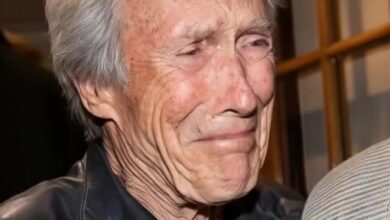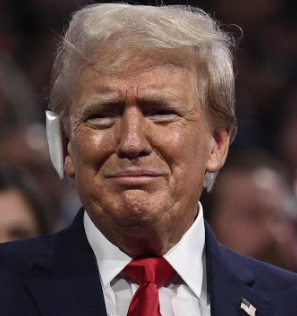
For a few seconds after he stepped to the podium, the room stayed almost unnaturally quiet.
Not respectful silence exactly.
Tense silence.
The kind that settles over crowds when people sense, before a single word is spoken, that something irreversible is about to happen. Staff members shifted uneasily in their seats. Supporters leaned forward instinctively. Reporters stopped whispering to one another and lowered their phones slightly, as though even the machinery of modern political spectacle understood this moment required something closer to stillness.
Then he began to speak.
And immediately, people realized they were not watching the version of him they had grown accustomed to over the years.
The voice was softer.
Slower.
Carrying strain impossible to disguise completely.
For decades, he had projected certainty almost relentlessly. Whether people admired him or despised him, they rarely described him as fragile. He built his public identity around endurance — surviving scandals, attacks, defeats, investigations, betrayals, ridicule, and pressure intense enough to hollow out most people long before cameras stopped rolling. Even critics often admitted he possessed unusual stamina beneath the spectacle.
But that night, something looked different.
Not broken exactly.
Exposed.
His pauses lasted slightly too long.
His breathing seemed heavier.
At moments, emotion interrupted sentences before he regained control again.
And perhaps most striking of all, he no longer appeared entirely armored against the room itself.
Public figures spend years constructing emotional distance carefully. It becomes necessary for survival eventually. Constant scrutiny teaches politicians, celebrities, and leaders how to perform steadiness even while exhausted privately. Vulnerability becomes dangerous because millions of strangers project expectations onto them constantly. The larger the public persona grows, the harder authenticity becomes to display safely.
Yet standing there beneath harsh lights, he looked less like a symbol and more like a man finally feeling the cumulative weight of years spent carrying one.
For supporters, the moment felt deeply unsettling precisely because strength had always been central to how they understood him. Many in the crowd had followed him through elections, controversies, victories, and humiliations alike. They defended him at family dinners, online arguments, workplaces, and friendships fractured by politics. Over time, loyalty became emotional rather than merely ideological. He represented persistence to them — the refusal to collapse under pressure no matter how relentless the attacks became.
So watching visible exhaustion break through his composure created something close to grief.
Not necessarily because of the announcement itself.
Because monuments are not supposed to look tired.
Yet suddenly, he did.
The room seemed to realize it collectively.
You could see it in faces across the audience: people no longer reacting politically first, but emotionally. Some stared downward quietly. Others watched with expressions usually reserved for funerals or farewells rather than political gatherings. A few looked almost stunned, as though confronted unexpectedly by the humanity of someone they had unconsciously transformed into something larger than ordinary life.
That transformation happens often in modern politics.
Supporters project resilience onto leaders because they need reassurance themselves. Public figures become symbols onto which millions deposit fears, frustrations, hopes, and identities. Over time, the individual beneath the symbol nearly disappears beneath expectation.
Until a moment arrives when the illusion cracks.
And everyone remembers there is still a person underneath it after all.
He spoke not only about politics that night, but about endurance.
About pressure.
About uncertainty.
Without directly naming every private battle or public humiliation, he acknowledged weariness in a way many people had never heard from him before. The effect was startling because vulnerability changes the emotional temperature of a room instantly. Strength commands attention; visible struggle invites recognition.
Suddenly supporters were not merely listening to a leader.
They were watching someone visibly carry years of accumulated conflict in real time.
Years of attacks.
Years of expectation.
Years of waking every morning knowing millions of people already decided who he was before he even spoke that day.
No public life leaves people untouched psychologically, no matter how powerful they appear externally.
And yet, even through obvious exhaustion, he kept returning to something larger than himself.
Unity.
Resilience.
Standing together when certainty disappears.
That may be what affected the crowd most deeply afterward. Despite visible strain, he still tried shifting focus away from his own pain toward collective endurance instead. He spoke about surviving moments when familiar structures collapse unexpectedly — politically, culturally, personally. About how people continue forward even after losing confidence in outcomes they once considered permanent.
Some listeners interpreted those words politically.
Others heard something more personal hidden underneath them:
a man trying to convince himself to keep believing in continuity while sensing an era ending around him simultaneously.
Because that was the unmistakable feeling inside the room by the end.
Not merely announcement.
Transition.
The awareness that something familiar had closed, even if nobody yet fully understood what would replace it afterward.
Politics often frames itself as endless movement forward, but emotionally, public life still depends heavily on chapters. Certain figures dominate cultural imagination so completely for years that their weakening creates psychological disorientation beyond policy itself. People organize emotional expectations around leaders they trust, admire, or even oppose intensely. Once those figures begin stepping away — voluntarily or otherwise — entire political identities suddenly feel unstable.
That instability hovered over the crowd heavily.
Some supporters cried openly afterward.
Others stood silently refusing to leave immediately.
Conversations happened in hushed voices rather than celebratory tones.
It felt less like victory or defeat than collective realization.
And perhaps the deepest discomfort came from understanding there would be no neat emotional resolution available.
No speech can fully prepare people for the ending of eras they built parts of themselves around.
Especially in modern America, where politics increasingly functions less like civic participation and more like emotional identity. Supporters do not simply vote anymore; many feel personally bound to leaders who symbolize cultural fears, hopes, or resistance itself. Losing certainty around those figures can feel strangely intimate — almost like family transitions unfolding publicly before millions of witnesses simultaneously.
That emotional intensity explains why the night lingered so heavily afterward.
Not because everyone agreed politically.
Because vulnerability briefly overpowered performance.
For a moment, beneath cameras, rhetoric, and polarization, people saw something rawer than politics alone:
a human being confronting limitation publicly after years spent appearing larger than it.
Some observers called it humility.
Others called it exhaustion.
Some interpreted it as strategic.
Others saw sincerity for the first time.
But nearly everyone sensed the same underlying truth:
the armor had cracked.
And once people witness humanity inside someone they once viewed as immovable, perception changes permanently.
That does not erase loyalty.
Or criticism.
Or ideological division.
But it complicates them.
Because suddenly the figure at the center of endless arguments no longer looks entirely symbolic anymore. He looks mortal. Finite. Burdened by years impossible for anyone to carry untouched forever.
Long after the room emptied and headlines replaced nuance with political analysis, many supporters would remember smaller details instead:
the pause before certain sentences,
the strain beneath his voice,
the glistening in his eyes when applause faded briefly into silence.
Those details mattered because they revealed something public life rarely allows people to witness honestly:
even the strongest personas eventually grow heavy for the people forced to live inside them.
And for everyone in that room, whether hopeful or fearful about what comes next, one realization settled in quietly by the end of the night:
a chapter had closed.
Not cleanly.
Not triumphantly.
Not catastrophically.
Humanly.
And that is often far harder to process.