By the time rescuers found Pear, her body had already begun giving up on the world.
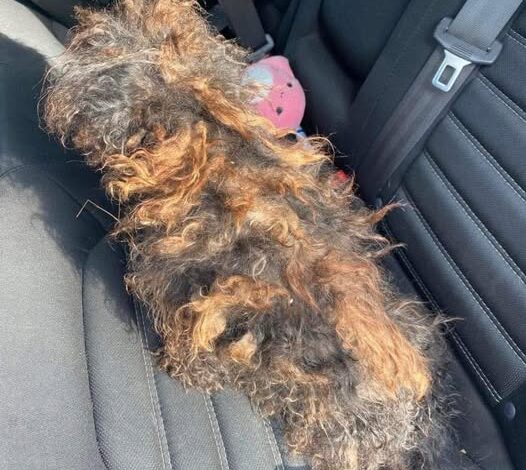
She lay curled beside the roadside almost motionless, hidden beneath layers of matted fur so thick they looked less like a coat and more like armor grown painfully into her skin. Dirt, infection, and neglect had fused together over years until even her shape barely resembled a dog anymore. One eye was gone completely. Her ribs pressed sharply beneath tangled patches of fur. Every breath came shallow and cautious, as though even breathing had become something she no longer fully trusted.
Cars passed.
People passed.
Heat rose from the gravel around her.
And still, somehow, she stayed alive.
That may have been the most heartbreaking part for the rescuers from Mac’s Mission when they finally approached her: Pear hadn’t stopped fighting. Even after years of abandonment, starvation, discomfort, and loneliness, some stubborn instinct inside her still clung quietly to survival.
Not loudly.
Not dramatically.
Just enough to keep breathing one more hour.
One more night.
One more day.
When volunteers gently lifted her into the rescue van, they weren’t performing some cinematic miracle in a single moment. They were interrupting a slow, invisible death already unfolding long before anyone knew her name. Pear did not suddenly transform the second she was rescued. She trembled violently. Her body smelled of infection and neglect. She flinched at sudden movement. Exhaustion hung over her so heavily that even safety looked unfamiliar.
Trauma doesn’t disappear simply because kindness arrives.
Sometimes kindness itself feels terrifying at first.
At the clinic, the work began slowly.
Painfully slowly.
Veterinarians spent hours carefully shaving away the hardened mats wrapped around her body. Some sections had tightened so severely they restricted movement and pulled constantly against damaged skin underneath. Layer by layer, the neglect peeled away. Beneath it appeared wounds no one had seen before — irritated flesh, pressure sores, patches of infection, old scars hidden beneath years of dirt and overgrowth.
Every removed mat revealed another piece of suffering she had carried silently.
And still, Pear never lashed out.
She barely resisted at all.
That frightened some rescuers more than aggression would have.
Animals who stop fighting entirely often aren’t calm — they’re exhausted beyond fear.
Yet even inside that exhaustion, tiny moments began appearing that suggested something deeper still survived inside her.
The first full meal she finished completely.
The first time she drank water without panic.
The first deep sleep where her body finally relaxed instead of staying tense and alert for danger.
To outsiders scrolling online, those moments might have looked small.
To the people caring for her, they felt enormous.
Because recovery from neglect is rarely one dramatic breakthrough.
It’s a series of quiet resurrections.
A body remembering nourishment.
A nervous system relearning safety.
A creature realizing pain is no longer constant.
Pear’s transformation eventually spread online through before-and-after photos people shared with shock and heartbreak. Millions reacted to the visual contrast alone: the skeletal roadside dog versus the cleaner, softer animal slowly emerging underneath weeks later.
But the real story wasn’t cosmetic.
It was emotional.
Rescuers often say the hardest wounds to heal are the invisible ones. Pear had learned over years that the world could ignore suffering indefinitely. That lesson settles deeply into animals. Even after food returns and infections heal, fear remains lodged inside ordinary moments: footsteps approaching, doors opening, hands reaching down unexpectedly.
Trust becomes the longest recovery of all.
That’s why one particular moment changed everything for her caregivers.
It happened quietly one afternoon during recovery.
A volunteer sat beside Pear’s bed speaking softly while changing blankets. Nobody expected interaction. Pear usually stayed cautious and withdrawn, watching people carefully without fully engaging. Then, without warning, she shifted closer.
Slowly.
Deliberately.
And leaned her head into the volunteer’s hand.
Not by accident.
Not out of fear.
By choice.
The room reportedly fell silent almost immediately.
Because everyone there understood exactly what that moment meant.
Pear had every reason to recoil from human touch forever. Every scar on her body argued against trust. Yet somehow, after everything, she still chose connection over permanent terror.
That choice became the true turning point in her story.
Not the haircut.
Not the medical treatment.
Not the viral photographs.
Trust.
The willingness to believe kindness might finally stay this time.
Her missing eye never returned.
Some scars never fully disappeared.
Even months later, certain sudden noises still startled her badly enough to make her freeze.
Healing is not erasure.
People often misunderstand rescue stories because they expect suffering to disappear cleanly once compassion arrives. Real recovery rarely works that way. Trauma leaves traces. Bodies remember pain. Fear echoes long after danger ends.
But healing doesn’t require perfection to become meaningful.
Pear no longer slept on scorching gravel waiting invisibly beside a road.
She no longer fought hunger alone.
No longer carried pounds of neglect fused painfully against her skin.
Instead, she learned routines.
Soft blankets.
Gentle voices.
Regular meals.
Windows with sunlight warming safe floors beneath her.
And perhaps most importantly, she learned rest.
True rest.
The kind that only becomes possible when a living being no longer expects survival to depend entirely on vigilance every second.
Eventually, Pear moved into a foster home where her personality began surfacing in ways rescuers hadn’t seen before. She followed people room to room quietly. Slept near doorways instead of hiding. Wagged her tail cautiously at familiar voices. Sometimes she even nudged toys clumsily across the floor like a dog rediscovering forgotten instincts from a life before suffering consumed everything.
The volunteers who helped save her still say the smallest moments affected them most deeply.
Pear stretching comfortably after a nap.
Pear eating slowly without guarding food.
Pear closing her eyes peacefully while someone stroked her remaining ear.
Tiny things.
Ordinary things.
Things neglected creatures often lose long before anyone notices.
That’s what stories like hers force people to confront: suffering does not always arrive loudly. Sometimes it exists quietly at the edges of roads, neighborhoods, and routines while the world keeps moving past it without stopping long enough to truly see.
Pear survived because eventually someone did stop.
Someone looked closely enough.
Cared long enough.
Stayed long enough.
And maybe that’s why her story resonates so deeply with people far beyond animal rescue communities.
Because beneath the missing eye and matted fur lives something universally recognizable:
the desperate hope that even after abandonment, pain, and invisibility, mercy can still arrive before it’s too late.
Pear’s body may have been failing when rescuers found her.
But her spirit, somehow, had left just enough room for trust to return.
And sometimes that single choice —
to lean toward kindness instead of away from it —
is where an entirely new life begins.