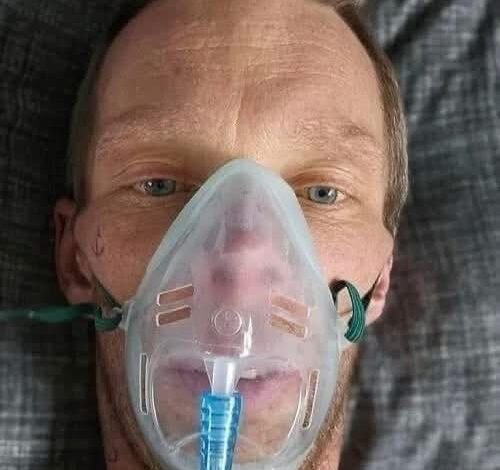
He was 35, a father of two little girls, and he spent his final years turning his fight into a lifeline for strangers. From Grimsby to the other side of the world, people watched Luke sit under harsh hospital lights and still find the strength to smile, to swear at cancer, to insist he was more than a diagnosis. Stage four leiomyosarcoma is rare, merciless, and he knew the odds. He outlived every prediction anyway.
At home on August 2, surrounded by his wife Beckey, his parents, and the family who had watched him fade and fight in equal measure, Luke finally let go. They called him a warrior and a hero because they had seen the nights the camera never caught. Now his channel is quiet, but the message he left behind isn’t: courage is not surviving forever, it’s choosing love and defiance while you still can.
Before cancer entered his life, Luke was simply a man building an ordinary future.
That is what makes stories like his land so heavily. Catastrophic illness does not arrive only in dramatic movie moments or distant headlines. Sometimes it enters through back pain ignored too long, unexplained exhaustion, a strange symptom brushed aside because life is busy and children still need breakfast and bills still need paying.
Luke was young.
Thirty-five.
A husband.
A father to two little girls who still expected bedtime stories and cuddles and the simple permanence children assume exists around their parents.
Then came the diagnosis:
stage four leiomyosarcoma.
Rare.
Aggressive.
Merciless.
Most people had never even heard the word before his story spread online. Soft tissue sarcomas occupy a strange emotional territory because they are uncommon enough to feel almost surreal. The name itself sounds clinical and distant until suddenly it belongs to someone’s husband, someone’s son, someone sitting in fluorescent hospital light trying to understand how quickly a future can collapse.
Doctors explained the odds carefully.
Stage four meant the cancer had already spread.
Treatment could slow it.
Maybe shrink it temporarily.
Maybe buy time.
But cure became increasingly unlikely.
That moment changes people forever—the instant life stops dividing neatly into years ahead and instead narrows into scans, medications, side effects, appointments, and percentages spoken in calm medical voices pretending statistics hurt less when delivered professionally.
Some people disappear inward after news like that.
Luke moved outward.
He began documenting his experience online not because he wanted pity, but because he refused invisibility. Cancer strips people aggressively:
privacy,
control,
certainty,
physical strength,
plans.
Speaking publicly became his way of reclaiming authorship over a story his body no longer fully controlled.
At first, the videos seemed almost deceptively ordinary.
Hospital visits.
Updates after treatment.
Small jokes made through exhaustion.
Moments with his family.
Fragments of fear hidden beneath stubborn humor.
But gradually something larger happened.
People connected to him.
Not because he performed heroism theatrically, but because he allowed vulnerability without surrendering dignity. He swore when treatment hurt. Admitted fear openly. Talked about mortality in ways many healthy people avoid entirely. Yet beneath everything remained a fierce insistence that cancer could threaten his life without becoming his identity completely.
That distinction mattered deeply to viewers.
Online spaces surrounding illness often swing between two extremes:
forced positivity,
or overwhelming despair.
Luke lived somewhere more honest in between.
Some days he sounded hopeful.
Some days furious.
Some days exhausted beyond language.
Real suffering is inconsistent like that.
And perhaps that honesty explains why strangers around the world began following his journey so intensely. They did not simply see a cancer patient. They saw a human being fighting to remain himself while disease slowly tried to erase ordinary life piece by piece.
From Grimsby to countries he would never physically visit, people waited for updates.
They watched him endure chemotherapy.
Scans.
Hospital stays.
Physical decline.
They watched his body weaken while his emotional stubbornness somehow remained startlingly intact.
Stage four cancer introduces brutal psychological contradictions into everyday life. Patients become simultaneously hyperaware of mortality and deeply attached to ordinary moments:
school pickups,
cups of tea,
family dinners,
quiet mornings.
Everything gains emotional weight because nothing feels guaranteed anymore.
Luke seemed to understand that instinctively.
He filmed small moments carefully because he knew they mattered:
laughing with his daughters,
holding Beckey’s hand,
celebrating stable scan results even temporarily.
The victories became smaller over time.
That made them more meaningful, not less.
People often misunderstand courage during terminal illness. They imagine courage means never crying, never fearing death, never admitting exhaustion. But real courage frequently looks quieter and more complicated:
getting up for another appointment,
allowing children to see love instead of panic,
continuing treatment while knowing the statistics,
finding reasons to laugh after terrible news.
Luke’s followers witnessed those quieter forms of bravery constantly.
And behind every public update existed realities the camera could never fully capture.
His wife Beckey saw them most directly.
The sleepless nights.
The pain management.
The moments after visitors left.
The physical deterioration impossible to hide privately.
The fear arriving suddenly at 3 a.m. when optimism felt temporarily unreachable.
Caregiving during terminal illness reshapes entire families emotionally. Loved ones become nurses, advocates, emotional anchors, and witnesses simultaneously. They learn medication schedules while grieving in advance. They celebrate tiny improvements while preparing internally for devastating decline.
Families often call people like Luke “warriors.”
Critics sometimes dislike battle language surrounding cancer, arguing it unfairly implies winners and losers. But for many families, the metaphor feels emotionally accurate because they witness daily resistance invisible to outsiders.
The fighting is real.
Not against weakness.
Against surrender.
Luke fought in exactly that sense. Not because bravery could cure metastatic cancer, but because he refused to let illness dictate the emotional meaning of his remaining time completely.
He outlived predictions repeatedly.
Doctors estimate survival using probabilities, but human beings experience time emotionally rather than statistically. Every extra month became precious. Every birthday mattered. Every holiday survived carried emotional gravity impossible to measure medically.
Followers celebrated alongside him.
Then feared alongside him when updates grew heavier.
Eventually the physical decline became undeniable.
Cancer does not only attack organs.
It consumes energy,
mobility,
appetite,
independence.
Toward the end, even speaking sometimes appeared exhausting. Yet Luke still tried reaching outward toward the community surrounding him because connection itself had become part of survival psychologically.
People who followed his journey often describe feeling strangely protective of someone they never met.
That happens when vulnerability is shared consistently online with honesty. Audiences stop consuming content passively and begin emotionally investing in outcomes. Strangers become emotionally significant because they accompany one another through fear and hope over time.
When news finally came that Luke had died at home on August 2, many people experienced genuine grief.
Not abstract sadness.
Actual grief.
Because they had watched him fight in real time.
At home, surrounded by family, he finally let go after years spent resisting something unstoppable. There is both cruelty and tenderness inside that image:
the devastation of loss,
the mercy of release.
By then, the people closest to him had already been grieving gradually for months while still loving him fiercely through every stage of decline.
His daughters will grow up carrying fragmented memories:
voices,
laughter,
photographs,
videos,
stories repeated lovingly by family members determined not to let him disappear entirely.
That may be one of the strangest aspects of modern illness narratives online. Luke documented enough of himself that his children will someday witness not only who he was physically, but how he faced fear emotionally.
That archive matters.
Not because it erases grief.
Because it preserves humanity.
Now his channel sits mostly quiet.
No new updates.
No fresh hospital videos.
No stubborn jokes after treatment sessions.
Silence always feels especially heavy after people share their lives publicly during illness. Audiences grow accustomed to hearing someone’s voice continue despite impossible circumstances. When the updates stop permanently, absence becomes tangible.
Yet the message underneath his story remains intensely alive.
Luke showed people that courage does not necessarily mean surviving forever. Human beings do not control mortality ultimately. Bodies fail. Disease wins eventually against even the fiercest fighters sometimes.
But dignity still exists inside that reality.
Love still exists.
Defiance still exists.
Humor still exists.
Connection still exists.
Luke continued choosing those things repeatedly even while death moved steadily closer.
That is why strangers called him inspiring.
Not because he defeated cancer.
Because he refused to let cancer completely erase tenderness, honesty, fatherhood, humor, or love before the end arrived.
And perhaps that is the hardest lesson terminal illness teaches the living:
life is not measured only by length,
but by presence.
By whether people continue reaching toward one another despite fear.
By whether love survives inside terrible circumstances.
By whether someone facing unimaginable pain can still help others feel less alone.
Luke did that.
From harsh hospital corridors in Grimsby to screens glowing quietly in homes across the world, he reminded strangers that even dying people remain fully human:
still laughing,
still swearing,
still loving,
still hoping,
still afraid.
Still alive right until they are not.
And long after the final update fades into silence, that humanity remains the part people carry forward with them most.