SHOCKING LIVE TELEVISION COLLISION Trump and Obama Go Head To Head In The Greatest Political Showdown Ever Captured On Camera

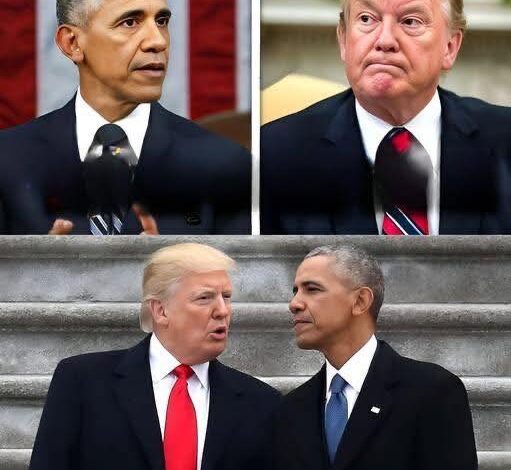
What unfolded on that stage was less an interview than a public unmasking of America’s fracture. Trump’s pivot from policy to personal indictment didn’t just challenge Obama’s legacy; it exposed how fragile the idea of shared reality has become. Each camp retreated instantly to its digital trenches, arming itself with clips, captions, and outrage, turning a single broadcast into a million parallel narratives. In that chaos, context evaporated, replaced by emotion and spectacle.
Yet beneath the noise, something deeper was revealed. The confrontation showed how politics has become performance, and how voters now judge leaders less on coherence than on impact. The question is no longer “Is this true?” but “Does this hit?” That night will be remembered not because one man “won,” but because it confirmed a darker truth: the loudest moment now writes the first draft of history, and perhaps the last.
For much of modern American history, political conflict still operated within at least the illusion of shared reality. Democrats and Republicans could disagree bitterly about taxes, wars, healthcare, or cultural values, yet they generally argued from a mutually recognized set of facts. Television networks presented similar footage. Newspapers worked from comparable timelines. Public debate revolved around interpretation more than completely separate versions of existence itself.
That fragile agreement has been collapsing for years.
And what unfolded on that stage revealed just how far the fracture has spread.
The moment itself seemed almost predictable in retrospect. Donald Trump has long understood something many traditional politicians never fully grasped:
attention is power,
emotion moves faster than policy,
and spectacle survives longer than nuance.
So when the conversation shifted away from technical policy arguments and toward personal indictment—toward Barack Obama as symbol rather than former president—the room changed instantly. It stopped feeling like governance and started feeling theatrical, almost gladiatorial.
Supporters heard strength.
Critics heard recklessness.
Neutral observers saw chaos.
And within seconds, the digital machinery surrounding modern politics activated exactly as it always does now.
Clips were isolated.
Quotes were stripped from context.
Captions transformed moments into ammunition.
Algorithms amplified outrage because outrage sustains engagement more efficiently than reflection ever could.
One broadcast became thousands of competing emotional experiences simultaneously.
That fragmentation may be the defining political condition of modern America.
People no longer consume shared events collectively. They consume customized emotional realities shaped by media ecosystems already designed to confirm prior beliefs. The same speech becomes either brilliance or disaster depending entirely on which timeline, platform, or commentator frames it first.
Truth itself starts dissolving under that pressure.
Not necessarily because facts disappear completely, but because emotional allegiance increasingly determines which facts people are willing to recognize at all.
That is what made the confrontation feel larger than politics.
It exposed epistemological collapse in real time:
a nation struggling not merely to agree on solutions,
but struggling to agree on what is actually happening.
And perhaps even more unsettling, many people no longer seem especially concerned about that collapse.
Because modern political communication increasingly rewards emotional impact over logical consistency.
The old political standard asked:
“Is this accurate?”
“Is this coherent?”
“Is this responsible?”
The newer standard often feels more primal:
“Did it dominate attention?”
“Did it humiliate the opponent?”
“Did it energize my side?”
“Did it create a moment people cannot stop replaying?”
Impact has overtaken substance.
Trump did not create that transformation entirely by himself, but he recognized it earlier and exploited it more effectively than almost anyone else in modern politics. He understands instinctively that in the age of viral media, memorable conflict often matters more politically than carefully constructed argument.
A dramatic insult spreads faster than a policy paper.
A shocking accusation outperforms nuance algorithmically every time.
Certainty, even unsupported certainty, feels emotionally stronger than complexity.
That emotional dynamic changes not only politicians, but voters too.
People increasingly experience politics less as civic participation and more as identity performance. Supporting a candidate becomes tied to tribe, worldview, cultural resentment, fear, belonging, and emotional validation all at once. Political figures evolve into symbols through which supporters project broader hopes and frustrations.
Obama represents one America.
Trump represents another.
Neither man functions merely as an individual politician anymore.
They carry mythology.
And mythology does not operate according to ordinary standards of rational debate. It operates emotionally, symbolically, almost spiritually. Every confrontation between figures like them becomes loaded with years of unresolved cultural conflict:
race,
class,
education,
globalization,
masculinity,
elitism,
patriotism,
media trust,
national identity itself.
That emotional weight explains why moments like this explode so quickly online. People are not simply reacting to statements. They are reacting to what those figures represent psychologically inside the national imagination.
Meanwhile, context dies almost immediately.
Context is slow.
Spectacle is instant.
A full interview contains ambiguity, pacing, contradiction, tone shifts, and complexity. Social media strips those away efficiently because complexity performs poorly in environments optimized for speed and emotional reaction.
So a ten-second clip becomes reality.
A screenshot becomes evidence.
A caption becomes historical memory.
The loudest interpretation often arrives before the most accurate one even finishes forming.
That shift profoundly alters how history itself gets recorded in public consciousness.
Previous generations still relied heavily on institutional gatekeepers—newspapers, broadcasters, historians—to shape collective memory gradually over time. Today, viral moments create immediate historical impressions before deeper analysis even begins. By the time nuance arrives, emotional narratives have already hardened.
People remember how events felt faster than they remember what actually happened.
That is why the confrontation mattered culturally beyond its immediate political implications. It demonstrated how modern politics increasingly resembles entertainment architecture:
conflict-driven,
personality-centered,
emotionally addictive,
algorithmically amplified.
Television once influenced politics.
Now politics often imitates television directly.
Characters matter more than coalitions.
Moments matter more than platforms.
Performance matters more than procedure.
And perhaps most importantly, attention itself becomes the ultimate currency.
Trump thrives inside that environment because he intuitively understands media gravity. He knows how to create moments impossible to ignore. Critics frequently underestimate how much modern political success depends not on universal approval, but on dominating collective attention long enough to define the emotional atmosphere surrounding an event.
Obama, by contrast, emerged politically during a period when eloquence, restraint, and intellectual coherence still carried broader cultural authority. His style depended heavily on measured persuasion and rhetorical sophistication. Trump’s style depends on disruption, instinct, provocation, and emotional immediacy.
Their confrontation therefore symbolized more than personal rivalry.
It represented two entirely different eras of political communication colliding publicly.
One rooted in institutional credibility and narrative discipline.
The other rooted in emotional velocity and digital fragmentation.
The audience watching experienced that clash according to their own emotional wiring.
Some saw Trump exposing uncomfortable truths establishment figures avoid.
Others saw him accelerating institutional erosion recklessly.
Some admired Obama’s composure.
Others interpreted restraint itself as weakness.
Again:
parallel realities.
And perhaps the deepest tragedy is not disagreement itself. Democracies survive disagreement constantly. The deeper danger emerges when citizens lose faith not only in opponents, but in the possibility of objective mediation altogether.
When every institution becomes suspect,
every fact negotiable,
every event instantly tribalized,
shared civic life weakens profoundly.
Because democracy ultimately depends on more than elections. It depends on some minimal belief that fellow citizens occupy the same reality even while disagreeing about its meaning.
That belief now feels increasingly unstable.
Yet emotionally, spectacle remains irresistible.
People claim to hate political theater while consuming it obsessively. Clips circulate because conflict activates ancient psychological instincts:
tribal defense,
dominance,
humiliation,
victory,
fear.
Modern media ecosystems monetize those instincts brilliantly.
Every outrage becomes engagement.
Every confrontation becomes content.
Every viral political moment becomes economic fuel for platforms designed to maximize emotional intensity.
The confrontation onstage therefore existed simultaneously as politics,
performance,
media event,
psychological warfare,
and algorithmic product.
That complexity makes modern political life exhausting in ways previous eras may not fully recognize. Citizens are bombarded constantly with emotionally heightened fragments demanding immediate reaction before reflection becomes possible.
And still, beneath all the spectacle, real consequences remain.
Policies matter.
Courts matter.
Elections matter.
Institutions matter.
But those realities increasingly compete against emotional narratives moving faster than governance itself.
Perhaps that is why the moment lingered so heavily afterward. Not because it resolved anything. Not because one side definitively “won.” But because it clarified the condition of the country with unusual bluntness.
America is no longer arguing only about policy.
It is arguing about reality,
authority,
truth,
identity,
and which emotional story deserves to become national memory.
That is a far more dangerous conflict than ordinary partisanship.
And in the age of endless clips, endless feeds, and endless outrage, the loudest moment often becomes the version history remembers first—sometimes before history even has time to understand itself.
Whether that remains merely chaotic or becomes truly irreversible may define the next era of American life more than any single speech, election, or politician ever could.