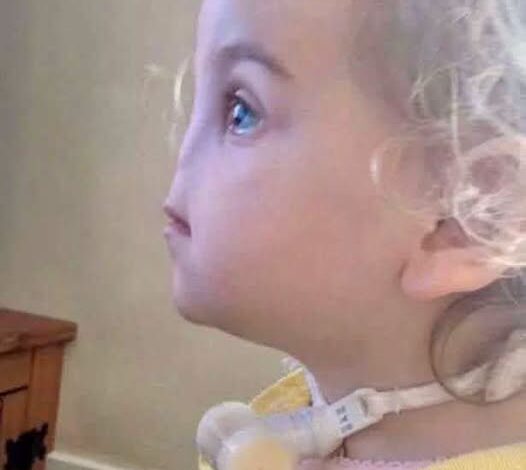
From the moment she took her first breath, Tessa challenged everything doctors thought they knew.
When she was born, the delivery room fell silent. Her parents, Grainne and Nathan, had spent months imagining the day they would finally meet their daughter. Every prenatal scan had suggested a healthy pregnancy, leaving no hint that anything was unusual. But when Tessa arrived, they were met with a reality no one had anticipated.
She had been born without a nose.
The condition, known as Bosma arhinia microphthalmia syndrome, is extraordinarily rare, affecting only a handful of people worldwide. Because her nasal passages had never developed, Tessa could not breathe the way most newborns do. The first moments of her life became a race against time as doctors worked to secure her airway and stabilize her fragile condition.
For Grainne and Nathan, joy was immediately intertwined with fear.
Instead of bringing their newborn home after the usual celebrations, they found themselves surrounded by specialists, complex medical terminology, and difficult decisions. The future they had imagined disappeared in an instant, replaced by uncertainty about whether their daughter would survive, how she would grow, and what challenges awaited her.
Like many parents facing an unexpected diagnosis, they experienced grief—not because they loved Tessa any less, but because they had to let go of the future they had imagined and embrace one they could never have predicted.
That adjustment was not easy.
But it changed everything.
Rather than allowing fear to define their daughter’s story, they made a decision that would shape every step that followed. They refused to hide her from the world or let her condition become the only thing people saw. Instead, they committed themselves to giving Tessa every opportunity modern medicine could provide while surrounding her with unwavering love and acceptance.
Only two weeks after she was born, Tessa underwent a tracheostomy, a procedure that created an opening in her windpipe to help her breathe safely. It also allowed her to eat and develop in ways that would otherwise have been impossible.
For most families, such an operation would be one of the most frightening moments they could ever experience.
For Tessa’s family, it was only the beginning.
As she grew, hospital visits became part of everyday life. Medical appointments replaced ordinary routines, and surgeries became milestones marking her progress rather than interruptions to it. Challenges that would overwhelm many adults became experiences this little girl faced before she was even old enough to understand why they were necessary.
Yet those who met Tessa often noticed something remarkable.
They saw a cheerful child whose curiosity outweighed her fear.
They saw parents who celebrated victories others might consider ordinary—a successful procedure, a peaceful night’s sleep, another step toward greater independence.
Behind every milestone stood a team of surgeons, specialists, engineers, and researchers determined to expand the possibilities for children born with rare craniofacial conditions.
One of the most groundbreaking moments came when Tessa was just two years old.
Using advanced 3D-printing technology and meticulous surgical planning, doctors created a custom cosmetic nasal implant designed specifically for her unique facial anatomy. The procedure represented a pioneering achievement in reconstructive medicine, making Tessa one of the youngest patients ever to receive such an implant.
It was far more than a cosmetic procedure.
The operation demonstrated how advances in technology could be adapted to help children with some of the world’s rarest medical conditions, offering hope not only to Tessa but also to families facing similar diagnoses in the future.
Even with those remarkable advances, some challenges remain.
Because Tessa was born without the structures necessary for a normal sense of smell, she cannot detect everyday odors or recognize potentially dangerous ones such as smoke or gas leaks. What many people experience without thinking requires constant awareness from those around her.
Her parents have adapted accordingly.
Their home is carefully monitored. Safety measures are planned with extraordinary attention to detail. The vigilance that protects Tessa has become second nature—not out of fear, but out of love.
Every ordinary day involves countless quiet acts of preparation that most families never have to consider.
Yet despite these realities, Grainne and Nathan have consistently refused to let their daughter’s story be defined by limitation.
Instead, they chose openness.
Through their Facebook page, “Tessa; Born Extraordinary,” they have invited the public into their journey—not to seek sympathy, but to foster understanding. Their posts document surgeries, recoveries, family milestones, and joyful everyday moments with honesty and hope, helping people around the world see beyond appearances.
Rather than presenting Tessa as someone to be pitied, they celebrate her resilience, humor, and personality.
That perspective has resonated with thousands of people.
Families raising children with rare conditions have found encouragement in Tessa’s journey. Others have gained a deeper appreciation for the strength required to navigate complex medical challenges while still embracing the ordinary joys of childhood.
Most importantly, children who look different can see someone who reminds them that uniqueness is not something to hide.
Tessa’s story gently challenges assumptions about beauty, normalcy, and disability. It asks people to look beyond first impressions and recognize the person before the diagnosis.
Every surgery she has endured speaks to remarkable medical innovation.
Every smile she shares reflects extraordinary courage.
And every decision her parents have made demonstrates the quiet determination of a family unwilling to let fear have the final word.
Today, Tessa continues to grow surrounded by unwavering support, remarkable medical care, and a community inspired by her journey. While Bosma arhinia microphthalmia syndrome remains exceptionally rare, her life has helped bring greater awareness to the condition and highlighted the possibilities created by advances in reconstructive medicine.
Her story is not one of tragedy.
It is one of resilience, innovation, and unconditional love.
Born into a world unprepared for her arrival, Tessa has done something extraordinary. She has encouraged countless people to rethink what it means to be different, proving that courage is not measured by the obstacles someone faces, but by the hope they carry through them. In doing so, she has become exactly what her parents believed she could be from the very beginning—not a child defined by what she lacks, but a young girl whose strength continues to inspire everyone fortunate enough to know her story.