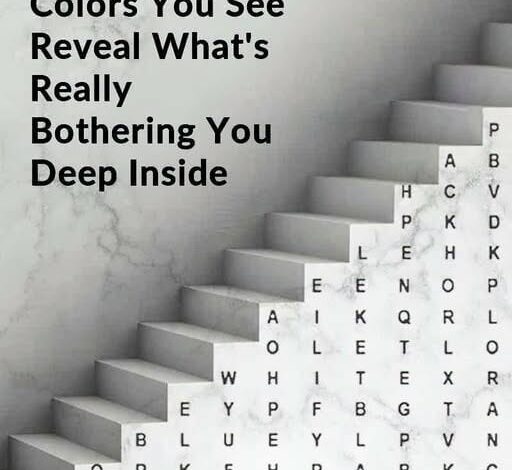
The first three colors that catch your attention often feel surprisingly personal.
You glance at an image, immediately notice red, blue, and yellow—or perhaps green, black, and white—and before long someone is offering a detailed explanation of what those choices supposedly reveal about your personality, emotions, or future.
It’s easy to see why these color exercises have become so popular.
They invite us to pause for a moment and look inward.
But it’s important to understand what they can—and cannot—tell us.
Your brain doesn’t choose colors at random.
It naturally pays attention to what stands out visually, what contrasts with its surroundings, and what feels emotionally significant based on your own memories and experiences. The colors that draw your eye first may reflect familiarity, personal preference, cultural associations, or simply what happens to be most visually prominent in the image you’re viewing.
That doesn’t make the exercise meaningless.
It simply means the meaning comes from you—not from the colors themselves.
Color psychology has long shown that people often associate certain colors with particular emotions or ideas.
Red is commonly linked with passion, excitement, urgency, or danger.
Blue is frequently connected with calmness, trust, or stability.
Yellow may suggest optimism, warmth, or energy.
Green is often associated with nature, growth, or renewal.
Black can represent elegance, strength, mystery, or, in some contexts, grief.
White is commonly connected with simplicity, peace, or new beginnings.
Yet none of these associations are universal.
Culture shapes them.
Personal history shapes them.
Life experiences shape them.
One person may see blue and think of peaceful ocean vacations.
Another may immediately remember a difficult period of loneliness.
Black might symbolize sophistication for one individual and mourning for another.
The same color can carry completely different emotional weight depending on the story attached to it.
That is why there is no single “correct” interpretation.
Color exercises become most valuable when they encourage reflection rather than prediction.
Instead of asking, “What does this color mean?” a more useful question might be, “Why did this particular color stand out to me today?”
Sometimes the answer is surprisingly simple.
Perhaps you’ve been spending more time outdoors, making green feel especially comforting.
Maybe you’re decorating a room, and certain colors are already on your mind.
Or perhaps a recent memory has quietly made one color feel more emotionally significant than another.
Those personal connections matter far more than any universal list of symbolic meanings.
A thoughtful way to use this exercise is to keep it simple.
Choose the first three colors that immediately catch your eye without overthinking them.
Then, for each one, write a single honest sentence describing what it makes you think or feel at this moment.
Don’t edit yourself.
Don’t search for the “right” answer.
Simply notice what comes naturally.
You might write:
- Blue: “I wish life felt as peaceful as this color.”
- Yellow: “I miss feeling excited about what’s coming next.”
- Black: “I’ve been carrying more stress than I’ve admitted.”
The colors didn’t create those thoughts.
They simply provided a starting point.
That distinction is important.
Exercises like this are not personality tests, psychological diagnoses, or tools for predicting your future.
They cannot reveal hidden truths with certainty.
Instead, they function as gentle prompts that encourage self-reflection.
Sometimes all we need is a small invitation to notice feelings we’ve been too busy to acknowledge.
A single honest sentence can reveal far more than pages of carefully rehearsed explanations.
You may recognize pressure you’ve quietly accepted as normal.
You may notice sadness you’ve been minimizing.
You may finally admit frustration you’ve kept buried beneath everyday routines.
None of those discoveries come from the colors themselves.
They come from your willingness to pause and listen to your own thoughts.
In that sense, the exercise isn’t about color at all.
It’s about attention.
Life moves quickly.
Many emotions remain unnoticed simply because we rarely stop long enough to examine them.
Something as simple as choosing three colors can interrupt that routine, creating a brief moment of curiosity and honesty.
Sometimes that’s enough to begin an important conversation—with yourself.
The colors won’t solve problems.
They won’t erase grief, anxiety, or uncertainty.
They won’t provide magical answers or hidden predictions.
What they can do is encourage awareness.
And awareness is often the first meaningful step toward understanding what you’re feeling and deciding what to do next.
Perhaps that’s why these exercises continue to resonate with so many people.
Not because colors hold secret messages, but because they remind us to slow down, pay attention, and ask ourselves questions we don’t always think to ask.
The answers have been there all along.
The colors simply give us a quiet place to begin looking.