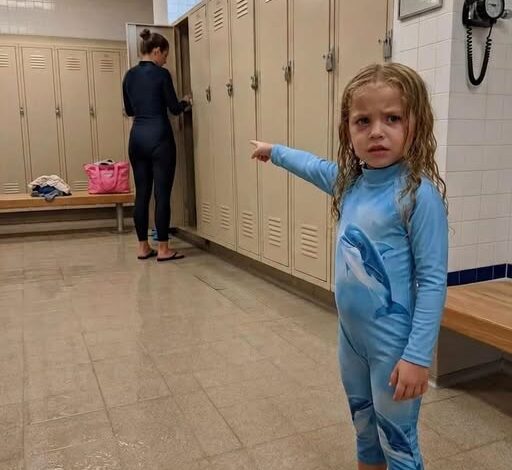
My Five-Year-Old Daughter Tugged My Arm in the Swimming Pool Changing Room and Whispered, ‘Mommy, We Have to Save Daddy! That Lady Put Him in Her Locker!’

I was certain I had uncovered my husband’s affair.
Every clue pointed in the same direction.
The unexplained absences.
The strange changes in routine.
The moments when he seemed distracted even while sitting across from me at dinner. At first, I ignored the uneasy feeling growing inside me, convincing myself that every marriage goes through difficult seasons.
Then I saw the woman.
She wasn’t someone I recognized.
She wasn’t a coworker I had heard about or a neighbor from across town. She was simply a stranger who appeared in my husband’s life often enough to make every instinct I had begin sounding alarms.
I told myself there had to be an explanation.
But I stopped believing that long before I followed him.
The afternoon everything changed, I parked half a block away and watched.
My heart pounded so hard I could hear it over the engine.
When I saw who I believed was Henry walk up the front path, the world around me seemed to disappear.
The woman opened the door.
She smiled.
Then she kissed him.
Not a casual greeting.
Not the kind of hug friends share.
A kiss.
The kind that leaves no room for innocent explanations.
In that instant, eighteen years of memories flashed through my mind all at once.
Our wedding.
The first apartment we struggled to afford.
Family vacations.
Birthdays.
Arguments we’d survived together.
Promises we’d made when life felt simpler.
I watched them collapse one by one.
I didn’t confront him.
I couldn’t.
I drove home in silence, barely remembering how I got there.
For the next two days, I moved through life like someone watching it happen from outside my own body.
Henry texted exactly as he always had.
“How’s your day?”
“Love you.”
“Need anything from the store?”
Every message felt surreal.
How could someone betray me so completely while sounding so ordinary?
I answered because I didn’t know what else to do.
Inside, I was already mourning my marriage.
By the time he walked through our front door each evening, I had rehearsed a hundred different confrontations.
None of them ever happened.
I kept waiting for him to confess.
He never did.
Finally, I couldn’t carry the weight any longer.
“I know,” I told him.
He looked genuinely confused.
“Know what?”
“I saw you.”
His expression didn’t change.
“I followed you.”
Still nothing.
“I saw you kiss her.”
For a long moment, he simply stared at me.
Then he said something that made no sense at all.
“Which one of us did you see?”
I blinked.
“What?”
“Which one?”
I thought he was mocking me.
“I saw you.”
“No,” he said quietly.
“I don’t think you did.”
He disappeared down the hallway and returned carrying an old cardboard storage box I had never seen before.
Inside were photographs.
Birth certificates.
Family albums.
Newspaper clippings.
Two baby bracelets.
Two identical little boys smiling into the camera.
My husband pointed to one.
“That’s me.”
Then he pointed to the other.
“That’s my brother.”
I felt the room shift beneath me.
“My… what?”
“My identical twin.”
I couldn’t speak.
Henry had an identical twin brother.
A brother I had never heard mentioned.
Not once.
Not in all the years we’d been together.
His name was Daniel.
As Henry slowly explained the story, pieces of a life I thought I understood began rearranging themselves.
They had once been inseparable.
Growing up, they had shared everything—bedrooms, birthdays, friends, clothes, and even the occasional harmless prank that confused teachers and neighbors.
But adulthood changed everything.
A bitter family conflict drove them apart.
Old wounds deepened.
Harsh words were exchanged.
Then tragedy struck.
Someone close to the family died.
Blame spread through everyone involved.
Instead of healing together, the brothers stopped speaking altogether.
Years passed.
Eventually, Henry convinced himself the relationship was over forever.
When we met, Daniel simply no longer existed in the version of his life he chose to tell.
Not because his brother had died.
Because pretending he didn’t exist hurt less than explaining why they no longer spoke.
“I kept thinking I’d tell you someday,” Henry admitted.
“Then too much time had passed.”
Each year made the secret feel harder to explain than the year before.
So silence became habit.
When I followed the man to that house, I hadn’t been following Henry at all.
I had been following Daniel.
The woman on the porch wasn’t a secret lover.
She was Daniel’s wife.
The jacket.
The car.
The familiar walk.
Even their voices.
Everything my eyes believed had been built upon one fact I never knew.
They were identical twins.
The slap I had imagined delivering to my unfaithful husband suddenly seemed absurd.
But the relief didn’t erase the hurt.
I looked at Henry differently now.
Not because he had been unfaithful.
Because he had allowed me to build an entire marriage without knowing something so fundamental about his life.
“You let me believe I knew you,” I whispered.
“I thought you did.”
“I knew the version you gave me.”
He lowered his eyes.
“I was ashamed.”
Ashamed of the family war.
Ashamed of how it ended.
Ashamed that he had spent years pretending a brother no longer existed.
He believed leaving Daniel out of every story would protect both of us from reopening old wounds.
Instead, the silence created a different kind of wound.
One neither of us saw coming.
Forgiveness arrived in unexpected pieces.
I could forgive the mistaken assumptions.
I could forgive the confusion that made me believe I had witnessed an affair.
I could even understand why seeing two identical men would fool anyone.
What proved harder was accepting that the greatest deception had never been another woman.
It had been omission.
An entire chapter of my husband’s life quietly removed before I ever had the chance to read it.
We’re still learning how to rebuild from that discovery.
Trust, I’ve learned, isn’t damaged only by lies.
Sometimes it’s weakened by the truths left untold.
Love doesn’t require perfection.
It does, however, require honesty deep enough to let another person see the uncomfortable parts of your story—not only the chapters you’re proud to share, but also the ones you’d rather forget.
Because real intimacy isn’t built on carefully edited histories.
It’s built on the courage to tell the whole story, even when doing so feels frightening.
I still love Henry.
Perhaps even more deeply than before.
But now our marriage rests on something stronger than assumptions.
It rests on the understanding that love isn’t simply believing someone without question.
It’s trusting them enough to ask for the truth—and trusting them enough to finally tell it, no matter how much it hurts.