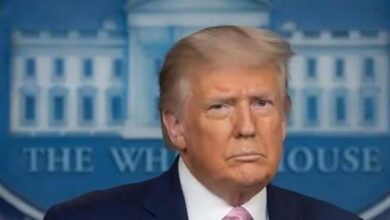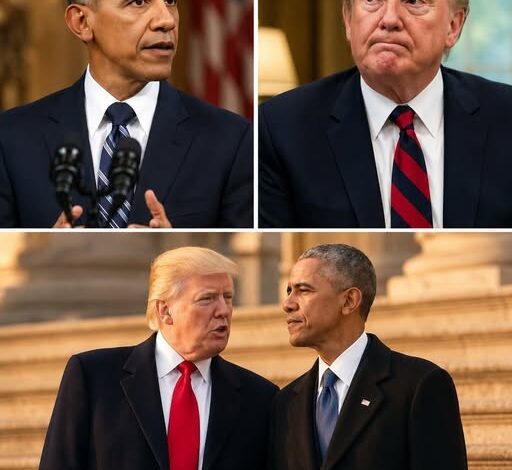
The moment spread because it felt bigger than television.
What was described as a tense political exchange involving Donald Trump and Barack Obama quickly became more than another clip in the endless stream of online commentary. To many viewers, it looked like two eras of American politics colliding in real time — two names, two styles, and two visions of the country forced back into the same national conversation.
At first, the scene was framed as a routine political discussion. Then the tone reportedly sharpened. What might have been ordinary commentary began to feel charged, emotional, and difficult to ignore. Viewers were not only listening to the words. They were watching expressions, pauses, posture, and every subtle signal that could be turned into meaning.
That is why the reaction was immediate.
Trump and Obama are not simply former presidents in the public imagination. They remain symbols. Obama is often associated with calm delivery, institutional confidence, and a message built around unity and gradual progress. Trump, by contrast, is linked to confrontation, disruption, loyalty, and a political style designed to dominate attention.
When their names appear in the same story, people rarely treat it as neutral.
They bring history with them.
Old campaigns. Old insults. Old speeches. Old arguments about race, power, patriotism, leadership, and what America should become. A single reported exchange can awaken years of unresolved political emotion.
For Trump’s supporters, the moment may have looked like strength — proof that he remains willing to challenge the establishment and confront figures they believe have long looked down on them. For Obama’s supporters, the same scene may have looked like a contrast in temperament, a reminder of dignity, restraint, and the dangers of political spectacle.
That is the strange power of modern politics.
The same moment can become two completely different stories.
Social media only intensified the split. Clips began circulating quickly, often without the full context of the discussion. Some posts highlighted the sharpest lines. Others added dramatic captions. Comment sections filled with praise, outrage, sarcasm, and certainty. Within minutes, the exchange was no longer just something people watched. It had become something they used.
A clip became evidence.
A pause became proof.
A facial expression became a political argument.
This is how political media now works. Long conversations are reduced to seconds. Complicated ideas are flattened into viral moments. The most emotional fragment often travels faster than the most accurate explanation. In that environment, people are encouraged to react before they understand.
The reported Trump-Obama clash became popular not only because of who was involved, but because it fit perfectly into the current media machine. It offered conflict, familiarity, symbolism, and emotional reward. Everyone could see what they already believed.
That may be the most revealing part.
The real story is not just whether one man “won” the exchange or whether the moment was as dramatic as people claimed. The deeper story is how quickly Americans turn political moments into cultural battles. Public events no longer have one meaning. They are filtered through party loyalty, personal identity, online communities, and years of frustration.
By the time many people see a viral clip, the interpretation has already been handed to them.
Powerful.
Humiliating.
Disrespectful.
Historic.
Pathetic.
Brilliant.
The label often arrives before the facts.
That makes real understanding harder. Context disappears. Viewers may not know what was said before or after the tense moment. They may not know whether the clip fairly represents the full exchange. But they know how they are supposed to feel, because the internet tells them instantly.
Still, the fascination with Trump and Obama reveals something important. Both men continue to occupy enormous space in American political identity. Trump represents a movement built on resentment, populism, defiance, and distrust of traditional institutions. Obama represents a different political memory — hope, diversity, composure, and belief in the system’s ability to improve.
To many Americans, they are not just politicians.
They are competing symbols of the country itself.
That is why any reported clash between them becomes larger than the details. People project their fears, loyalties, hopes, and anger onto it. A short exchange becomes a national mirror. What people see depends largely on what they already carry.
In the end, the moment matters less as a contest between two famous men and more as a warning about how politics is consumed now. Attention rewards drama. Outrage spreads faster than patience. A sharp line can eclipse an entire discussion. A viral clip can shape public memory more powerfully than the full truth.
The lesson is simple but difficult: look beyond the headline.
A democracy cannot survive on fragments alone. Real political understanding requires context, patience, and the willingness to question the version of events that feels most satisfying.
In a culture driven by speed, emotion, and performance, the rarest act may be the most important one:
Pause before reacting.
Watch more than the clip.
And remember that the loudest version of a political moment is not always the truest one.