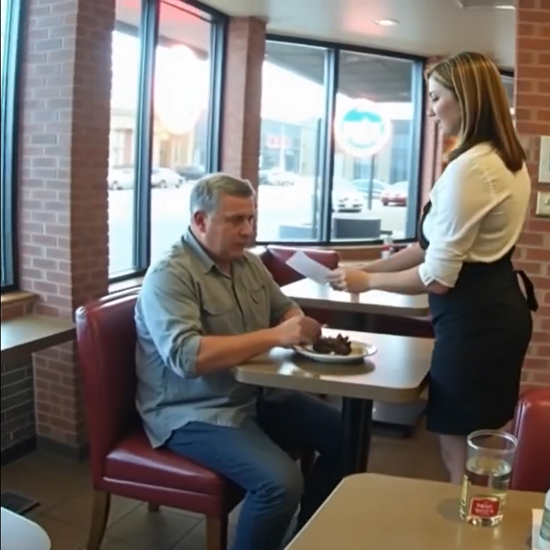
The smell of sizzling steak and caramelized onions drifted through Whitmore’s Chop House like a familiar promise. Laughter rolled across the dining room. Glasses clinked. Servers weaved between tables carrying heavy trays loaded with ribeyes and baked potatoes.
To the customers, it looked like another successful night.
To Daniel Whitmore, something felt wrong.
The founder of the restaurant chain stood near the entrance, observing quietly. Years of building businesses had taught him a simple truth: numbers could be manipulated, reports could be polished, and managers could hide behind impressive statistics.
But people couldn’t hide exhaustion forever.
As he scanned the room, he noticed things most guests never would.
A server forced a smile that never reached her eyes.
A line cook avoided looking toward the manager’s office.
A hostess flinched slightly when a sharp voice echoed from the back.
Tiny details.
Yet together they painted a troubling picture.
Daniel slipped his hand into his pocket and felt the folded note waiting there.
Six words.
Six words that had brought him to Fort Smith.
You need to see what’s happening.
The message had arrived anonymously three days earlier. No signature. No explanation.
Only a plea.
And now, standing inside one of his most profitable locations, Daniel was beginning to understand why.
His eyes drifted toward Bryce.
The restaurant manager stood near the hostess stand greeting regular customers with a confident smile. On paper, Bryce Anderson was a star employee. Revenue targets exceeded expectations. Food costs remained low. Corporate evaluations praised his efficiency.
Everything about him looked impressive.
Everything except the atmosphere surrounding him.
Employees moved carefully when Bryce was nearby. Conversations stopped when he approached. Shoulders stiffened.
Fear had a way of revealing itself.
And Daniel knew exactly what it looked like.
Across the room, a young server caught his eye.
Jenna.
The woman who had finally agreed to meet him.
She glanced toward the hallway leading to the kitchen and gave the slightest nod.
Now.
Daniel followed.
He moved through the EMPLOYEES ONLY door and stepped into a narrow corridor lined with stainless-steel shelving and humming refrigeration units. The sounds of the dining room faded behind him.
The farther he walked, the quieter it became.
At the end of the hallway stood Jenna.
Under the harsh fluorescent lights, she looked younger than he expected. Nervous. Tired.
But determined.
She kept glancing over her shoulder as if expecting someone to appear.
When Daniel reached her, she swallowed hard.
“Mr. Whitmore…”
“Daniel,” he corrected gently. “Please.”
She nodded.
“Daniel.”
For a moment, neither spoke.
Then the words started pouring out.
“I wasn’t sure you’d come.”
“You sounded like it mattered.”
A bitter laugh escaped her.
“It does.”
Daniel waited.
Over the years, he’d learned that people often needed silence more than questions.
Finally, Jenna took a deep breath.
“Bryce isn’t the person corporate thinks he is.”
The statement hung in the air.
Daniel remained silent.
“He manipulates schedules,” she continued. “If someone disagrees with him, suddenly their hours disappear. He pressures people into covering shifts they can’t work. He cuts corners everywhere—staffing, supplies, training. Then he makes employees take the blame when something goes wrong.”
Daniel listened carefully.
“Has anyone reported it?”
Jenna’s expression darkened.
“A few tried.”
“And?”
“Nothing happened.”
Daniel felt a familiar knot tighten in his stomach.
The worst kind of workplace problems weren’t caused by incompetence.
They were caused by silence.
“People are scared,” Jenna said quietly. “Most of us need these jobs. Bryce knows that.”
The hallway felt colder somehow.
Daniel folded his arms.
“What about the rest of the team?”
Jenna’s eyes softened.
“They’re good people.”
There was no hesitation in her voice.
“They care about this place. They work hard. They’re just exhausted.”
Her gaze drifted toward the kitchen.
“You built something people were proud to work for.”
The words hit harder than she realized.
“You should see how things feel now.”
Daniel looked away briefly.
Because he understood exactly what she meant.
Years ago, he’d started with one small restaurant and a secondhand grill.
He remembered washing dishes after midnight.
Taking orders.
Mopping floors.
He remembered every employee who had helped build the company from nothing.
Restaurants weren’t made of brick and steel.
They were made of people.
And somewhere along the way, this location had forgotten that.
“Thank you for telling me,” Daniel said finally.
Jenna looked uncertain.
“You believe me?”
Daniel met her eyes.
“I do.”
Relief flooded her face.
For the first time since he’d arrived, her shoulders relaxed.
Just a little.
But enough.
And that was when Daniel made his decision.
This wouldn’t be handled from a boardroom.
He would see everything himself.
The next several days became an exercise in observation.
Daniel arrived early.
Stayed late.
Listened more than he spoke.
The deeper he looked, the more disturbing the pattern became.
A line cook quietly revealed that Bryce delayed supply orders to make budgets look better, forcing staff to improvise during busy weekends.
A server described being publicly humiliated during a rush because a customer complained about a mistake that wasn’t hers.
A host admitted she often worked double shifts because Bryce refused to hire additional support.
None of the stories alone seemed catastrophic.
Together they revealed a culture built on intimidation.
And intimidation always came with a hidden cost.
Morale.
Trust.
Pride.
The very things that made great teams successful.
Jenna became one of Daniel’s most valuable allies.
She understood the staff dynamics better than anyone.
She knew who felt overlooked.
Who was struggling.
Who still believed things could improve.
Most importantly, she knew who had stopped believing.
Those employees concerned Daniel the most.
Because when people lose hope, they stop caring.
And when they stop caring, an organization begins to die from the inside.
Slowly.
Quietly.
Almost invisibly.
Daniel wasn’t about to let that happen.
He implemented small changes first.
Fairer scheduling.
Clear communication procedures.
Additional staffing support during peak hours.
Nothing dramatic.
Nothing that would immediately trigger resistance.
But employees noticed.
They noticed their concerns being addressed.
They noticed promises being kept.
Most importantly, they noticed someone listening.
The atmosphere began changing.
At first, the shifts were subtle.
A joke shared during prep.
A laugh in the break room.
A conversation that didn’t stop when a manager walked by.
Then the transformation accelerated.
Servers helped each other more.
Kitchen staff communicated better.
New employees seemed less anxious.
For the first time in months, people started acting like a team again.
Even customers noticed.
Online reviews improved.
Guest satisfaction scores climbed.
The dining room felt lighter.
Warmer.
Alive.
Which made Bryce increasingly uncomfortable.
Daniel could see it.
The manager’s confidence began cracking around the edges.
Questions he once dismissed now required answers.
Decisions he once made unchallenged now faced scrutiny.
Eventually, the confrontation became unavoidable.
Daniel scheduled a private meeting.
Bryce entered the office looking composed.
But not relaxed.
He knew something was coming.
Daniel gestured toward a chair.
“Sit down.”
Bryce complied.
The founder opened a folder filled with notes.
Employee statements.
Operational reports.
Scheduling records.
Evidence collected carefully and methodically.
Nothing exaggerated.
Nothing emotional.
Just facts.
For nearly an hour, Daniel walked through the findings.
Each example.
Each inconsistency.
Each complaint.
Bryce’s posture stiffened with every page.
At first he denied everything.
Then he minimized it.
Then he blamed employees.
Finally, he ran out of explanations.
Silence filled the office.
Daniel leaned forward.
“Leadership isn’t about control.”
Bryce looked away.
“It’s about responsibility.”
The manager said nothing.
“You achieved results,” Daniel continued. “But you did it by creating fear.”
The words landed heavily.
“And fear isn’t leadership.”
For the first time, Bryce had no response.
The conversation ended with clear expectations, corrective measures, and ongoing oversight.
Whether Bryce improved or not would depend entirely on his choices.
But one thing was certain.
The old way was over.
The following weeks brought visible progress.
Communication improved.
Employee turnover slowed.
Productivity increased without constant pressure.
People began taking pride in their work again.
Not because they were afraid.
Because they wanted to.
Jenna emerged as a natural leader.
She mentored new employees.
Supported coworkers.
Solved problems before they escalated.
The confidence that had once been buried beneath anxiety finally had room to grow.
Watching her transformation reminded Daniel why he loved this business in the first place.
Great leaders didn’t create followers.
They created more leaders.
Two weeks later, Daniel gathered the entire staff before opening.
The dining room was quiet.
Employees stood together near the booths and tables they knew so well.
Some looked nervous.
Others curious.
Daniel stepped forward.
“I want to thank all of you.”
The room fell silent.
“This restaurant succeeds because of the people standing here.”
He looked around carefully.
Every face.
Every employee.
Every person who made the operation run.
“Over the last few weeks, I’ve seen resilience. Professionalism. Commitment.”
Several employees exchanged surprised glances.
Many had gone a long time without hearing praise.
“Never forget that respect isn’t earned through fear,” Daniel continued. “It’s earned through trust.”
The words settled over the room.
“You deserve a workplace where your voice matters.”
A server wiped away a tear.
A cook nodded quietly.
Jenna smiled.
And for the first time since arriving in Fort Smith, Daniel felt genuine confidence about the future.
When the meeting ended, applause filled the restaurant.
Not loud.
Not dramatic.
But heartfelt.
Real.
The kind that meant something.
Later that night, Daniel stepped outside.
Cool Arkansas air greeted him.
The parking lot shimmered beneath rows of streetlights.
Behind him, the restaurant buzzed with energy.
Servers laughed as they prepared for the next rush.
Kitchen staff joked while organizing supplies.
The tension that once clung to the building had disappeared.
In its place stood something stronger.
Trust.
Daniel paused beside his truck and looked back one final time.
The glowing Whitmore’s Chop House sign illuminated the night sky.
Inside, employees moved with confidence.
Customers enjoyed their meals.
And the heartbeat of the restaurant felt healthy again.
Not because of new policies.
Not because of corporate reports.
But because people had finally been heard.
As Daniel climbed into the driver’s seat, he allowed himself a small smile.
Challenges would come again.
They always did.
But tonight proved something important.
One person willing to speak up.
One leader willing to listen.
And one team willing to believe in change.
Sometimes that was all it took to transform an entire workplace.
The engine started.
Headlights cut across the pavement.
And as Daniel drove into the Fort Smith night, he carried with him a simple reminder: