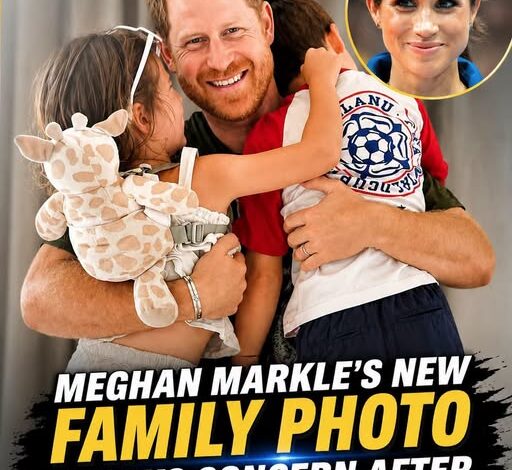
What should have been remembered as a simple, affectionate family photograph quickly became something far more revealing—not about Prince Harry, Meghan Markle, or their children, but about the culture surrounding celebrity itself. A quiet image of a father spending time with his son and daughter was transformed into a battleground of assumptions, where every tiny detail became evidence for competing narratives. In an age where a single photograph can travel the world in minutes, the picture stopped being a family memory and became a canvas onto which millions projected their own beliefs, frustrations, and suspicions.
At first glance, the moment appeared ordinary. Harry was with Archie and Lilibet outdoors, sharing the kind of relaxed family experience countless parents enjoy every day. There were no grand gestures, carefully choreographed poses, or glamorous backdrops demanding attention. It felt spontaneous and intimate—a snapshot that captured the small, imperfect moments that often become the most treasured memories in family albums.
Yet that simplicity did not survive for long.
Almost immediately, online commentators began examining the image with remarkable intensity. Every corner of the frame was scrutinized as though it contained hidden clues waiting to be uncovered. Innocent details were stripped of their ordinary meaning and assigned entirely new significance. Harry’s bare feet, which many families would barely notice during a casual day outside, were labeled by critics as evidence of carelessness or an attempt to manufacture authenticity. A backpack resting naturally within the scene became, in some interpretations, a deliberately placed prop designed to influence public perception.
Even the children’s body language became the subject of endless speculation.
Because Archie and Lilibet were facing away from the camera instead of smiling toward it, some viewers concluded there must be emotional distance within the family. Others suggested the children appeared detached or uncomfortable, despite the reality that young children rarely behave according to the expectations adults place upon photographs. They wander. They explore. They become fascinated by insects, flowers, sticks, and countless other distractions that pull their attention away from cameras.
To many parents, nothing about the image seemed unusual.
Children often end a day outdoors with dirty clothes, messy hair, scraped knees, and grass stains that tell stories of climbing, running, and discovering the world around them. Those signs are rarely viewed as failures of parenting. More often, they are quiet reminders that childhood is meant to be active, curious, and wonderfully imperfect.
But once a family exists beneath the relentless glare of global attention, ordinary moments are rarely allowed to remain ordinary.
Supporters of Harry and Meghan saw the photograph as something refreshingly genuine. Rather than presenting another polished royal portrait, they believed it reflected parents trying to give their children as normal an upbringing as circumstances allow. To them, the image represented freedom—the freedom to play, explore nature, and spend time together without every second being carefully managed for public approval.
Critics reached the opposite conclusion.
They viewed the same photograph through a lens already shaped by years of headlines, interviews, documentaries, and public controversies involving the couple. Instead of seeing a peaceful family outing, they saw confirmation of opinions they had already formed. Every perceived imperfection reinforced existing beliefs, proving once again how powerfully expectations shape what people believe they see.
That contrast highlights an uncomfortable truth about modern media consumption.
People rarely approach celebrity images as blank slates. Instead, they arrive carrying preconceived ideas, loyalties, and frustrations that influence every interpretation. The photograph itself becomes almost secondary. What truly matters is the story each viewer already wants to tell.
Beneath the arguments over bare feet, backpacks, and body language lies a much larger conversation about privacy in the digital age.
Harry and Meghan have repeatedly expressed their desire to protect Archie and Lilibet from the intense public scrutiny that has followed the royal family for generations. Their decision to limit public appearances and carefully control photographs of their children has sparked ongoing debate. Some respect their efforts to preserve a normal childhood, while others argue that public figures inevitably invite public curiosity.
That tension has only intensified as social media encourages instant judgment. A single image no longer exists in isolation. Within minutes it is enlarged, cropped, analyzed, debated, and transformed into countless posts, videos, and headlines. Every expression, gesture, and background detail can become the basis for elaborate theories that often reveal more about the observer than the subjects themselves.
Perhaps that is the most striking lesson hidden within the controversy.
The photograph does not definitively prove exceptional parenting, nor does it expose neglect or dysfunction. It simply captures one fleeting instant—one fraction of a family’s life that outsiders can never fully understand. Everything built upon that instant is shaped by imagination, bias, and personal perspective rather than certainty.
In the end, the strongest emotions surrounding the image are not really about Archie or Lilibet at all. They are about society’s complicated relationship with celebrity, our fascination with private lives, and our growing tendency to construct entire narratives from the smallest visual fragments. We search for symbols, assign motives, and fill gaps with assumptions until a quiet family moment becomes something it was never intended to be.
What remains is a powerful reminder that the photograph says far less about two young children than it does about the people looking at them. Some viewers find warmth and authenticity. Others discover evidence supporting long-held criticisms. Both reactions originate not from the image itself, but from the stories already living in our minds. And perhaps that is the greatest irony of all: while the world continues debating what can be learned from seeing only the backs of two children, the clearest reflection in the frame has always been our own.