The morning began with the kind of quiet that usually makes weekends feel like a reward.
Golden sunlight spilled across my apartment floor, stretching through the living room in long, warm bands while the city outside slowly woke to the distant hum of traffic, barking dogs, and the occasional clatter of someone moving furniture on a neighboring balcony. There was nothing unusual about the day. I shuffled into the kitchen still half asleep, started the coffee maker without really thinking, and reached for my favorite mug.
Like every Saturday, I planned to spend an hour outside before the day became busy.
My balcony wasn’t impressive.
A pair of weathered chairs sat beside a tiny metal table whose paint had begun peeling years ago. A few flowerpots lined the railing, though “garden” would have been a generous description. Most of the plants survived more through determination than through my inconsistent care. Cracked concrete tiles covered the floor, and a string of old lights hung overhead, even though I almost never remembered to switch them on.
It was ordinary.
Comfortably ordinary.
I slid open the glass door, mug in hand, and took one step outside.
Then I stopped.
Something sat in the far corner near the railing.
For a second, my brain simply refused to understand what I was looking at.
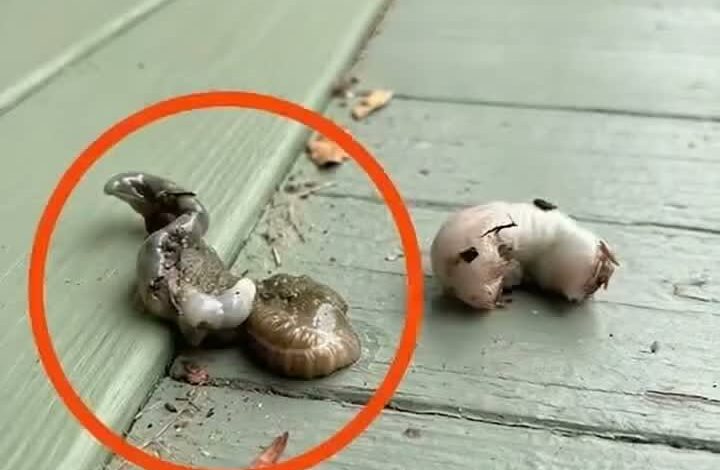
Against the dull gray concrete was a pale, strangely soft-looking shape that almost seemed to glow in the morning sun. It wasn’t large, but it didn’t need to be. There was something deeply unsettling about it that immediately sent every alarm bell in my mind ringing.
I didn’t move.
Neither did it.
That somehow made everything worse.
Balconies collect all kinds of harmless things.
Leaves.
Feathers.
Twigs.
Occasionally a pigeon wanders through as though paying rent.
But this didn’t resemble any of those.
It looked…alive.
Or at least as though it had once been.
My coffee suddenly felt much less important.
I slowly stepped backward into the apartment without taking my eyes off the object.
My heart was beating far harder than the situation probably deserved, but logic hadn’t caught up with instinct yet.
The human brain is remarkably efficient at inventing disasters.
Within seconds, I had convinced myself it might be some kind of parasite, an exotic insect, a poisonous creature, or the beginning of a full-blown infestation that had somehow reached my building.
The pale color only made it stranger.
It looked wrong.
As if it belonged underground rather than sitting openly in the sunlight.
Trying to keep my distance, I grabbed my phone.
Instead of approaching it directly, I zoomed in with the camera, using the screen like a protective shield.
The closer image did not calm me.
If anything, it intensified every irrational thought.
Its surface appeared segmented, almost ribbed, with a curved shape that reminded me of something halfway between a grub and an alien creature from an old science-fiction movie.
Definitely not trash.
Definitely not a stone.
Definitely something organic.
I swallowed hard.
“Okay…”
I whispered to nobody.
“What are you?”
It offered no answer.
It simply remained perfectly still.
I spent the next several minutes pacing around my apartment while sneaking nervous glances through the glass door.
Each time I looked, I expected it to move.
It never did.
From different angles it appeared completely different.
One moment it looked curled into a crescent.
Another moment it resembled some strange shell.
The uncertainty became the most frightening part.
If I could identify it, maybe I could stop imagining the worst.
But uncertainty has a way of inviting fear inside.
Soon my imagination was producing increasingly ridiculous possibilities.
Maybe there were dozens more hidden beneath the flowerpots.
Maybe they multiplied quickly.
Maybe they carried diseases.
Maybe touching one would somehow trigger a nightmare I wasn’t prepared to deal with.
None of these thoughts had any evidence behind them.
They simply arrived because my brain desperately wanted an explanation.
I snapped a few photos and sent them to friends.
Trying to sound casual, I wrote:
“Anybody know what this nightmare is?”
Their replies arrived almost immediately.
“What IS that?”
“Nope.”
“Burn the whole balcony.”
“I’d be moving.”
One friend added a string of horrified emojis.
None of them were remotely helpful.
In fact, they made my anxiety considerably worse.
Apparently I wasn’t the only person whose imagination preferred horror over biology.
After nearly twenty minutes of staring through the glass door, curiosity finally overpowered fear.
I opened my search engine.
“Pale bug on balcony.”
Nothing useful.
“White segmented insect.”
Still nothing convincing.
“Soft ribbed worm thing.”
That produced results I immediately regretted seeing.
Page after page displayed photographs of larvae, caterpillars, parasites, beetles, worms, and insects I hadn’t known existed.
Every image somehow made me more uncomfortable than the last.
Then one photograph stopped me.
I stared at it.
Then back at my own picture.
Then at the screen again.
It matched almost perfectly.
The terrifying creature occupying my peaceful Saturday morning wasn’t a venomous monster.
It wasn’t an invasive species.
It wasn’t dangerous.
It was simply a beetle larva.
An ordinary beetle larva.
The article explained that many beetle larvae spend most of their lives underground, feeding quietly among roots and soil. Occasionally heavy rain, gardening activity, birds, or simple chance can leave one stranded somewhere completely unfamiliar.
Their pale color wasn’t unusual.
It was exactly what they were supposed to look like.
Their stillness wasn’t threatening.
It was defensive.
Unable to stop laughing at myself, I finally walked outside.
Only minutes earlier I had treated the tiny creature like something from a disaster movie.
Now it looked almost…
helpless.
Using a piece of stiff cardboard, I gently lifted it from the concrete and carried it to one of my larger flowerpots.
I tipped the cardboard slightly.
The larva slowly wriggled into the loose soil before disappearing beneath the surface where it belonged.
That was it.
No attack.
No infestation.
No catastrophe.
Just a tiny creature returning home.
I stood there for a long moment looking around the balcony.
Nothing had actually changed.
The cracked tiles were still cracked.
The old chairs still leaned slightly to one side.
The neglected plants still reached lazily toward the sunlight.
Cars continued passing below.
Birds chirped from nearby rooftops.
The world had remained exactly as it had been all morning.
Only my understanding had changed.
And somehow, that single difference transformed the entire atmosphere.
Fear disappeared almost instantly.
Peace returned just as quickly.
Sitting back down with my now-cold coffee, I found myself thinking about how often people mistake uncertainty for danger.
The mind hates unanswered questions.
When it cannot identify something immediately, it begins filling the empty space with possibilities.
Unfortunately, those possibilities are rarely comforting.
Imagination almost always paints darker pictures than reality ever intended.
That little beetle larva taught me something I hadn’t expected to learn before breakfast.
Most fear isn’t born from what we know.
It’s born from what we don’t.
Understanding has a remarkable way of shrinking monsters into ordinary things.
An hour earlier, I had been convinced something terrifying had invaded my balcony.
By lunchtime, I was smiling at the thought that I’d nearly declared war on a harmless beetle larva simply because my imagination had reached its conclusion before my curiosity reached the truth.
Sometimes the difference between panic and peace is surprisingly small.
Sometimes it’s nothing more than learning the right name for what scares you.
And once you know its name, the monster often disappears all by itself.