Few small mistakes feel as frustrating as sealing an envelope too soon.
Maybe you forgot to include an important document. Perhaps you addressed it to the wrong person, noticed a typo in the letter, or realized you enclosed the wrong page entirely. Whatever the reason, you’re suddenly faced with a familiar dilemma: open the envelope and risk tearing it apart, or throw it away and start over.
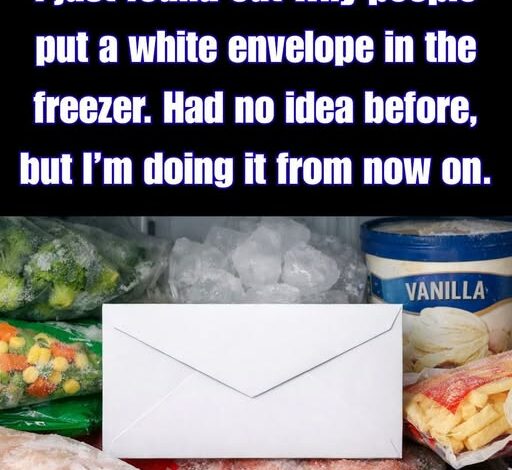
That’s when many people remember an old household trick involving the freezer.
Surprisingly, it isn’t just a myth—at least not for certain types of envelopes.
The idea is based on the way traditional envelope adhesives work.
Older envelopes that require moisture to seal typically use a water-activated adhesive, often made from dextrin, a starch-based glue. When you moisten the flap, the adhesive softens and bonds to the paper as it dries.
After spending time in the freezer, that adhesive can become more brittle and slightly less flexible. In some cases, the bond weakens just enough that the flap may separate from the envelope with careful, patient handling.
The process is simple.
Place the sealed envelope inside the freezer for an hour or two, or even longer if needed. Once it’s thoroughly chilled, remove it and work quickly before it begins warming again.
Using a fingernail, a thin butter knife, or a letter opener, gently ease the edge beneath one corner of the flap.
The key is patience.
Instead of trying to pull the flap open all at once, work a few millimeters at a time, slowly moving across the seal. If the adhesive has become brittle enough, the flap may lift with surprisingly little resistance.
When it works, the envelope can often be resealed after the contents have been corrected.
However, the freezer is far from a guaranteed solution.
Modern envelopes frequently use pressure-sensitive peel-and-stick adhesives rather than traditional water-activated glue. These adhesives are designed differently and generally aren’t affected by cold in the same way. After freezing, they often remain firmly attached, making the trick ineffective.
Even with older envelopes, success depends on several factors.
If too much moisture was used when sealing the flap, the adhesive may have penetrated deeper into the paper fibers, creating a stronger bond. Likewise, pressing the flap down firmly or storing the envelope for a long period may make it much harder to separate cleanly.
The condition of the paper matters as well.
Thin paper can tear easily, while thicker envelopes may tolerate gentle lifting better. Humidity, age, and the quality of the adhesive all influence whether the flap releases cleanly or leaves behind ragged fibers.
For that reason, it’s wise to proceed carefully and manage your expectations.
If you encounter resistance, forcing the flap usually causes more damage than stopping and accepting that the envelope may need to be replaced.
Fortunately, envelopes are inexpensive.
A damaged letter containing important documents—or one that appears to have been tampered with—is often worth avoiding if a fresh envelope is readily available.
The freezer trick isn’t the only method people have tried over the years.
Some use steam to soften water-activated glue, while others experiment with specialized tools. Each approach has advantages and risks, and none can guarantee a perfectly clean result every time. Much depends on the type of adhesive and how the envelope was originally sealed.
In the end, the freezer trick is best viewed as a practical option rather than a foolproof solution.
Sometimes it provides exactly what you hoped for—a neatly opened envelope and the chance to correct a simple mistake without anyone ever knowing.
Other times, the paper tears, the flap wrinkles, or the adhesive refuses to budge despite your best efforts.
That’s simply the nature of the materials.
The experience offers a small reminder that applies well beyond stationery.
Not every mistake can be erased without leaving a trace.
Some can be corrected with patience and careful handling.
Others require letting go, starting over, and doing the job again with a little more attention than before.
So if you ever find yourself staring at a sealed envelope containing the wrong contents, the freezer may be worth a try—provided it’s an old-style, water-activated envelope.
Just remember that the cold isn’t magic.
It’s simply another tool, one that sometimes gives you the opportunity for a second chance.
And when it doesn’t, a fresh envelope, a new stamp, and a few extra moments of care are often the simplest—and smartest—way forward.