Xavier Becerra’s advance into California’s November gubernatorial election was not merely a campaign milestone—it was a lifeline thrown to a Democratic Party that had spent months drifting through political turbulence.
For much of the race, Democrats appeared trapped in a cycle of setbacks. Internal divisions deepened. Once-promising campaigns stalled. Scandals reshaped the field. Candidates who were expected to compete at the highest level either faltered or disappeared altogether. What should have been a confident march toward the general election instead became a scramble for stability.
Against that backdrop, Becerra’s rise took on significance far beyond his own political ambitions.
His campaign did not surge with dramatic headlines or breakthrough moments. Instead, it advanced steadily, surviving a chaotic primary season that eliminated many of the assumptions political observers had made at the outset. What began as an uncertain path gradually transformed into something more substantial: a candidacy capable of providing Democrats with what they suddenly feared they might lose.
A place in the final contest.
A recognizable standard-bearer.
And perhaps most importantly, a candidate around whom a fractured coalition could begin to unite.
By securing his position in the November race, Becerra delivered a measure of relief to party leaders who had watched months of political turmoil threaten to undermine their standing in the nation’s most populous state. His emergence offered Democrats a chance to shift the conversation away from internal struggles and back toward the broader battle for California’s future.
But if the primary provided an escape from crisis, it did not provide peace.
The general election promises to be far more complicated.
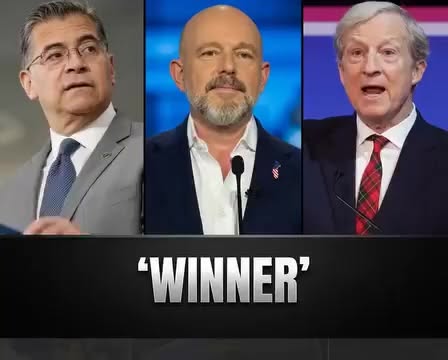
Even as Becerra moves forward, the fight for the second spot remains one of the most consequential questions in California politics. Trump-aligned Republican Steve Hilton and billionaire Democrat Tom Steyer continue to compete for a place in the final showdown, creating uncertainty that extends far beyond simple electoral math.
The outcome will shape the entire character of the race.
A matchup against Hilton could transform the election into a high-profile ideological confrontation, pitting competing visions of government, leadership, and California’s direction against one another. Such a contest would likely nationalize the campaign, drawing attention from political figures across the country and turning the state into a symbolic battleground for broader political debates.
A race against Steyer, however, would create a different challenge altogether.
Rather than a clash between opposing parties, it could become a battle over the future identity of California’s Democratic coalition itself. Questions about policy, priorities, and political leadership would move to the forefront, forcing voters to decide not merely which candidate they prefer, but what kind of Democratic Party they want leading the state in the years ahead.
For Becerra, neither path promises an easy victory.
He enters the next phase of the campaign carrying significant political baggage accumulated during years in public office. Critics have repeatedly targeted his record, raising questions about decisions made during his tenure in government and linking him to controversies that continue to generate scrutiny.
Becerra has consistently rejected responsibility for many of the criticisms leveled against him, arguing that he is being blamed for problems rooted in broader institutional challenges rather than personal decisions. His supporters maintain that his experience provides valuable perspective during a period of extraordinary uncertainty.
His opponents see things differently.
They argue that experience has tied him too closely to the very systems many voters have grown frustrated with.
That debate is likely to become one of the defining themes of the campaign.
California faces a complex collection of challenges that touch nearly every corner of public life. Concerns about housing affordability, public safety, homelessness, economic pressure, infrastructure, and governance continue to dominate conversations among voters. Citizens increasingly express frustration over problems that have persisted despite years of political promises and policy initiatives.
In that environment, Becerra must convince voters that experience should be viewed as an asset rather than a liability.
That may prove to be his greatest challenge.
At a time when many voters are searching for change, he must make the case that familiarity does not equal stagnation. He must persuade Californians that navigating overlapping crises requires knowledge, institutional understanding, and tested leadership rather than political experimentation.
The task is made even more difficult by growing voter fatigue.
After years of political conflict, economic uncertainty, and social upheaval, many Californians are approaching another election cycle with skepticism. Campaign slogans alone are unlikely to move an electorate increasingly focused on results.
Becerra therefore faces a delicate balancing act.
He must defend his record without appearing defensive.
Promote continuity without seeming complacent.
Offer solutions without sounding like every politician who came before him.
Meanwhile, his rivals will seek to define him before he can define himself.
Every policy decision, every past controversy, and every public statement will be examined through the lens of a high-stakes statewide race. The scrutiny will intensify as Election Day approaches, ensuring that the campaign remains one of the most closely watched contests in the country.
For now, however, one reality is clear.
Xavier Becerra has achieved what once seemed uncertain.
He survived a chaotic primary season and secured a place in the fight ahead.
But survival was only the first challenge.
The far more difficult battle begins now.
The months ahead will determine whether his candidacy becomes a story of political resilience or merely a temporary reprieve for a party searching for direction. As California voters prepare to make their choice, the central question is no longer whether Becerra can reach the general election.
It is whether he can convince a weary and demanding electorate that he represents the leadership needed to guide the state through its next chapter.
And in a political climate defined by frustration, uncertainty, and competing visions of the future, that may be the hardest campaign of all.