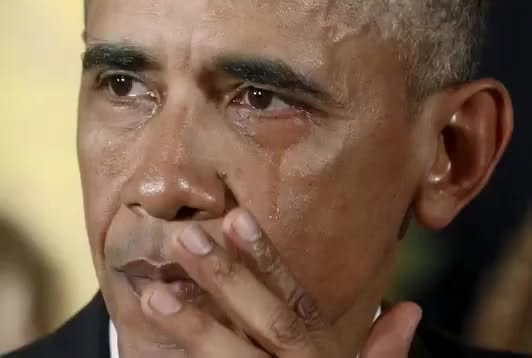
When Barack Obama openly wept before the cameras, the moment resonated far beyond politics.
Presidents are often remembered for speeches, policies, victories, defeats, and the carefully crafted images that define their time in office. They stand behind podiums, issue statements, project confidence, and carry themselves with a composure that can make them seem almost immune to ordinary emotion. The office itself encourages that perception. The presidency demands steadiness in moments of crisis and certainty in moments of doubt.
Yet on that day, something different happened.
The familiar barrier between the nation’s highest office and the nation’s deepest pain briefly disappeared.
Obama’s tears were not dramatic. They were not theatrical. They arrived reluctantly, the way genuine grief often does—unexpected, unwelcome, and impossible to suppress forever. As he spoke about lives lost and families forever altered, the emotion became visible. His voice tightened. His eyes filled. For a few seconds, the world was not watching a political figure manage a message.
It was watching a human being struggle under the weight of tragedy.
That distinction mattered.
The modern presidency often feels distant from everyday suffering. Decisions made in Washington can seem abstract compared to the realities unfolding in homes, schools, hospitals, and communities across the country. Citizens frequently view leaders through the lens of ideology, party affiliation, or policy disputes. They become symbols rather than people.
But grief has a way of stripping away symbols.
In moments of genuine sorrow, titles lose some of their power.
Political labels become less important.
What remains is the simple fact that loss affects everyone.
Parents.
Children.
Neighbors.
Teachers.
And yes, presidents.
For many Americans, Obama’s tears became memorable not because they changed policy, but because they acknowledged pain that could not be reduced to statistics. Behind every headline were families whose lives had been permanently altered. Behind every public debate were empty chairs at dinner tables, unfinished futures, and questions that could never be fully answered.
His emotion served as a reminder that leadership is not solely about solving problems.
Sometimes it is about witnessing them.
Sometimes it is about refusing to look away.
Public life often rewards distance. Leaders are expected to remain composed, controlled, and unaffected by the storms around them. Displays of vulnerability can be criticized as weakness or dismissed as performance. Yet moments like this challenge that assumption.
There is another kind of strength.
The strength to feel publicly.
The strength to acknowledge suffering without immediately turning away from it.
The strength to admit that some tragedies are so profound they overwhelm even the language designed to describe them.
Many people remember where they were when they saw those images.
Not because they agreed with every policy Obama pursued.
Not because they viewed him as flawless.
But because they recognized something universal in his reaction.
Anyone who has attended a funeral, comforted a grieving friend, or received devastating news understands the experience of trying—and failing—to keep emotion contained. There is a point where words are no longer enough.
The tears represented that point.
Critics and supporters interpreted the moment differently, as they often do with public figures. Some saw authenticity. Others questioned the significance. Such debates are inevitable in a polarized political culture.
Yet the enduring power of the image lies in its humanity.
Long after specific policy arguments faded from public attention, the photograph remained.
A president pausing.
A voice breaking.
A visible reminder that even those entrusted with immense authority remain vulnerable to sorrow.
Perhaps that is why the moment continues to be remembered.
Not because it resolved a national crisis.
Not because it ended a debate.
But because it interrupted the normal rhythm of public life and forced people to confront something uncomfortable.
The reality of suffering.
The reality of loss.
The reality that tragedies affecting ordinary families deserve more than a passing glance before the next news cycle begins.
In an age saturated with information, it is surprisingly easy to become numb. Headlines flash across screens. Images appear and disappear. Outrage surges and fades. Attention shifts constantly.
Moments of genuine emotion disrupt that pattern.
They force us to stop scrolling.
To stop arguing.
To stop treating human suffering as background noise.
Obama’s tears became powerful because they challenged the culture of detachment that often surrounds public tragedy.
They suggested that empathy is not a distraction from leadership.
It is part of leadership.
That compassion is not weakness.
It is responsibility.
And that the willingness to grieve alongside those who suffer may reveal as much about character as any speech or policy proposal ever could.
Years later, the image still endures.
Not as a political statement.
Not as a campaign moment.
But as a reminder that leadership, at its best, involves more than authority.
It involves presence.
It involves empathy.
It involves the courage to remain emotionally awake in the face of pain that would be easier to ignore.
And perhaps that is the lasting question the moment leaves behind.
If a president could not look away from the suffering before him, should the rest of us?
Because every tragedy ultimately asks the same thing of a society: not merely what it will do, but whether it is willing to care enough to act.
For a brief moment, visible through tears that millions witnessed, the answer seemed clear.