The World Cup final delivered everything football fans could have hoped for—drama, emotion, unforgettable moments, and a celebration watched by millions around the globe. But while the action unfolded on the pitch, another story was quietly taking shape online. It had nothing to do with tactics, goals, or the trophy itself. Instead, it centered on a few fleeting seconds of television footage that sent social media into a frenzy.
It began with a single clip.
Viewers paused the broadcast.
They replayed it.
Then they replayed it again.
Within minutes, screenshots were circulating across X, Reddit, TikTok, and Instagram, accompanied by increasingly elaborate theories. Some users claimed they had spotted a body double. Others insisted there was a hidden signal embedded in the footage. A few suggested the cameras had accidentally captured someone they were never supposed to show.
The evidence, they argued, was right there on the screen.
To others, it looked like nothing more than an ordinary television shot.
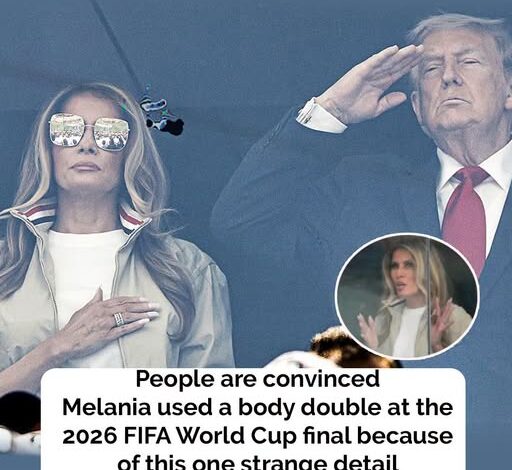
At the center of the speculation was Melania Trump. Wearing mirrored sunglasses beneath the intense stadium lights, she appeared in a brief camera angle that quickly became the subject of endless online analysis. The reflections in her lenses, combined with a particularly unflattering frame and the challenging lighting conditions inside the stadium, were enough to convince some viewers that something seemed “off.”
That was all the internet needed.
Soon, freeze-frames appeared covered in arrows, circles, and zoomed-in comparisons. Amateur investigators scrutinized facial features, posture, and reflections in the sunglasses. Some claimed her face looked different. Others pointed to shadows that, in their view, didn’t align naturally. A handful even argued that subtle differences proved the woman on screen couldn’t possibly be Melania Trump at all.
The theories grew more elaborate with each passing hour.
Yet those familiar with photography and live broadcasting offered a much simpler explanation.
High-powered stadium lights can create harsh contrasts that dramatically alter facial appearance. Mirrored sunglasses reflect bright sources of light from multiple angles, often distorting what viewers believe they see. Television cameras also capture only fractions of a second, and a single awkward frame can make almost anyone appear unfamiliar when removed from the natural movement of live video.
Still, rational explanations rarely spread as quickly as intriguing mysteries.
Then attention shifted to someone else entirely.
Behind Melania, barely visible and significantly out of focus, stood another woman in the background. Under ordinary circumstances, she would have blended seamlessly into the crowd. Instead, internet detectives transformed her into the next puzzle.
Who was she?
Why was she standing there?
Was she connected to security?
Was she part of the event staff?
Or, according to increasingly imaginative theories, was her presence evidence that something much larger was happening just beyond the camera’s view?
The blurred figure soon acquired an identity that existed almost entirely online.
Posts referred to her as the “mystery woman.”
Some users claimed she appeared in multiple camera angles, suggesting there had to be a deeper significance. Others compared clothing, hairstyles, and facial outlines to photographs of unrelated public figures, convinced they had uncovered a hidden connection.
But despite thousands of comments and countless viral posts, no credible evidence emerged supporting any extraordinary explanation.
No official statement suggested anything unusual had occurred.
No reputable news organization uncovered a hidden story.
No verified information connected the woman to any scandal or secret event.
What remained was simply a blurred background figure elevated into internet folklore through repetition and speculation.
The episode highlights a broader phenomenon that has become increasingly common in the age of social media.
Today’s audiences consume major public events differently than ever before. Live broadcasts are no longer experienced only in real time. Every frame can be paused, enlarged, enhanced, and shared within seconds. Millions of viewers effectively become investigators, examining tiny details that television producers never expected anyone to study so closely.
Sometimes that process uncovers genuinely important moments.
Far more often, however, it magnifies ordinary imperfections into extraordinary theories.
Our brains are naturally wired to search for patterns. We instinctively look for meaning, connections, and hidden explanations, especially when presented with incomplete information. A reflection becomes a secret message. An awkward facial expression becomes evidence of deception. A blurred stranger becomes the centerpiece of an imagined conspiracy.
The less information available, the easier it becomes for speculation to fill the gaps.
Public figures experience this phenomenon more intensely than almost anyone else.
Every appearance is photographed from dozens of angles. Every gesture is dissected. Every expression invites interpretation. For someone as recognizable as Melania Trump, even a split-second television frame can become the subject of international discussion, regardless of whether anything unusual actually occurred.
In many cases, the scrutiny says more about the audience than the individual being watched.
Modern social media rewards mystery. Platforms favor content that provokes curiosity, debate, and emotional reactions. A simple explanation rarely attracts the same attention as an elaborate theory. As a result, speculation often travels faster than verification, encouraging users to build narratives long before reliable information becomes available.
That cycle can transform completely ordinary moments into worldwide talking points.
A passing glance becomes evidence.
A shadow becomes a clue.
A background figure becomes the center of countless conversations.
By the time factual explanations emerge—or fail to emerge at all—the viral story has often taken on a life of its own.
In the end, there was no confirmed conspiracy hiding within those few seconds of World Cup footage. No verified body double. No secret guest accidentally revealed. No hidden message concealed behind mirrored sunglasses or blurred television images. Just a brief moment captured under difficult lighting conditions, viewed through the powerful lens of collective imagination.
Perhaps that is the real lesson.
The most fascinating part of the story was never the clip itself, but the speed with which millions of people transformed an ordinary broadcast into an international mystery. In an era where every frame can be endlessly replayed and every detail endlessly debated, the line between observation and speculation grows thinner by the day.
Sometimes the image isn’t telling us something extraordinary at all.
Sometimes it’s simply reminding us how eager we are to believe that every passing glance hides a secret waiting to be uncovered.