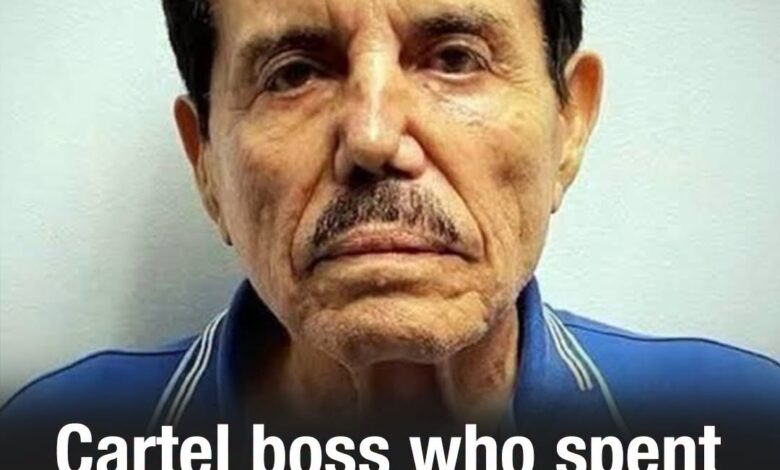
For almost four decades, Ismael “El Mayo” Zambada built one of the world’s most powerful criminal empires while remaining almost invisible.
Unlike many cartel leaders who embraced notoriety, Zambada survived by staying in the shadows. He rarely appeared in public, almost never granted interviews, and managed to evade capture year after year as authorities searched for the elusive figure believed to be at the heart of the Sinaloa Cartel. While others became the faces of the organization, he quietly strengthened its operations, helping oversee a network prosecutors say was responsible for trafficking enormous quantities of cocaine, fentanyl, methamphetamine, and other illegal drugs across international borders.
His ability to avoid arrest became part of his legend.
For years, it seemed as though he would never be caught.
Then everything unraveled in a way few expected.
According to the account presented in court, the man who had spent decades avoiding law enforcement did not fall during a dramatic gun battle or a high-profile military raid. Instead, his downfall allegedly came from within the very organization he had helped build.
Authorities say he was betrayed by Joaquín Guzmán López, the son of his longtime associate Joaquín “El Chapo” Guzmán. Prosecutors alleged that Zambada was lured into what he believed would be an ordinary meeting, only to find himself ambushed and placed aboard an aircraft bound for the United States.
For a man who had spent most of his life controlling every move, it was a stunning reversal of fortune.
The hunter had become the captive.
The strategist who had long orchestrated events from behind the scenes was suddenly at the mercy of others.
When he eventually entered the courtroom, the contrast between his former reputation and his new reality was impossible to ignore.
Gone was the untouchable cartel leader whose name had inspired fear across generations.
Standing before the court was an aging man facing accusations that prosecutors said had left an immeasurable trail of suffering.
According to the government’s case, the criminal organization he helped lead fueled years of violence through drug trafficking, corruption, kidnappings, torture, and assassinations. Communities across Mexico and beyond were left to bear the consequences as families mourned loved ones lost to both organized crime and the addiction crisis fueled by the narcotics his organization allegedly distributed.
For many victims and their families, the courtroom represented more than another criminal proceeding.
It represented the possibility of accountability after decades of violence.
During the hearing, Zambada acknowledged aspects of his past in remarks that surprised many observers.
He spoke of growing up in an environment where violence had become normalized, describing it as something woven into everyday life from an early age. Yet he also admitted that countless innocent people had ultimately paid the price for decisions he had made throughout his criminal career.
Those words could not erase decades of bloodshed.
Nor could they undo the pain carried by victims’ families.
But they marked a rare public acknowledgment from a man who had spent much of his life speaking through silence rather than statements.
His cooperation with prosecutors ultimately spared him from the death penalty, according to the proceedings, but it did not spare him the consequences of the crimes attributed to his leadership.
The court imposed a sentence that ensured he would spend the remainder of his life behind bars.
In addition, prosecutors secured a financial judgment totaling $15 billion, describing it as part of an effort to strip away the enormous profits allegedly generated through decades of international drug trafficking.
Government attorneys characterized the outcome as the closing chapter of one of the most destructive criminal careers in modern organized crime.
They argued that while no sentence could restore the lives lost or fully repair communities devastated by cartel violence, holding one of its most influential leaders accountable carried profound symbolic importance.
Before leaving the public stage, Zambada delivered one final message directed not toward the court, but toward younger generations tempted by the same path he had taken.
He urged aspiring traffickers to walk away before it was too late.
According to his remarks, the violence had continued for far too long, destroying families, communities, and countless lives in pursuit of power and money.
Whether those words will carry weight among those still involved in organized crime remains uncertain.
For critics, they arrived far too late to outweigh the suffering prosecutors say his organization inflicted over decades.
For others, they stood as an acknowledgment—however belated—that the cycle of violence ultimately consumes nearly everyone it touches.
In the end, the man who once seemed untouchable did not escape history.
The empire he helped build brought unimaginable wealth and influence, but it also left behind shattered families, grieving communities, and generations marked by fear.
His rise became one of organized crime’s most enduring legends.
His fall became a reminder that even the most powerful figures can eventually face judgment.
And while the courtroom marked the end of one man’s reign, the broader challenge remains: ending the violence, corruption, and human suffering that allowed such empires to flourish in the first place.