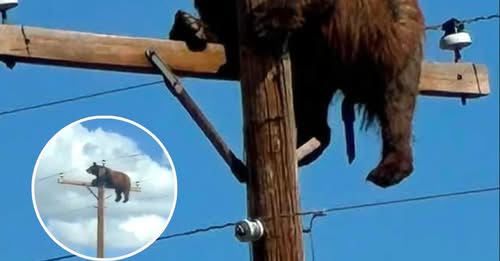
At first, passing drivers thought they were looking at a dark shape caught high above the roadway.
Some assumed it was debris.
Others believed it might be the remains of an animal.
Only when they looked more closely did they realize the truth.
Perched on electrical equipment above Highway 56 was a frightened bear, visibly distressed and trapped in a place no wild animal should ever have been.
Within hours, photographs and videos spread across social media.
The images sparked an outpouring of concern, but they also unleashed a wave of instant opinions from people watching safely behind their screens.
“Why don’t they just tranquilize it?”
“Turn the power off.”
“Someone should climb up and rescue it.”
From a distance, every solution sounded simple.
On the scene, nothing was.
Wildlife officials and emergency responders were forced to weigh impossible choices, each carrying significant risks. Sedating a large animal while it was positioned high above the ground could have caused it to lose its balance and fall. Working near energized electrical equipment posed obvious dangers for both the rescue team and the bear. Even if rescuers reached the animal safely, a frightened bear could react unpredictably, creating additional hazards for everyone nearby.
Sometimes, the safest option available is also the hardest to accept.
Officials chose to monitor the situation while minimizing additional stress, hoping the bear would eventually find a safe way back to the ground on its own.
It was a decision that required patience at a moment when the public wanted immediate action.
As people continued to watch and speculate, responders remained focused on a reality that cameras could not fully capture: every minute demanded careful judgment, and every possible intervention carried consequences.
Tragically, the outcome was not the one anyone had hoped for.
According to reports, the bear ultimately came into contact with energized electrical equipment and died.
What had begun as a startling wildlife encounter ended in heartbreak.
In the aftermath, grief quickly gave way to frustration.
Many questioned whether more could have been done.
Some directed their anger toward public officials.
Others criticized the utility company.
Still others blamed the growing crowds that gathered to watch, fearing the noise and attention may have added to the animal’s stress, even if the exact impact could not be determined.
The tragedy also prompted broader conversations about how communities respond when wildlife enters dangerous, human-made environments.
Experts frequently note that encounters involving wild animals are often unpredictable and that the safest response depends on the specific circumstances. Decisions must balance the welfare of the animal, the safety of emergency personnel, and the protection of the public—factors that are rarely as straightforward as they appear from a short video or a single photograph.
As urban development continues to overlap with natural habitats, such incidents are becoming an increasing challenge in many regions. Bears, deer, mountain lions, and countless other species may wander into neighborhoods, roads, or utility corridors while searching for food or following traditional migration routes that have been altered by expanding human activity.
Each encounter becomes a reminder that coexistence requires preparation as much as compassion.
Improved planning, wildlife-safe infrastructure where possible, coordinated emergency response protocols, and public education can all help reduce the risks when animals unexpectedly enter hazardous areas.
For members of the public, experts often recommend keeping a safe distance from distressed wildlife, avoiding actions that could increase an animal’s stress, and allowing trained professionals to assess the situation.
The bear’s death left behind more than a viral headline.
It became a sobering reminder of how fragile the boundary between the natural world and the one humans have built can be.
In the end, the photographs captured a frightened animal.
The public saw a dramatic spectacle.
Responders faced an extraordinarily difficult situation with no guaranteed safe outcome.
Perhaps the most lasting lesson is that our responsibility to wildlife extends beyond admiration. It includes giving wild animals the space they need, supporting thoughtful conservation and emergency planning, and recognizing that the best way to help is not always the fastest or the most dramatic—it is the response that places both safety and the animal’s welfare at the center of every decision.