For a few unforgettable seconds, the puzzle wasn’t Joey Moorman’s biggest opponent.
His own mind was.
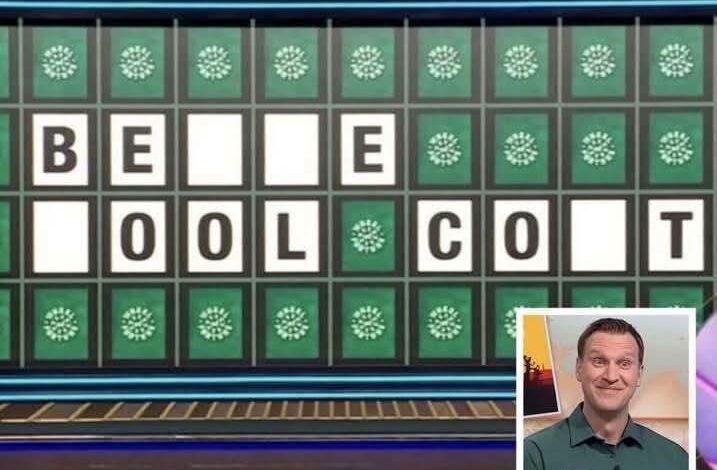
Standing beneath the brilliant studio lights during the Wheel of Fortune Bonus Round, he faced a puzzle that would soon have millions of viewers insisting they knew the answer instantly. On the board, only a handful of letters were missing:
BE_ _E WOOL CO_T
From the comfort of a living room, the solution appeared almost effortless.
In the studio, it was anything but.
The Bonus Round is designed to test far more than vocabulary. Contestants have only a few moments to process incomplete information while cameras roll, an audience watches in silence, and a countdown reminds them that every passing second could mean thousands of dollars.
Under those conditions, even familiar words can seem to disappear.
Psychologists sometimes refer to this kind of experience as “choking under pressure” or a retrieval failure—moments when stress interferes with the brain’s ability to access information that would normally come easily. Most people have experienced a version of it: forgetting a name they’ve known for years, blanking on an answer during an exam, or struggling to recall a simple word while everyone waits.
The difference is that those moments usually happen in private.
Joey’s unfolded before a national television audience.
As the clock ticked down, he searched for the missing word.
The letters were there.
The clue was there.
The answer was painfully close.
Yet “beige” remained just out of reach.
When time expired, the buzzer sounded.
Then the puzzle was completed.
BEIGE WOOL COAT.
The reveal lasted only an instant, but its emotional impact lingered far longer.
It wasn’t simply the realization that he had missed a correct answer.
It was the realization that he had come so incredibly close.
Anyone who has experienced a forgotten word sitting frustratingly on the tip of the tongue understands that feeling. You know the answer is somewhere in your mind, but no amount of effort seems able to bring it forward before the moment passes.
On television, that frustration becomes impossible to hide.
As the clip spread across social media, reactions arrived almost immediately.
Some viewers couldn’t understand how such a common word had been missed.
Others rushed to defend him, pointing out that solving puzzles from a couch bears little resemblance to solving them under studio lights with significant money at stake.
The debate reflected a familiar pattern.
People often judge performances after knowing the correct answer, a tendency psychologists call hindsight bias. Once the solution is revealed, it feels obvious, making it difficult to remember how uncertain the situation appeared just moments earlier.
But certainty is much easier to achieve after the countdown has ended.
Joey’s experience also served as a reminder that television captures only the final result, not the invisible mental effort behind it.
Viewers see a few seconds.
They don’t feel the adrenaline.
They don’t hear the clock echoing in their thoughts.
They don’t experience the split-second calculations, the self-doubt, or the awareness that one missed word could change the outcome.
Those pressures are real, and they affect even highly capable contestants.
Despite the disappointment, Joey did not leave empty-handed.
His time on the show included impressive winnings, a memorable travel prize, and the rare opportunity to compete on one of television’s most recognizable game shows—an accomplishment that thousands of hopeful applicants never experience.
Yet, like many unforgettable television moments, one missed word became the scene people remembered most.
That’s often the nature of public competition.
Success can take years to build.
One tense moment can become the clip replayed over and over.
Still, there is another way to view what happened.
Rather than seeing only a missed puzzle, we can recognize something profoundly human.
Everyone has experienced a moment when pressure clouded judgment, when the obvious suddenly became elusive, or when the perfect answer appeared only after the opportunity had passed.
Most of us simply don’t experience those moments in front of millions of viewers.
In the end, Joey Moorman’s Bonus Round wasn’t memorable because he failed.
It was memorable because it reminded us how fragile human performance can be under extraordinary pressure.
The puzzle may have gone unsolved, but the moment revealed something far more universal: intelligence is not measured by whether we always find the right answer, but by our willingness to step into situations where the whole world might watch us get one wrong.
That kind of courage lasts far longer than any puzzle—and far longer than any prize.