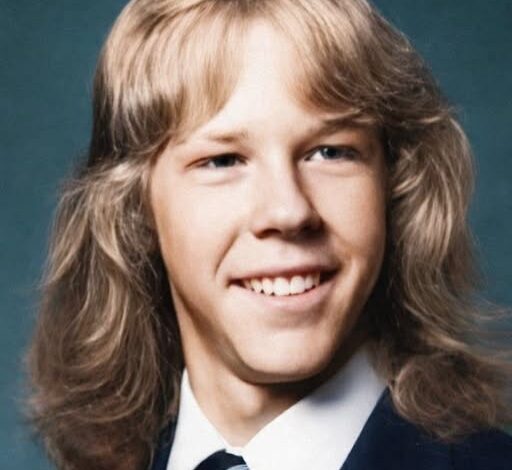
Before James Hetfield became the unmistakable voice of Metallica, his life had already been shaped by loss, silence, and wounds that no child should have carried. Long before sold-out stadiums and platinum records, he was learning how to survive in a home where faith often replaced comfort and painful emotions were expected to stay buried. Those early years didn’t simply influence his music—they forged the emotional core that would eventually make it resonate with millions around the world.
Growing up, Hetfield experienced a childhood marked by isolation. His family’s strict religious beliefs set them apart from those around them, leaving him feeling different at an age when fitting in seemed to matter most. Questions that other families answered with medicine or reassurance were often met with unwavering faith instead. As a young boy, he learned to keep his fears to himself, quietly navigating a world that often felt confusing and lonely.
Then came another devastating blow.
His father walked away from the family, disappearing from his daily life without providing the closure a child desperately needs. The absence left more than an empty chair at the dinner table. It planted questions that lingered for years—questions about worth, abandonment, and whether people you love can simply decide not to stay. Those unanswered emotions settled deep inside him, becoming burdens he had no words to explain.
Not long afterward, tragedy struck again.
His mother became seriously ill, but because of the family’s religious convictions, she declined medical treatment that might have saved her life. Watching someone he loved slip away under those circumstances left scars that reached far beyond ordinary grief. It wasn’t only the pain of losing a parent—it was the confusion of witnessing a death that seemed heartbreakingly preventable. For a young James, that experience shattered any simple understanding of faith, security, or fairness.
Most children process heartbreak through conversations, comfort, or time.
Hetfield found another outlet.
He picked up a guitar.
The instrument became far more than a hobby. Every aggressive riff, every pounding rhythm, and every raw lyric allowed him to release emotions that had been locked away for years. The anger he couldn’t express became distortion. The sadness he couldn’t admit transformed into melody. The loneliness he carried found a home inside music that was louder than words could ever be.
Then fate introduced him to someone whose ambition matched his own.
When James met drummer Lars Ulrich, their partnership sparked something extraordinary. Both shared an obsession with creating music that refused to soften its edges or hide uncomfortable emotions. Together they built Metallica—not simply as another heavy metal band, but as a vehicle for feelings many listeners struggled to articulate themselves.
The band’s music wasn’t heavy merely for the sake of volume.
It carried emotional weight.
Songs pulsed with themes of abandonment, betrayal, inner conflict, broken trust, and existential fear. Beneath the thunderous guitars and relentless drums lay stories shaped by childhood wounds, fractured relationships, and questions that rarely have satisfying answers. Listeners heard more than technical brilliance—they heard authenticity. The fury in Hetfield’s voice wasn’t manufactured for entertainment. It came from experiences that had carved themselves into his identity long before he ever stepped onto a stage.
That honesty helped Metallica connect with millions of fans across generations.
People who had never experienced Hetfield’s exact circumstances still recognized something familiar in the music. Feelings of isolation, heartbreak, confusion, and suppressed anger crossed every cultural boundary. The songs became places where listeners could confront emotions they often struggled to express in everyday life.
But success didn’t erase the pain that inspired it.
If anything, fame often amplified it.
As Metallica’s popularity exploded, so did the pressure surrounding Hetfield. Endless touring, public expectations, and constant exposure couldn’t silence the unresolved trauma he carried from childhood. Instead, many of those old wounds resurfaced in destructive ways. Alcohol became an escape. Anger became a shield. Emotional distance became a survival mechanism that protected him from vulnerability while quietly damaging the relationships around him.
From the outside, he appeared unstoppable.
Inside, the battles continued.
His story became a powerful reminder that extraordinary talent doesn’t grant immunity from emotional suffering. Awards, wealth, and worldwide recognition cannot automatically heal childhood grief or erase years of buried pain. The applause faded after every concert, but the internal struggles remained.
Eventually, those struggles demanded to be confronted.
Choosing rehabilitation wasn’t simply about ending addiction—it represented something much deeper. It meant acknowledging that survival required more than endurance. Therapy, self-reflection, and difficult conversations forced Hetfield to revisit memories he had spent decades trying to outrun. The process was painful, imperfect, and ongoing, but it opened the possibility of healing instead of merely coping.
Recovery didn’t rewrite his past.
His father still left.
His mother was still gone.
Those losses could never be undone.
What changed was his relationship with them.
Rather than allowing trauma to define every decision, he gradually learned to understand it, speak about it, and transform it into something that no longer controlled his future. The same honesty that once fueled his songwriting began shaping his life away from the stage as well.
That transformation may be one of James Hetfield’s greatest accomplishments.
His influence certainly lives on through iconic albums, unforgettable performances, and music that helped redefine heavy metal. Yet perhaps his most enduring legacy reaches beyond riffs, record sales, or sold-out arenas.
It is the example he offers to anyone carrying invisible scars.
His journey shows that trauma may shape a person, but it does not have to imprison them forever. Pain can inspire extraordinary creativity, but it doesn’t have to become a lifelong sentence. Healing is rarely dramatic or immediate. More often, it arrives through difficult choices, honest conversations, and the courage to face memories that once seemed unbearable.
James Hetfield’s story is ultimately about far more than music. It is about a boy who transformed unimaginable loss into artistic expression, a man who discovered that success alone could not heal old wounds, and a survivor who proved that confronting your past takes far greater strength than running from it. His songs may have introduced the world to his pain, but his willingness to seek healing revealed something even more powerful: sometimes the bravest act isn’t creating art from suffering—it’s refusing to let that suffering write the final chapter of your life.