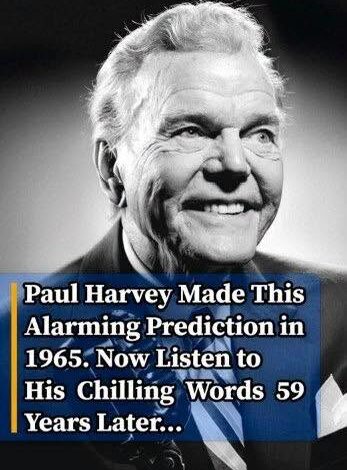
There was a man whose name has long since disappeared from your memory.
What remained was a single sentence.
He had leaned forward, his voice barely louder than the room around him, and said, “You won’t feel the moment everything changes. By the time you notice, the line will already be behind you, and everyone will be too busy accusing each other to see it.”
At the time, it sounded like the kind of warning people dismiss as melodrama.
He spoke with unsettling certainty about a future where outrage would become entertainment instead of alarm. Where facts would matter less than loyalty. Where people would stop asking whether something was true and begin asking whether it helped their side. He described a society that would slowly divide itself into competing realities, each convinced the other had abandoned reason.
You remember exchanging skeptical glances with the people around you.
Someone laughed.
Someone rolled their eyes.
You walked away thinking he was another man predicting the end of the world.
Life moved on.
Years passed.
His face blurred with time until you could no longer picture it clearly.
Only fragments of his words survived.
Then the headlines began to change.
Every week seemed to introduce another “historic” crisis.
Every disagreement became a battle.
Every debate became a referendum on who belonged and who didn’t.
Words that once sounded extraordinary became part of the daily vocabulary.
“Unprecedented.”
“Deeply polarized.”
“Constitutional crisis.”
“Democracy at risk.”
They appeared so often that they gradually lost the power to shock.
What had once been exceptional slowly became routine.
That was another thing he had warned about.
He said people could adapt to almost anything if it happened slowly enough.
Not because they approved of it.
Because repetition dulls surprise.
The extraordinary becomes familiar.
The familiar becomes normal.
Eventually, no one remembers when the shift actually began.
You started noticing it everywhere.
Television panels where guests shouted over one another instead of exchanging ideas.
Social media feeds that rewarded outrage faster than understanding.
Conversations with friends that ended not in disagreement, but in silence.
One by one, people disappeared from your contact list—not because they had harmed you, but because speaking to them had become exhausting.
You muted old classmates.
Ignored relatives.
Avoided topics that once felt harmless.
Without realizing it, your world grew quieter.
Smaller.
More carefully filtered.
And every time it happened, you remembered another piece of what he had said.
He claimed the greatest danger wouldn’t be people disagreeing.
It would be people losing the ability to imagine that disagreement could exist without hatred.
He feared a future where identity mattered more than evidence, where belonging to a side became more important than questioning the side itself.
Back then, those ideas sounded exaggerated.
Now they felt strangely familiar.
Not because every prediction unfolded exactly as he described.
History is never that simple.
But because the patterns he spoke about seemed impossible to ignore.
Public conversations became performances.
Certainty replaced curiosity.
Every event generated two entirely different stories, each insisting the other was obvious nonsense.
The loudest voices often received the most attention, while quieter, more careful ones struggled to be heard.
Some days it felt less like people were searching for understanding and more like they were competing to win an argument that never truly ended.
Yet the final part of his warning stayed with you more than anything else.
He said there would come a moment when people finally recognized something was deeply wrong.
Not all at once.
Gradually.
The realization would arrive after years of accumulated frustration, confusion, and distrust.
And when that moment came, he believed everyone would begin searching desperately for someone to hold responsible.
A politician.
A journalist.
A corporation.
A stranger.
An institution.
Anyone.
Anyone except themselves.
Because accepting even a small share of responsibility would be far more uncomfortable than pointing outward.
At the time, that felt unfair.
Surely individuals couldn’t be blamed for problems so much larger than themselves.
Now you understand his words differently.
Not as an accusation.
As a challenge.
Every society is shaped not only by its leaders or its loudest voices, but also by countless ordinary choices—what people share without checking, what they ignore, what they reward with attention, what they refuse to question, and what they quietly accept because resisting feels too exhausting.
Looking back, what unsettles you most isn’t whether every prediction came true.
It’s how ordinary the path toward division can seem while you’re living through it.
Rarely does change arrive with alarms loud enough to stop everyone in their tracks.
More often, it slips forward one compromise, one headline, one argument, one assumption at a time.
Perhaps that was the real meaning behind his warning.
The line isn’t crossed in a single dramatic moment.
It’s crossed gradually, while everyone is convinced the real danger lies somewhere else.
And if there is a lesson worth remembering, it isn’t to spend your life searching for villains.
It’s to remember that the health of any community depends not only on the people speaking the loudest, but also on the willingness of ordinary people to question themselves with the same honesty they expect from everyone else.
Sometimes the hardest person to examine isn’t the one standing across from us.
It’s the one staring back from the mirror.