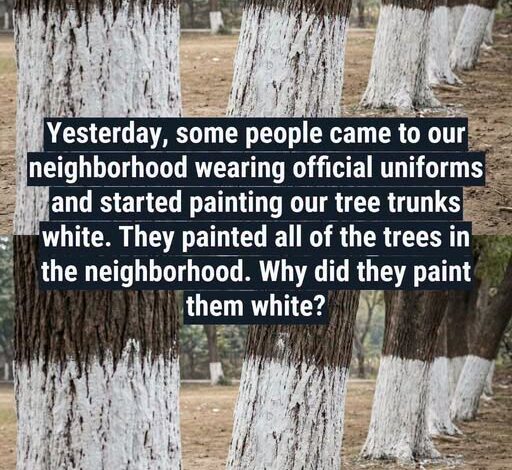
At first glance, a tree with its trunk painted white can seem like an odd sight. Some people assume it’s done for decoration, while others believe it marks property lines or identifies trees scheduled for removal. The truth is far more practical—and far more important. That simple coat of white paint is often a carefully planned form of protection, helping trees survive one of nature’s most overlooked challenges.
The danger doesn’t come from snowstorms or heavy winds.
It comes from the dramatic temperature swings that occur during winter.
On cold, sunny days, the dark bark of a tree absorbs the sun’s warmth, especially on the south and southwest sides of the trunk. Even when the surrounding air remains chilly, direct sunlight can warm the bark significantly, causing the living tissues beneath it to become active.
Then night falls.
Temperatures can plummet in just a few hours, freezing those tissues almost as quickly as they warmed. This rapid cycle of warming and freezing places tremendous stress on the bark, sometimes causing it to crack or split open.
This type of injury is commonly known as sunscald or southwest injury.
Although the name sounds mild, the damage can be severe. Long vertical cracks may develop in the bark, exposing the tree’s inner layers to the elements. Once the protective outer bark has been compromised, the tree becomes far more vulnerable to fungi, bacteria, wood-decaying organisms, and insects that can enter through the wound.
Young trees are especially at risk.
Species with thin bark—including many fruit trees, maple, linden, ash, and other ornamental varieties—have less natural insulation than mature trees with thicker bark. Newly planted trees are also more susceptible because they haven’t yet developed the resilience that comes with age.
A single harsh winter can leave lasting scars.
Even if the tree survives the initial injury, damaged bark may take years to heal completely. During that time, the weakened area can become a point of entry for pests and diseases, reducing the tree’s vigor and shortening its lifespan.
Fortunately, there is a remarkably simple way to reduce that risk.
Many arborists, orchard managers, and experienced gardeners apply a diluted coat of water-based white latex paint to the lower portion of the trunk. The white surface reflects much of the winter sunlight instead of absorbing it, helping keep the bark at a more consistent temperature throughout the day.
The goal isn’t to warm the tree.
It’s to prevent it from warming too quickly in the first place.
By reducing temperature fluctuations, the paint lowers the likelihood of the freeze-and-thaw cycles that cause sunscald.
Typically, the paint is diluted with water before application, although recommendations can vary depending on the product and the tree species. Gardeners often coat the trunk from the base upward to the first major branches, covering the areas most exposed to winter sunlight.
Some people also mix a small amount of joint compound into the paint.
This can create a slightly thicker protective coating that some gardeners believe provides additional physical protection while helping discourage certain wood-boring insects. However, practices vary, and anyone considering additives should follow guidance from local horticultural experts or cooperative extension services, since recommendations differ by region, climate, and tree species.
The important point is that the paint is not ordinary exterior house paint loaded with oils or solvents.
When used for tree protection, experts generally recommend water-based interior-grade white latex paint, properly diluted if advised, because it allows the bark to continue exchanging gases while providing the desired reflective surface.
This simple practice has been used for generations in orchards around the world.
Rows of apple, peach, citrus, and other fruit trees often display their white trunks throughout the colder months, not because growers want them to look uniform, but because protecting the bark helps safeguard years of careful cultivation and future harvests.
The same principle applies in home landscapes.
A few minutes spent painting a vulnerable young tree in late fall can help prevent injuries that might otherwise take years to recover from—or prove fatal if disease gains a foothold through damaged bark.
Of course, white paint isn’t the only option.
Some gardeners prefer commercial tree wraps or protective trunk guards, which can also help shield bark from winter temperature extremes. The best choice often depends on local climate, the species of tree, and advice from regional gardening experts.
Ultimately, that pale white band around a tree’s trunk represents something much deeper than appearance.
It reflects foresight.
It reflects patience.
It reflects an understanding that healthy trees don’t thrive by accident but through countless small acts of care performed long before problems become visible.
The next time you pass a tree with its trunk painted white, you’ll know you’re not looking at decoration or a mysterious tradition.
You’re looking at a quiet form of protection—one designed to help a living thing withstand the hidden stresses of winter, heal more easily, and continue growing stronger year after year.
Sometimes the simplest acts make the greatest difference.
A brush, a little white paint, and a few minutes of care today may help a tree not only survive the coming winter, but flourish for decades to come.