What if someone claimed they had seen the next century—not through imagination, but by living it?
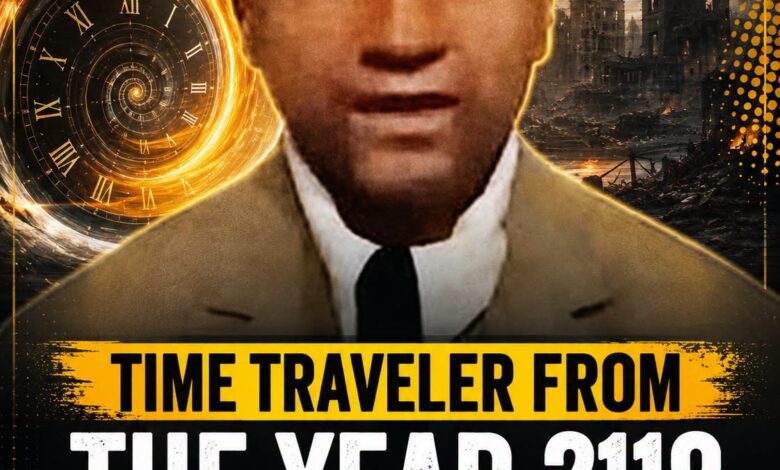
That is the extraordinary story told by a man calling himself Alexander Smith, whose sensational claims have circulated online for years. Concealing his identity behind a rubber mask and altered voice, he says he was part of a secret CIA experiment that transported him from 1981 to the year 2118. According to his account, he didn’t simply witness the future—he lived in it long enough to describe a civilization transformed by technology, global upheaval, and discoveries beyond anything most people consider possible.
His story is undeniably fascinating.
Whether it is viewed as science fiction, a thought experiment, or an extraordinary personal claim, it presents a vision of humanity that is both unsettling and strangely hopeful.
According to Smith, the world of 2118 bears little resemblance to the one we know today.
He describes enormous vertical cities stretching high into the sky, where millions of people live in self-contained structures supported by technologies far beyond current capabilities. Artificial intelligence, he claims, manages much of daily life, seamlessly coordinating transportation, communication, healthcare, and countless other systems that make modern technology seem primitive by comparison.
He also alleges that humanity is no longer alone.
In his version of the future, governments have publicly acknowledged the existence of intelligent extraterrestrial life, and interactions with alien civilizations have become an accepted part of society. Technologies once considered impossible—including advanced medical treatments and methods of travel that appear almost supernatural—are, according to his story, simply everyday realities.
But Smith insists this remarkable future comes at an enormous cost.
He claims humanity first endures a catastrophic global conflict.
According to his account, escalating tensions between the United States and North Korea eventually spiral into a devastating war, with Russia becoming involved as the conflict expands. Missiles are launched, cities are destroyed, and millions of lives are lost in what he portrays as one of history’s darkest chapters.
It is important to note that there is no credible evidence supporting these predictions or Smith’s claims of time travel. His account has not been verified, and his descriptions should be regarded as unsubstantiated claims rather than established fact.
Within his narrative, however, the aftermath of that conflict becomes the turning point for civilization.
Faced with unimaginable destruction, humanity supposedly reaches a collective realization that endless rivalry and division threaten everyone’s survival. Nations begin cooperating on an unprecedented scale, political boundaries become less significant, and global priorities shift toward shared scientific advancement rather than military competition.
Smith portrays this transformation as the defining lesson of the future.
Not technological progress.
Not contact with other civilizations.
But the recognition that survival depends upon cooperation rather than conflict.
Among his most remarkable predictions is the claim that commercial time travel becomes publicly available by 2028, offered much like airline travel. He also asserts that governments—particularly the United States—will officially reveal the existence of intelligent extraterrestrial life.
These predictions have attracted widespread attention online, largely because of their boldness.
Yet despite their popularity on social media and in speculative discussions, none has been supported by reliable evidence. Extraordinary claims require extraordinary proof, and Smith has provided no independently verifiable documentation demonstrating that he traveled through time or witnessed future events.
That absence of evidence has led most scientists, historians, and experts to dismiss the story as fiction, fabrication, or imaginative storytelling rather than genuine testimony.
Still, stories like Smith’s continue to capture public imagination.
Perhaps that is because they tap into questions people have always asked.
Where is humanity heading?
Will technology ultimately unite us or divide us?
Can civilization learn from its mistakes before tragedy forces change?
Even if the details of Smith’s account remain unsupported, the themes resonate because they reflect concerns already shaping today’s world—rapid advances in artificial intelligence, geopolitical tensions, scientific breakthroughs, and humanity’s ongoing search for meaning in an increasingly interconnected age.
In that sense, his story functions less as a verified prediction and more as a modern cautionary tale.
It invites people to imagine the long-term consequences of decisions being made today.
How should nations balance competition with cooperation?
How should powerful technologies be developed responsibly?
Can humanity avoid repeating the mistakes that have fueled conflict throughout history?
These questions remain relevant regardless of whether time travel is possible.
In the end, Alexander Smith leaves behind far more questions than answers.
His account offers no convincing proof that he journeyed to the future, and there is no credible evidence supporting his extraordinary claims about secret government experiments, future wars, commercial time travel, or contact with alien civilizations.
Yet the fascination surrounding his story endures.
Not because people necessarily believe every detail, but because it encourages reflection on the future we are creating ourselves.
Whether his tale is viewed as fantasy, speculation, or an elaborate hoax, its central message remains thought-provoking: the choices humanity makes today—about conflict, cooperation, technology, and compassion—will shape tomorrow far more reliably than any prediction ever could.
The future has not yet been written.
Whatever it becomes will depend less on mysterious travelers from tomorrow and far more on the decisions we make in the present.