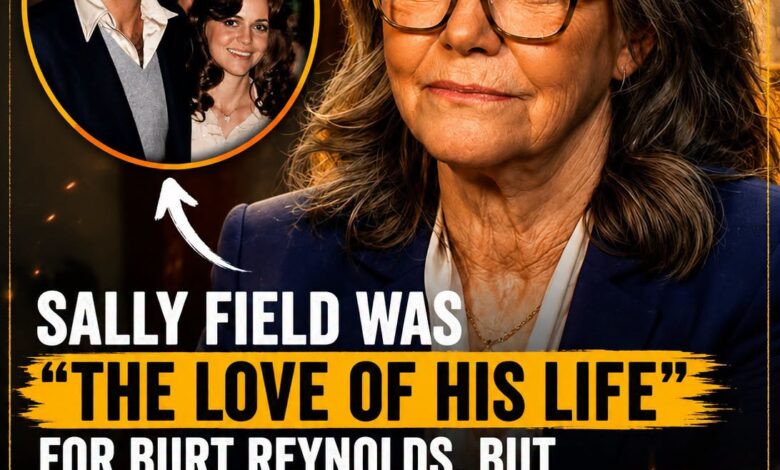
Some Hollywood romances sparkle brightly before fading into memory. Others leave behind a legacy so complicated that, decades later, people are still trying to understand where love ended and heartbreak began.
The relationship between Burt Reynolds and Sally Field was one of those stories.
It began in the late 1970s on the set of Smokey and the Bandit, where two of Hollywood’s biggest rising stars found themselves sharing not only scenes but an undeniable connection. Audiences instantly recognized the chemistry between them. Their playful banter, effortless charm, and natural affection made them one of the most memorable on-screen pairings of the era.
What many viewers didn’t realize was that the romance continued long after the cameras stopped rolling.
From the beginning, Reynolds was one of Field’s strongest supporters. According to both actors, he championed her casting in Smokey and the Bandit after some studio executives questioned whether she fit their idea of a leading lady. Reynolds believed she was exactly right for the role, and his confidence helped secure her place in the film that would become one of the biggest hits of 1977.
Years later, he would speak openly about his admiration for her, saying he had been captivated by her long before they ever worked together. Their relationship quickly became one of Hollywood’s most talked-about romances, with fans fascinated by the apparent ease and affection they shared both on and off the screen.
But public appearances rarely reveal the whole story.
Behind the glamour, Field has since described a relationship that was far more complicated than it appeared from the outside.
In her 2018 memoir, In Pieces, she reflected candidly on those years, writing that she gradually lost sight of herself while trying to navigate a partnership shaped by Reynolds’ powerful personality and enormous celebrity. She described feeling overwhelmed by the dynamics of the relationship, saying there were times when she felt she had stopped “existing” as her own person.
Field also wrote about emotional pain, including moments when she felt controlled, diminished, and deeply hurt. She recounted how public attention and reports of Reynolds’ relationships with other women left her feeling embarrassed and emotionally wounded, experiences that became part of the broader struggles she faced during that period of her life.
Their relationship lasted for approximately five years before coming to an end.
For Reynolds, however, the story never truly seemed finished.
In the decades that followed, he spoke about Field with remarkable consistency. During numerous interviews, he described her as the love of his life and openly expressed regret over the way their relationship had unfolded. He acknowledged making mistakes and often accepted responsibility for losing someone he believed had been extraordinarily important to him.
His reflections carried the tone of someone looking back with the clarity that often comes only after many years have passed.
Field chose a different path.
Rather than revisiting the relationship publicly, she maintained her distance for decades. She has said that she did not speak with Reynolds for roughly thirty years following their breakup, despite his continued public expressions of affection and admiration.
That silence wasn’t rooted in indifference.
Instead, it reflected the boundaries she believed were necessary for her own well-being.
When In Pieces was published, readers gained a fuller understanding of why. Rather than portraying Reynolds as either a hero or a villain, Field presented a far more nuanced portrait of a man she described as charismatic, talented, confusing, and, at times, deeply hurtful. She acknowledged the love they had shared while also explaining the emotional cost that relationship had carried for her.
It was a reminder that two people can remember the same relationship very differently.
One may look back with overwhelming regret.
The other may remember both genuine affection and lasting pain.
Both experiences can be true at the same time.
When Burt Reynolds died in September 2018, many wondered how Sally Field would respond.
Her statement was brief, thoughtful, and deeply human.
She expressed sadness at his passing while recognizing the significant role he had played in her life. She acknowledged that he would always remain part of her personal history, someone who had mattered profoundly during an important chapter of her life.
There was compassion in her words.
There was respect.
But there was also an unmistakable sense that some chapters are best left where they belong—in the past.
Her response reflected an important truth that many people understand only through experience.
Love does not erase hurt.
Regret does not rewrite history.
And forgiveness, when it comes, does not always require returning to the relationship that caused the pain.
Today, Burt Reynolds and Sally Field remain one of Hollywood’s most fascinating former couples, not because their romance had a fairy-tale ending, but because it reflected the complexity of real relationships. Their story included passion, admiration, success, disappointment, heartbreak, and years of reflection that shaped how each of them understood what they had shared.
For Reynolds, Field remained the great love he believed had slipped away.
For Field, Reynolds was an unforgettable part of her life’s journey—someone she loved, someone who hurt her, and someone whose influence she could never completely erase.
In the end, theirs was not a story about perfect romance.
It was a story about how love can be both beautiful and painful, how memory softens some edges while leaving others untouched, and how moving forward sometimes means honoring the past without allowing it to define the future.
Some people never truly leave our hearts.
But that doesn’t always mean they belong in our lives.