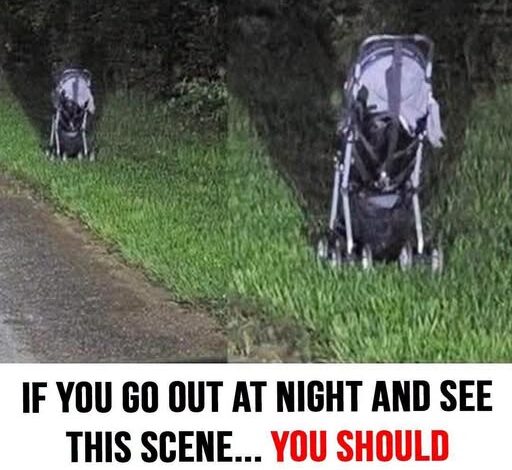
If you find an abandoned stroller at the roadside, here’s why you might want to wait before getting out of your vehicle

The quiet glow of the streetlights should have marked the end of another ordinary evening.
Instead, they illuminated the beginning of a nightmare.
Security footage later revealed a scene that few could watch without feeling a chill. In the grainy video, a lone figure lingered in the shadows, appearing to wait with deliberate patience. Every movement seemed calculated. Every passing second suggested intent. While the neighborhood carried on as usual, one unsuspecting pedestrian walked into a situation they never saw coming.
What began as a routine evening walk quickly transformed into a desperate fight for safety.
Within moments, normalcy disappeared.
The victim’s peaceful stroll became a frantic attempt to escape, fueled by instinct and fear. It was the kind of experience that can change a person long after physical injuries have healed. Even when bruises fade and headlines move on, the emotional impact of such an encounter often lingers—reshaping routines, disrupting sleep, and turning once-familiar streets into places filled with anxiety.
When investigators released portions of the surveillance footage, the community reacted with disbelief.
Residents who had always considered their neighborhood safe watched the video repeatedly, searching for something they might have overlooked.
Was there a warning sign?
Could someone have intervened?
Would a passing car, an open porch light, or a single shout have changed the outcome?
Those questions echoed through conversations on sidewalks, in local businesses, and across neighborhood social media groups. Like many communities confronting a shocking crime, people found themselves replaying the events over and over, hoping to discover an answer that might make the senseless feel understandable.
But tragedies rarely offer simple explanations.
Police encouraged residents to remain alert, report suspicious activity, and stay aware of their surroundings. Their message was practical, but it also carried a deeper truth.
Danger does not always announce itself.
It rarely looks exactly as people expect.
Sometimes it appears ordinary enough to blend into the background until it is too late.
That reality unsettled many who had grown comfortable with familiar routines.
The streets hadn’t changed overnight.
The houses were still the same.
The streetlights continued to cast their quiet pools of light across sidewalks and driveways.
Yet the sense of security people once took for granted suddenly felt more fragile than anyone had realized.
Still, fear did not become the neighborhood’s defining legacy.
Something else began to emerge.
Neighbors who had rarely spoken before started checking in on one another.
Community groups organized meetings to discuss practical ways to improve safety.
Residents shared information about neighborhood watch programs, exchanged phone numbers, and offered to accompany one another on evening walks.
Simple acts of kindness became small but meaningful acts of protection.
A porch light left on a little longer.
A message asking whether someone had made it home safely.
A wave from a neighbor paying closer attention than before.
None of those gestures erased what had happened.
But together, they reminded people that communities grow stronger when individuals refuse to remain isolated.
The incident also sparked conversations about balancing awareness with compassion.
Staying vigilant does not mean living in constant fear.
It means recognizing the importance of looking out for one another without allowing suspicion to overshadow humanity.
The strongest neighborhoods are often those where people know their neighbors, notice when something seems out of place, and are willing to act when someone needs help.
In the weeks that followed, the surveillance footage became more than evidence in an investigation.
It became a reminder of how quickly ordinary moments can change—and how powerfully communities can respond when they choose unity over indifference.
The attack left lasting scars for the person who endured it.
It also left an imprint on everyone who called that neighborhood home.
Yet amid the fear and uncertainty, residents made a quiet promise to one another.
They would pay closer attention.
They would check in more often.
They would refuse to let tragedy convince them to retreat behind closed doors.
Because while no community can eliminate every danger, every community can choose how it responds.
And in this one, people decided that no neighbor should feel invisible, no concern should be dismissed, and no one should have to face the darkness believing they were entirely alone.
The streetlights still shine each evening, illuminating the same sidewalks and familiar corners.
But now they also bear witness to something different—a neighborhood that answered fear not with silence, but with solidarity, proving that sometimes the most powerful response to violence is a community determined to protect one another, one walk, one conversation, and one act of kindness at a time.