Maxine Waters INSULTS John Kennedy With the Words “Sit Down, Boy” — And the Moment Instantly Changes the Entire Room

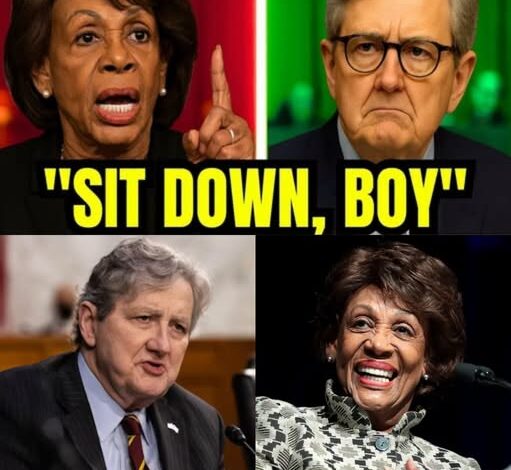
In today’s political landscape, a single exchange can travel farther in a few hours than an entire legislative debate. A clipped video, a sharp remark, or a tense confrontation can quickly become the day’s defining headline, often eclipsing the broader issues that brought lawmakers together in the first place.
One widely shared exchange involving Representatives Maxine Waters and Senator John Kennedy drew attention not only for the words that were reportedly exchanged, but for what many viewers believed it revealed about political communication under intense public scrutiny. As with many viral clips, interpretations varied, and short excerpts circulated online often lacked the broader context of the full discussion.
What made the moment resonate with so many observers was not simply the language itself, but the dynamics of tone, timing, and restraint.
Political debates are rarely remembered solely because of the arguments presented. More often, they become memorable because of how those arguments are delivered. A pointed remark can dominate headlines, while a measured response can reshape the audience’s perception in an instant.
In highly charged environments, emotion naturally runs high.
Lawmakers are expected to defend their positions passionately, challenge opposing viewpoints, and respond to criticism in real time, all while cameras record every expression and every pause. Under those conditions, even a brief exchange can take on a significance far beyond the room in which it occurred.
Communication experts have long noted that audiences evaluate more than just the substance of a disagreement.
They notice body language.
Facial expressions.
Voice inflection.
Whether someone interrupts or waits.
Whether they respond emotionally or remain composed.
These nonverbal elements often influence public perception as much as the words themselves.
When one participant appears visibly frustrated while another maintains a calm demeanor, viewers may interpret the interaction in very different ways depending on their own experiences, values, and political perspectives. Some see passionate confrontation as evidence of conviction. Others view measured restraint as a sign of confidence and discipline.
Neither impression necessarily tells the full story.
A brief viral clip rarely captures everything that occurred before or after the moment that spreads online. Context, surrounding discussion, and the broader purpose of the hearing or debate can easily be lost as a complex exchange is condensed into a few seconds designed for social media.
That reality has become a defining feature of modern politics.
Today’s public officials often communicate with two audiences at once: the people sitting across the room and the millions who may later watch edited clips online. Every statement carries the potential to become a headline, a meme, or a talking point, sometimes detached from the larger conversation it originally served.
As a result, political exchanges are frequently analyzed less for the policy questions they address than for the impressions they leave behind.
Who appeared confident?
Who seemed defensive?
Who maintained composure?
Who controlled the pace of the conversation?
These questions often dominate public discussion long after the specific legislative issues have faded from view.
Supporters on each side may come away convinced that their preferred representative prevailed, highlighting different moments from the same interaction as evidence. Critics may draw the opposite conclusion. Such disagreements illustrate how political communication is shaped not only by what is said, but also by the expectations and perspectives audiences bring with them.
That is one reason viral political moments tend to endure.
They become symbols onto which people project larger debates about leadership, civility, accountability, and public discourse. A single exchange can come to represent competing ideas about strength, respect, and persuasion, even when reasonable observers disagree about exactly what unfolded.
Ultimately, the lasting significance of these moments rarely lies in one sentence alone.
It lies in the conversations they spark about how elected officials engage with one another, how political disagreements are presented to the public, and how quickly a few seconds of video can shape national narratives.
In an era when every hearing, interview, and debate can be clipped, shared, and replayed countless times, communication has become inseparable from politics itself. Whether viewers remember a confrontation as forceful, restrained, effective, or divisive often depends as much on the broader context as on the exchange itself—a reminder that understanding any political moment requires looking beyond the viral clip and considering the full picture.